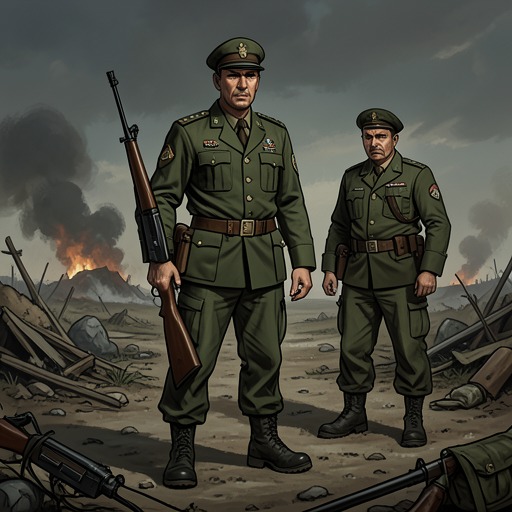
Lieutenant Mamiya’s Ordeal in the Well
The Wind-Up Bird ChronicleLieutenant Mamiya’s ordeal in the well is the pivotal experience through which he explains both his survival and his enduring sense that his life was lost. Captured during a military mission on the Outer Mongolian steppe, he was left injured and without food or water in a deep well. There, brief sunlight seemed to offer a revelation or grace, but its meaning remained beyond his grasp; he later described the decades that followed as an empty shell of life.
Mission and Capture
Lieutenant Mamiya had been assigned to command a small escort accompanying Yamamoto across the border region. His selection reflected his responsibility for mapping the western Manchukuo border near the Khalkha River, not combat experience. The maps available for the region were crude, while the political uncertainty surrounding the frontier made accurate border surveys sensitive. At the same time, the possibility of war made detailed military maps essential for planning camps, artillery positions, marches, water supplies, and provisions.
The party travelled from Hsin-ching to Hailar by train and then by truck to a border observation post near the Khalkha River. The landscape offered almost no landmarks against which Lieutenant Mamiya could check his maps. The mission’s border setting thus joined practical military uncertainty to the vast, featureless steppe where his later ordeal would take place.
The Well and the Brief Light
After capture by Outer Mongolian troops, Lieutenant Mamiya was thrown into a deep, dark well. His leg and shoulder were broken, and he had neither food nor water. He had also witnessed a man being killed. Looking back, he suggested that these extreme circumstances had concentrated his consciousness and made him receptive to an experience at the core of his being.
For a few seconds, intense sunlight penetrated to the bottom of the well. Lieutenant Mamiya perceived something beginning to emerge within the light, as if it might confer grace, but it never assumed a form he could recognize before dissolving. The same event occurred on two consecutive days. His deepest distress, he later said, was not simply hunger or thirst but the inability to see clearly what seemed to be offered to him.
The light’s brief return made the experience more consequential without making it more intelligible. Lieutenant Mamiya believed that he had seen something he could never see again, yet he could not explain with certainty what it was or what it meant. His account therefore presents the experience as a lasting conviction and an unresolved hypothesis, rather than a revelation whose content he could name.
Survival and Its Aftermath
Lieutenant Mamiya survived the well, but he came to regard survival as a curse. He recalled that Corporal Honda had predicted he would return to Japan and live a long life. The prediction proved accurate: after his ordeal, Lieutenant Mamiya later lost a hand in battle with a Soviet tank unit, endured a Siberian labor camp, returned to Japan, and spent thirty years teaching social studies in a rural high school before living alone and working the land. Yet he experienced these later years as unreal by comparison with the steppe and the well.
He connected that inward emptiness directly to the light. In his interpretation, the revelation’s force had burned away the living core of his former self; after it disappeared, he could neither recover what he had seen nor regain his former sense of life. He therefore felt little fear of physical death and imagined it as a possible release from the continuing pain of existence.
Telling the Ordeal
Lieutenant Mamiya’s account reaches Toru Okada more than forty years after the event. He remembers the steppe with exceptional clarity, while the later decades seem to him like a dream or delusion. This contrast makes the well not only a place of physical confinement but also the point by which he measures everything that came afterward.
The narrative does not resolve the meaning of the light. Instead, Lieutenant Mamiya’s repeated emphasis on what he almost saw gives the ordeal its enduring shape: survival preserved his life, but the lost possibility of understanding left him convinced that he had missed a singular chance. Telling the story to Toru Okada offers a fragile form of consolation, even as the experience remains beyond definitive explanation.