May Kasahara Traps Toru in the Well
The Wind-Up Bird ChronicleMay Kasahara Traps Toru in the Well is the moment when Toru Okada’s chosen retreat becomes a place of confinement: May has removed the ladder and, by shutting the well cover, cuts off the light. Her actions transform a private descent undertaken for thought into a stark test of dependence, in which Toru recognizes that the person who knows where he is can also leave him there to die.
How the Trap Is Revealed
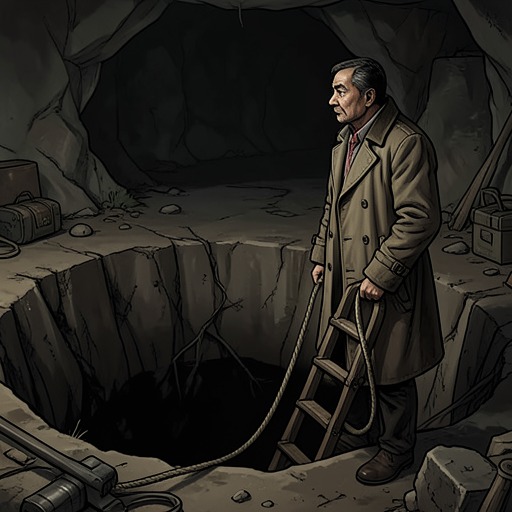
The scene turns on a fact May makes Toru acknowledge rather than on an unseen force: the ladder is gone, and she is responsible. She asks whether he noticed its absence, then reveals that she pulled it up. When he asks why, she recounts how she had gone to his house repeatedly the previous day, hoping he would accompany her to work again. He was not there. She waited after finding his note in the kitchen, and eventually suspected he might be at the empty house. The well cover was half open and a ladder hung down, but she assumed a workman had left it; the thought that Toru might be sitting at the bottom never occurred to her.
That history makes the discovery more unsettling than a simple act of hostility. May had been looking for Toru, and her first explanation for the open well was ordinary: someone had been working there. Only later, having found him below, does she frame the ladder’s removal as a choice that gives her power over his fate. Her casual question about whether he knew she had pulled it up becomes the hinge between the missed encounter aboveground and the danger she has created below.
Dependence and the Threat of Death
May spells out the consequences with chilling precision. She is the only person who knows Toru is in the well, and she has hidden the ladder. If she walks away, he could die without anyone hearing his calls; no one would think to look for him at the bottom. His lack of a job and the fact that his wife has run away sharpen the possibility that his absence would not be noticed in time. May imagines that somebody might eventually report him missing, but by then he would be dead and his body undiscovered.
Toru does not deny that she has the power to leave him there. He agrees that he could die depending on her mood. When May asks how he feels about that, the danger becomes an explicit question of his dependence on her judgment, not merely a practical problem of getting out. She challenges his expectation that she could not be cruel; he answers that he does not know whether she could do it or not, only that the possibility exists. His response refuses reassurance and leaves the threat open.
Darkness as an Act
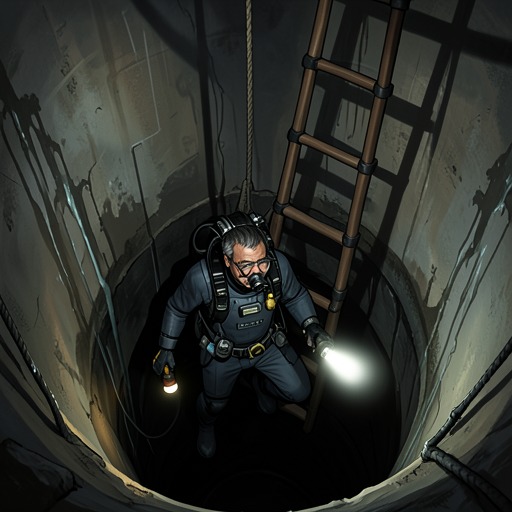
May then shifts from the possibility of death to the immediate conditions of the well. She recalls that Toru went to the trouble of climbing down in order to think, and proposes making it easier for him to concentrate. The suggestion turns his own purpose against him: the isolation he sought can be intensified by someone else, without his consent. He asks how she can do that. She closes the well cover’s open half, making the darkness total.
The closure gives the scene its decisive physical turn. Toru had been in the well by choice, with a way back above him; now May’s action seals away the light and confirms her control over the means of escape. The change is achieved by a small, ordinary movement of the cover, but its consequence is absolute within the moment: thought becomes confinement, and the well’s darkness is no longer simply a setting he entered voluntarily.
Narrative Significance
The episode joins two forms of entrapment without making them identical. The missing ladder places Toru in actual danger, while May’s account of his isolation—unemployed, separated from his wife, and apparently unmissed—makes that danger feel socially possible as well as physical. Her words expose how easily a person can become unlocatable when ordinary attachments and routines have fallen away. The possibility that no one would notice his disappearance gives the well a human context beyond its depth and darkness.
May’s actions also reverse the expected roles of the encounter. She had been trying to find Toru and wanted him to return to work with her; now she is the one above ground, holding the knowledge and the power to release him. Her stated intention to help him concentrate is inseparable from the threat she has just described, so the offer cannot be taken as simple kindness. The scene leaves that contradiction unresolved: she has made the darkness total, while Toru has acknowledged that his survival depends on what she chooses to do next.