Miyawaki house
The Wind-Up Bird ChronicleThe Miyawaki house is the abandoned Setagaya home whose overgrown garden and deep, dry well become a threshold in Toru Okada’s search for what has vanished from his life. Once the peaceful home of the Miyawaki family, it is left to deteriorate after they abruptly disappear; Toru enters its yard, returns to its well, and eventually finds the site erased beneath a bulldozer’s earth. The house matters not only as a setting for action but as a changing record of habitation: the more its occupants recede, the more insistently the building seems to have a life—and a history—of its own.
Setting and the route to the house
The house stands beyond a narrow passage the neighborhood calls an alley, although it has neither entrance nor exit in the ordinary sense. The passage runs for roughly two hundred yards between the back gardens of houses and is barely more than three feet wide in places. Its original shortcut between two streets was progressively squeezed by construction, screened at one end, and closed by a cinder-block wall at the other, until the route became a trapped corridor. Toru reaches it by climbing over a wall; approaching the house therefore requires crossing a boundary and entering a space the surrounding neighborhood has effectively sealed off.
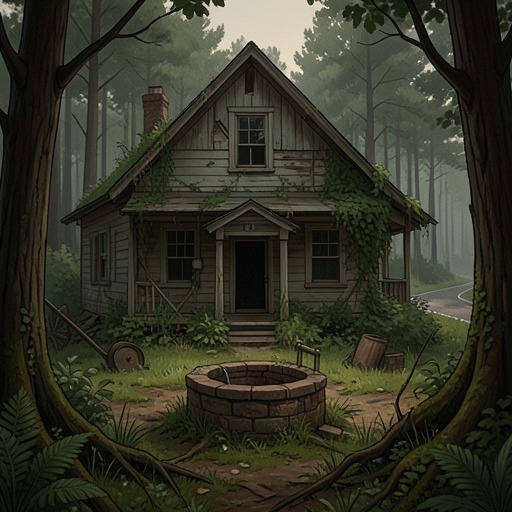
The alley’s cramped, improvised character contrasts with the conventional domestic scenes visible behind its fences: abandoned toys, a neglected Christmas tree, lawn furniture, and rooms arranged like a television set. At the end of this route, the Miyawaki house is recognizable as a relatively new two-story building, yet its shutters are already weathered and its upstairs railings rusted. The property’s deterioration is not simply a matter of age. The house was left behind, and the visible signs of ordinary care have given way to weeds, insects, and objects with no one to use them.
The Miyawaki family and the vacant house
The Miyawakis had appeared to be a proper, prosperous family. Mr. Miyawaki owned several family restaurants, and his two daughters attended a private girls’ school. In the recollection of a neighborhood child, the family had seemed unusually happy: both girls appeared kind, the parents and children laughed together, and even their dog seemed part of that domestic ease. Their disappearance therefore registers as a sharp break with the life the house had seemed to promise.
The family left suddenly, apparently clearing out in a single night about a year before the early account of the vacancy. A possible debt is offered as speculation, not established fact. For some time the neighbors did not realize the family was gone; only when the lights stopped coming on did their absence become noticeable. The empty house was then left to deteriorate and, according to neighborhood talk, to breed cats. Reports describe sickly strays, including cats with missing fur or a damaged eye. These accounts make the abandoned garden part of the neighborhood’s everyday awareness, even as residents keep their distance from it.
The house’s transformation is striking because it does not look merely like a damaged version of the home that stood there before. In the child’s recollection, it seems almost to disown its former occupants, acquiring an impassive, self-contained appearance as soon as they leave. That impression produces anger: the house had been cared for and had shared in the family’s apparent happiness, yet after their departure it seemed to behave as if it had never known them. The recollection culminates in the blunt judgment, “You just can’t trust a house.” The building thus becomes an unsettling counterpart to the vanished family, retaining their address while seeming to erase their presence.
The garden, bird sculpture, and well
When Toru first sees the property, the small garden is already overgrown. A stone bird stands on a chest-high base amid weeds and tall goldenrod, its wings open as if it were trying to escape. A bright azalea blooms beside a stack of aging plastic chairs, but its red appears strangely unreal against the neglected surroundings. The garden could have been a refuge for cats, yet Toru sees none there. A pigeon calls from the television antenna while the stone bird’s shadow breaks across the undergrowth; the contrast is between a living bird that can move and a fixed image whose outstretched wings promise a departure it cannot make.
On a later visit, the garden has grown wilder. Rain has made the grass shine, but fruit trees are choked by maypop vines and the osmanthus hedge is coated with insects’ eggs. The house looms under low gray clouds, its second-story shutters nailed shut, like a wreck stranded and left to rot. A white butterfly crosses the grass in hesitant, seemingly purposeless movements. Toru enters through the chain-link gate despite recognizing that being discovered could bring police questioning and expose his unemployment. He closes the gate behind him, sits beneath the eaves on a plastic lawn chair, and whistles Rossini’s The Thieving Magpie overture while the rain falls. The act of sitting quietly inside the neglected garden turns the property from something observed from outside into a place he has chosen to occupy.
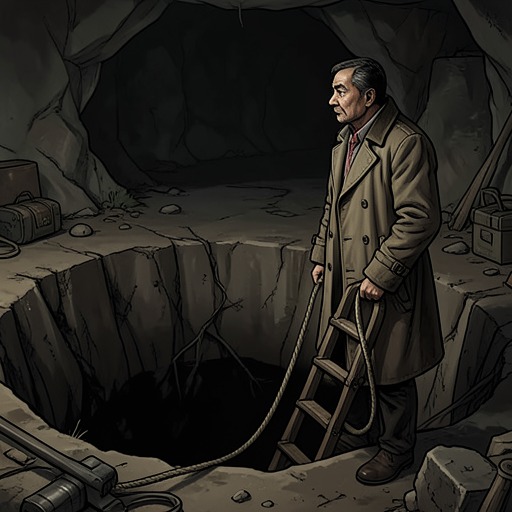
The well gives that occupation a more dangerous direction. Toru later removes the stones holding its cover and lifts one of the wooden half-circles to check the bottom. A pebble lands with a dry thud: there is no water. He anchors a rope ladder to a nearby tree and lowers it into the darkness, but cannot see whether it reaches the bottom. The ladder is a practical means of descent, yet its insecure-seeming length and the light swallowed by the depth make the well a passage whose endpoint cannot be confirmed from above. On another visit, Toru worries that leaving the ladder there could cause trouble, then returns in the night because he remembers that Creta Kano was last seen at the well. He calls her name and hears a faint moan from below, but receives no clear answer.
Ownership, reputation, and demolition
The house where Toru and Kumiko live is also tied to family arrangements and conditional ownership. Toru’s uncle had bought that house when young and lived there for ten years; later, when Toru and Kumiko needed an inexpensive place to live, he offered it to them for nominal rent. He wanted the option to reclaim it on three months’ notice when he could redevelop the property. The arrangement gave the couple the feeling of belonging to a real household while reminding them that the home was never fully theirs. The uncle distinguishes that residence from the Miyawaki property, which he regards as a different matter, though he says his own house has caused no particular trouble.
The Miyawaki property’s reputation and uncertain history become tangible in a conversation about its sale. A local real-estate veteran says the land sold the previous August after mortgage and title problems were resolved. The nonlocal speculator who bought it intended to demolish the house and sell the land, but the lot’s local reputation made it difficult to move. Although it measured a little over 3,500 square feet and would ordinarily command a high price, its valuation had already fallen; the broker estimates that further bargaining might bring the whole property to about 100 million yen. The house’s neglect and the stories attached to the lot thus affect not only its atmosphere but its market value and ownership history.
The property includes a deep well, but the local broker believes it has been filled in because it was dry and useless. He remembers hearing that it held water before the war and says it was dry by the time an actress lived in the house; he cannot specify when it dried. This uncertain local history contrasts with Toru’s direct experience of the open well, its darkness, and the rope ladder descending into it. The land’s public account treats the well as a disused feature to be removed, while Toru’s encounters make it a place of immediate physical and emotional consequence.
By winter, the house itself has been demolished. Toru returns to find a high plank fence enclosing a flat, dark stretch of compacted earth, with no paving stones, trees, well, antenna, or bird sculpture. Looking through gaps in the fence, he can hardly believe that a deep well once stood there and that he climbed down into it. The removal of the building and garden does not resolve what the site meant to him; instead, it makes the gap between remembered experience and visible evidence stark. The house that once appeared to forget its occupants has itself been erased, leaving Toru to remember a place the land no longer displays.