Mr. Honda
The Wind-Up Bird ChronicleMr. Honda is a hard-of-hearing former Kwantung Army noncommissioned officer who serves as a spiritual medium and gives Toru Okada advice that reverberates through the novel’s stories of water, wells, and historical consequence. His authority does not rest on an orderly doctrine: it emerges from a life shaped by the Battle of Nomonhan, where thirst and military failure taught him the cost of mistaking visible possibility for a safe path. His warnings to Toru and Kumiko join private uncertainty to the unresolved violence of prewar Manchuria.
Identity and Background
For roughly a year after their marriage, Toru and Kumiko visited Mr. Honda once a month. He was a spirit-possession practitioner favored by the Wataya family, though the couple did not visit because either believed firmly in his powers. Toru had little interest in spiritual matters; Kumiko was less trusting of them than her parents or brother, although ominous predictions could unsettle her. Their visits therefore place Mr. Honda at the edge of their ordinary life: a figure introduced through family connections and ritual, but not accepted as an unquestioned oracle.
Mr. Honda had lost his hearing in the war. Even with a hearing aid, he could barely understand visitors, who had to shout until their voices seemed to rattle the shoji paper. Toru wonders whether impaired hearing might somehow make a person more receptive to spirits, reversing the usual expectation that a medium must be especially attuned to ordinary sound. The novel leaves that possibility unresolved, but the contrast suits Mr. Honda’s position between worlds: he struggles to hear conversation while claiming access to voices beyond it.
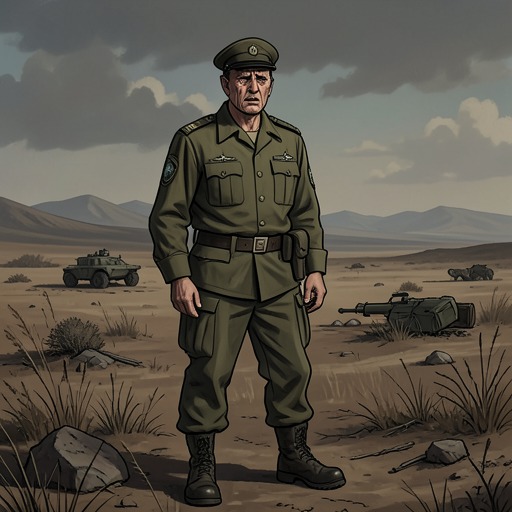
His disability came from service as a noncommissioned officer with Japan’s Manchurian garrison, the Kwantung Army. During the Battle of Nomonhan, an artillery shell or grenade exploded nearby and burst his eardrums. In the cramped house where Toru and Kumiko visit him, an enormous color television dominates the ceremonial alcove, tuned continually to the government-supported NHK network. Mr. Honda sits facing it, stirring divining sticks at the sunken hearth while cooking programs, bonsai instructions, news, and political discussions play. The scene sets ritual practice beside relentless broadcast noise, without making either a simple explanation of the other.
Counsel on Flow and Water
Mr. Honda tells Toru that legal work may be the wrong profession for him because law belongs to a world that divides shadow from light and one person from another. Toru, he says, belongs above or below that world. When Toru asks which direction is better, Mr. Honda rejects the premise: the essential matter is not choosing a superior position but moving when the flow calls for movement, descending when descent is required, and remaining still when there is no flow. Resisting it, he warns, dries everything up and leaves the world in darkness. His counsel is at once practical and metaphysical, a rule against forcing action when circumstances offer no passage.
Kumiko asks whether the moment has arrived when there is no flow. Mr. Honda does not give her a clear answer. Instead, he turns to water, and the discussion leads into his account of Nomonhan. The evasive transition matters: his teaching is not delivered as a fully explained system, and the couple must live with a warning whose meaning is not immediately available to them.
At the front, Mr. Honda suffered through three days with almost no water after the front line collapsed and supplies were cut off. There were no rations, bandages, or bullets to spare. Dew collected on a washrag left outside, and a few drops could be wrung from it in the morning. A large river flowed nearby, apparently offering everything the soldiers needed, but Soviet tanks equipped with flamethrowers, machine-gun positions, and sharpshooters blocked the route. Japanese soldiers had Model 38 infantry rifles and only twenty-five bullets each. Driven beyond endurance by thirst, most of Mr. Honda’s companions tried to reach the river; none returned. Their deaths give his instruction to stay still its terrible, concrete source: what looks like relief may be inaccessible, and an attempt to force the passage may be fatal.
After recounting the thirst, Mr. Honda remarks that his deafness may have spared him from being sent to the South Pacific, where many survivors of Nomonhan were killed. He condemns the military hierarchy that pursued territorial occupation without providing supplies, then sent surviving soldiers toward further danger while officers responsible for the debacle advanced in their careers; some later became politicians. Toru asks why the army treated the survivors so badly despite their courage and losses. Mr. Honda appears not to hear the question. He rattles his divining sticks and tells Toru to be careful of water, ending the session without explanation.
Connection to Lieutenant Mamiya
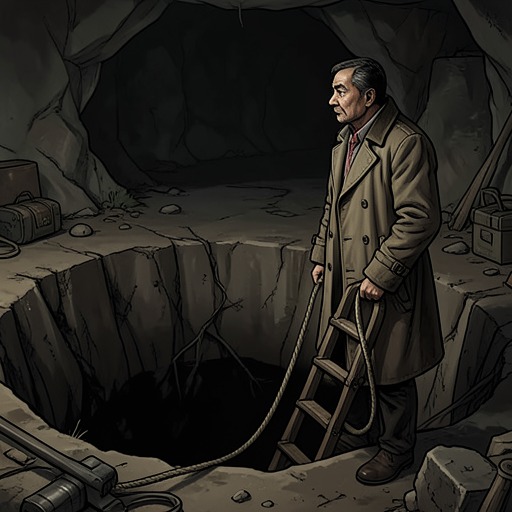
Mr. Honda’s history continues through Lieutenant Mamiya, whom he had guided toward Toru. When Toru later sorts through the preceding day’s events, he recalls Mamiya’s visit and his account of capture by Outer Mongolian troops and imprisonment in a well. Mamiya had also brought the keepsake left by Mr. Honda: an empty box. The object offers no contents to interpret, yet it carries a connection between the old medium, the veteran, and Toru as the latter is drawn into the stories of wells and disappearance.
Mamiya’s later letter makes that connection explicit in his own account. At Nomonhan, the light and revelation he experienced in a well vanished before he could grasp them; afterward, he describes himself as having lost his life while continuing to live. He recalls that Corporal Honda predicted he would return to Japan and live a long time, a prediction that became a curse rather than comfort. Mamiya also says that Honda was right that it would have been better not to know. The letter does not make Mr. Honda’s spiritual knowledge readily verifiable; instead, it places his prediction beside Mamiya’s painful memory, leaving the force of the prophecy suspended between foresight and retrospective meaning.
Historical and Narrative Significance
Mr. Honda’s connections extend beyond his own visits with the newly married couple. Toru later sees a network linking the mark on his cheek with Cinnamon’s clients and with Cinnamon’s grandfather, the veterinarian; the grandfather and Lieutenant Mamiya are joined by the city of Hsin-ching; Mamiya and Mr. Honda by special duties on the Manchurian-Mongolian border; and Toru and Kumiko to Mr. Honda through the Wataya family. The two men’s separate experiences in wells add another link. These connections converge on prewar Manchuria and the 1939 fighting at Nomonhan, events that preceded Toru and Kumiko’s births but nonetheless shape the present they inhabit.
The pattern does not explain why Toru and Kumiko have been drawn into this historical chain. Toru recognizes the links but cannot comprehend the cause of their involvement. Mr. Honda is consequently more than a medium who supplies predictions: he is one of the human conduits through which wartime experience, inherited family associations, and the novel’s recurring well imagery pass into the present. His advice to follow the flow offers no guarantee of safety or understanding. It leaves Toru with an imperative whose meaning must be tested amid circumstances Mr. Honda himself never fully explains.