Outer Mongolian Army
The Wind-Up Bird ChronicleThe Outer Mongolian Army is the armed force guarding a disputed frontier with Manchukuo in the novel’s account of Lieutenant Mamiya’s wartime past. Its patrols and covert river crossings make the border more than a line on an uncertain map: they reveal a militarized landscape in which a small reconnaissance mission can become an international crisis, and where local operations are connected to the prospect of a wider Soviet-Japanese war.
Borderland and Strategic Setting
In 1938, the frontier near the Khalkha River remained deliberately ill-defined. The Japanese army had not produced definitive maps of the region because Manchukuo’s claims overlapped with those of Outer Mongolia and the Soviet Union, and an official map asserting one side’s boundary might provoke a serious diplomatic incident. The Kwantung Army, already committed to war in China and lacking the forces for a major confrontation with the Soviet Union, preferred to leave the northwestern border unsettled.
That official uncertainty did not mean the area was peaceful. The army needed detailed military maps in case fighting broke out: commanders required information about routes, camps, artillery positions, water, and the movement of infantry and horses. The Khalkha frontier was thus a place where cartographic work and intelligence gathering converged. Mamiya’s escort mission, assigned under the cover of supporting Yamamoto’s work, entered a region in which even routine mapping had strategic consequences.
The geopolitical stakes extended beyond a bilateral border dispute. Outer Mongolia was described as formally independent but closely subject to Soviet power, while Manchukuo was under Japanese control. The account identifies an anti-Soviet current in Outer Mongolia, including discontent among military men, landowners, and Lamaist priests. After a planned uprising came to light in 1937, thousands were secretly executed. Japanese military intelligence could therefore view contact with insurgent elements as an opportunity, while the Outer Mongolian authorities had reason to monitor and restrict movement near the frontier.
Patrols and Concealed Crossings
The Outer Mongolian Army knew the river region well and had established concealed crossing points that allowed units to move over the Khalkha even during the spring snowmelt. The hidden fords were more than improvised paths: one described crossing used a plank bridge held in place by ropes beneath the fast current. Its position underwater made it difficult for reconnaissance aircraft to detect, while a fall in the water level could make it usable by military transport and armored vehicles.
Yamamoto told Mamiya that he had crossed at such a point before and that the army had already cleared the operation at a high level. The existence of these passages supported his claim that a crossing was technically possible, but it did not remove the political danger. Crossing to the far bank meant entering Outer Mongolian territory, where a Japanese party caught by a patrol could be treated as having committed an unambiguous border violation. The distinction between the contested bank and the opposite shore made the river a sharp dividing line between disputed presence and a potentially undeniable intrusion.
The crossing’s military significance was also visible in the land itself. The far bank rose higher than the side from which Mamiya’s party approached, offering a broad view across the desert. The narrative connects this elevation advantage to the later Battle of Nomonhan: it would improve the Soviet side’s position and affect artillery accuracy. A concealed passage could therefore enable movement, but it could not erase the terrain’s larger tactical inequalities.
Contact, Surveillance, and Capture
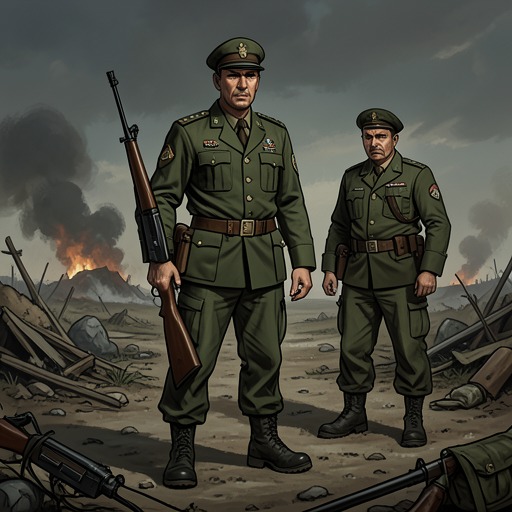
After moving south along the river, Yamamoto’s party faced an Outer Mongolian patrol guarding a ford. Mamiya and Yamamoto observed eight soldiers, including a light machine gun and a heavy machine gun positioned on a rise and aimed toward the river. The patrol had tents by the water and horses nearby, suggesting that it was prepared to remain in place and prevent a crossing. When Mamiya asked whether they could use another ford, Yamamoto said it lay two days away and that they had no time to spare.
The patrol’s presence turned the mission’s concealed purpose into immediate operational risk. The group could not simply cross openly without confronting the armed position, yet waiting or taking a long detour threatened the schedule. The scene makes the Outer Mongolian Army’s border security concrete: its soldiers were not an abstract strategic factor but a small, alert force able to block the route on which the Japanese mission depended.
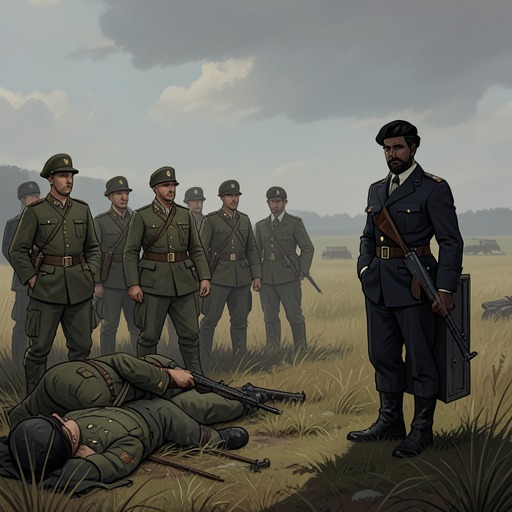
The patrol later surprised Mamiya and Yamamoto at their camp before the party had crossed. Mamiya woke to find Outer Mongolian soldiers holding them at gunpoint; Yamamoto was also under guard, while Corporal Honda and Hamano were nowhere in sight. The narrative leaves their immediate fate uncertain at that moment. The capture demonstrates that the patrol had located the party and that the mission’s movements had not remained hidden, even before the intended river crossing could be completed.
Narrative and Historical Significance
The Outer Mongolian Army appears through Mamiya’s retrospective account rather than through an independent institutional portrait. Its organization is glimpsed in the patrols, guarded approaches, and concealed crossings; the account does not offer a full command structure or a general description of the force. This limited perspective keeps attention on the practical consequences of military presence: surveillance, restricted movement, the danger of capture, and the fragility of a mission operating without clear political authorization.
The army’s actions also expose the tension between formal borders and competing imperial ambitions. Its patrols defend territory that Manchukuo and Japan also claim, while secret contacts with anti-Soviet elements could draw the Japanese military into a conflict it was not equipped to sustain. The episode consequently links a handful of soldiers at a river crossing to a much wider crisis, one that would erupt at Nomonhan the following year. The frontier’s concealed bridges, uncertain maps, and armed patrols make the Outer Mongolian Army a decisive presence in the novel’s account of how local reconnaissance becomes entangled with the possibility of war.