Room 208
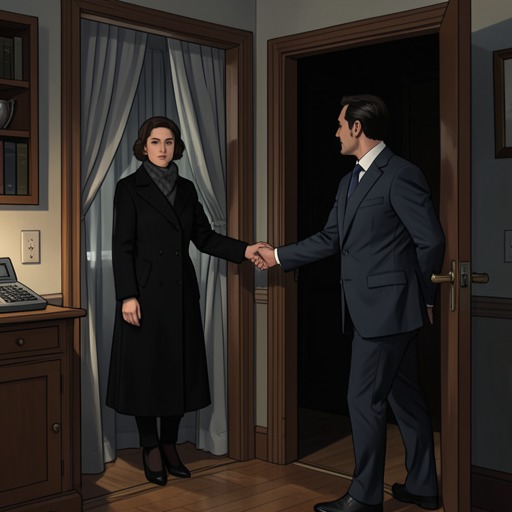
The Wind-Up Bird ChronicleRoom 208 is a hotel suite that gives physical form to the novel’s uncertain traffic between memory, dream, and pursuit. Toru Okada first encounters it in a dream where he is dressing Creta Kano in a dress that belongs to Kumiko Okada; later, in another dream, he finds the room by following a waiter carrying whiskey, ice, and glasses. The remembered suite becomes the place where the dream’s earlier sexual encounter and the mysterious Telephone Woman’s voice converge.
The Alley and the Okada Home
Room 208’s appearances are set against Toru’s ordinary neighborhood life, whose geography already resists clear passage. The narrow alley behind the houses is not quite a road or path: it has been closed at both ends, leaving a roughly two-hundred-yard strip between gardens, narrowed by fences and household objects. The story Toru heard from his uncle explains its condition: housing growth in the mid-1950s squeezed the former shortcut between new houses, after which neighbors screened or sealed its ends and accepted it as a buffer against crime. Spiders spread webs in the overgrowth, and the unused passage comes to resemble an abandoned canal.
Toru repeatedly goes down this alley to look for the missing cat, even after Malta Kano tells him the animal is no longer in the neighborhood. On one gray, rainy morning, he hears no birds or street sounds; the quiet seems to absorb not only sound but perception. As he slips past drying poles and fences, a radio talk show fades behind him until its caller and the caller’s horse-racing-obsessed mother-in-law seem to disappear with it. The alley is thus both a concrete route through the neighborhood and a place where familiar reality can feel strangely attenuated.
The Okadas live in a house in Setagaya that Toru’s uncle rents to them for a nominal sum, on the condition that they leave with three months’ notice when the uncle is ready to redevelop it. The house gives Toru and Kumiko the feeling of belonging to a household, though it is never truly theirs. That provisional domestic setting places the alley and its vacant neighboring property close to the couple’s daily life, while the condition of temporary occupancy quietly shadows their sense of stability.
The Dream Suite
In one dream, Toru begins by zipping up Kumiko’s dress and sees a woman’s bare back; only when the zipper reaches the top does he realize the woman is Creta Kano. The setting is the same hotel suite as in an earlier dream. A bottle of Cutty Sark, two glasses, and a stainless-steel ice bucket stand on the table; the curtained windows are shut, and wall lamps provide the dim light. Creta wears Kumiko’s pale-blue bird-patterned summer dress, joining the two women in the image before Toru has fully understood the substitution.
The suite therefore appears not as a neutral hotel room but as a scene in which identities and memories overlap. The dress belongs to Kumiko, while the body inside it is Creta; the familiar room is identified by its furnishings, yet its dreamlike darkness makes recognition incomplete. Rather than explaining the relationship between these images, the scene lets the repeated objects and exchanged clothing hold the unresolved connection in view.
Room 208 Found Again
In a later dream, Toru walks through a long, winding hotel corridor lined with numbered doors. He cannot remember the number of the room to which he had been taken before. A room-service waiter passes carrying Cutty Sark, an ice bucket, and two glasses, then proceeds alone down the corridor, occasionally whistling the overture to The Thieving Magpie. Toru follows him through a passage where no one else appears.
The waiter stops at Room 208, knocks three times, and is admitted. Toru recognizes the number with sudden certainty, wondering why he could not recall it earlier. After the waiter leaves, Toru knocks in the same measured way. No one answers, but the door opens when he turns the knob. The room is almost entirely dark; through the curtained window, a little light reaches the table and sofa. The Cutty Sark bottle, glasses, and ice bucket confirm that this is the suite where Toru had coupled with Creta. He enters quietly, keeping his hand on the door knob and listening for the person he believes must be inside.
From the bedroom comes the voice of the Telephone Woman, whom Toru recognizes immediately. She tells him not to turn on the light. He moves toward her voice through the more opaque darkness of the inner room; bedsheets shift, and he sees a black shadow move. When the woman again tells him to leave it dark, Toru agrees. The suite has led him from the recovery of a room number to an encounter with the voice that has previously reached him by telephone, while withholding the woman’s visible identity.
Return to the Vacant Ground
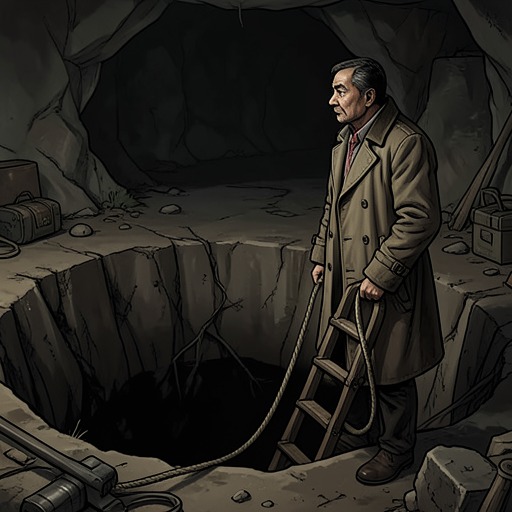
After emerging from the well, Toru goes back through the alley to the vacant Miyawaki property and finds the rope ladder gone and the well covered. The neighborhood is so hushed that he feels its old reality may have been replaced by a new one during his absence. This altered sense of place gives the earlier hotel corridor’s disorientation a counterpart in the waking world: familiar locations remain physically identifiable, yet no longer feel securely continuous with the past.
Later, in winter, Toru finds that the Miyawaki house has been demolished and the yard enclosed by a high plank fence. Looking through its gaps, he sees only compacted black earth and weeds: no house, paving stones, trees, well, antenna, or bird sculpture. He can hardly believe he once climbed down into the deep well. The disappearance of the site makes remembered spaces—among them Room 208—carry a particular weight: their objects and layouts can be revisited in dreams even as the physical neighborhood that helped shape Toru’s experience is erased.