Rope ladder
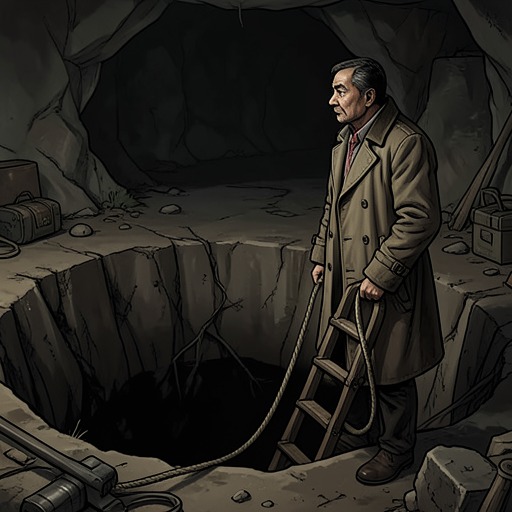
The Wind-Up Bird ChronicleThe Rope ladder is the means by which Toru Okada can enter and leave the well at the vacant house, but its movements make it more than equipment: when it is pulled up, escape becomes impossible; when it reappears, Okada can climb back into the world above; and when May Kasahara takes it away, the object becomes the means of testing the well’s darkness on her own. Its shifting presence gives physical form to the unstable boundary between confinement and return.
Function and First Crisis
The ladder is anchored near the well mouth and descends to Okada, who is trapped below. When he asks whether it is his ladder, the person above confirms that it is. Okada explains that someone has pulled it up without telling him, leaving him unable to get out. He asks for it to be lowered and warns that it must be secured to the base of the tree; otherwise, it could not safely serve as a way out. The exchange makes the ladder’s two functions inseparable: it provides a route between the well and the surface, yet its position is controlled by someone beyond Okada’s reach.
Return and Escape
The person at the well mouth disappears before Okada can establish what has happened. When he aims his flashlight upward, he sees the ladder hanging where it belongs, “as if it had been there all the time.” The restored route loosens the hard knot he feels inside, and he climbs. The ascent is laborious: the ladder is unstable, and each careful step taxes his body. As he nears the rim, the air grows warmer, the smell of grass reaches him, and insects become audible. He pulls himself over the curb and lies on the earth aboveground. The ladder’s return therefore marks a bodily passage as well as a practical escape, carrying him from the well’s darkness back into the summer night.
Creta Kano and the Well at Night
After a late-night telephone call with Malta Kano, Okada remembers that he left the ladder hanging in the well and worries that someone might find it there. He also recalls that he last saw Creta Kano at the well. Near three in the morning, he returns to the vacant house and finds the ladder still anchored to the tree, with the well only half covered. Calling down, he hears a faint moan, though his flashlight cannot reach the bottom. He decides to leave for the night and check again in the morning, reasoning that if May Kasahara pulls the ladder up, he can find another way to help Creta Kano out.
At nine-thirty the next morning, Okada finds the ladder gone. Someone has untied it from the tree and carried it away; both halves of the well cover are now firmly in place, weighted with stones. He opens one side, calls into the well, and tosses in pebbles, but hears no answer and no longer senses anyone below. He concludes that Creta Kano may have climbed out after morning came, taken the ladder, and left. The ladder’s disappearance closes off a route Okada had been monitoring, while leaving the circumstances of Creta Kano’s exit uncertain.
May Kasahara’s Descent
May Kasahara later confirms that she was the one who took the ladder away. She says that after her family left for the summer house, she went down into the well and sat there for five or six hours. The admission gives the ladder a second, distinct role: it is not only the means by which Okada is trapped or rescued, but also the instrument of May’s deliberate encounter with the well. Her account of the darkness describes a growing sense that she no longer knew who she was, while something inside her seemed to swell until it might break her apart. The ladder links her experiment to Okada’s ordeal without making their experiences identical.
In the immediate exchange, May admits responsibility with a small frown. Okada watches her push out a cigarette in an empty Sprite can; her explanation follows after she has described the hours spent below. The concrete object that had made descent and return possible is thus bound to an absence of easy explanation: May’s decision to remove it is disclosed, but the account establishes her motive through her own experience of the darkness rather than through a simple practical reason.
Narrative Significance
The ladder’s appearances and disappearances organize a sequence of suspended possibilities. Its removal leaves Okada below with no way out; its unexplained return permits him to climb; its later presence at the well raises the immediate question of who might find it; and its disappearance the next morning leaves Creta Kano’s fate at that moment unresolved. The object repeatedly turns an unseen action into a material fact at the well mouth, while withholding certainty about the people involved.
Its significance also lies in the contrast between the ladder’s ordinary construction and the uncertainty surrounding its control. Okada needs it to cross the well’s physical boundary, but he cannot determine who has raised it, who has restored it, or precisely when Creta Kano leaves the bottom. May’s later confession supplies one answer about its removal and transforms the ladder from a device in Okada’s escape into a connection between two separate descents. It remains an object of access, dependence, and interruption: each change in its position alters what is possible at the well.