Siberian coal mine
The Wind-Up Bird ChronicleThe Siberian coal mine is both a strategic industrial facility and a prison camp in Tokutaro Mamiya’s account of captivity after the Khalkha River mission. Japanese prisoners of war, Russian and other prisoners, and civilian miners are confined in separate, guarded areas, while the camp’s leadership treats human lives as replaceable labor. For Mamiya, the mine is not simply a destination after the war: it is where military defeat gives way to a new regime of exploitation, and where Boris Gromov turns a promise of limited autonomy into a mechanism of control.
Origins and Institutional Setting
Mamiya’s account places the camp within a longer history of military preparation and imperial expansion. Before the Khalkha River mission, he had served in Manchukuo as an officer responsible for topographical information along the western border. The maps were inadequate for a possible conflict with the Soviet Union: the steppe was immense, landmarks scarce, and the border politically sensitive. Military maps mattered not only for locating troops but for planning encampments, artillery, marches, water supplies, and horse feed. The border work belonged to an apparatus preparing for war even as officials tried to keep the frontier’s status indefinite.
That preparation unfolded amid the Japanese war in China, which Mamiya describes as a conflict whose costs were mounting while officers in Hsin-ching could still live as if war were distant. The quiet was illusory. Japan lacked the resources for a major confrontation with the Soviet Union, and the need to stabilize Manchukuo competed with the demands of the widening war. By August 1945, the Kwantung Army had been depleted of equipment and troops; as Soviet forces advanced, its command withdrew its main force and left border garrisons and Japanese civilian settlers exposed. The collapse of Manchukuo and the disorder surrounding the capital form the political backdrop to Mamiya’s eventual captivity.
The camp’s institutional character is made explicit in his description of its administration. It is a major strategic facility, overseen by political officials and secured by the army. The director’s overriding concern is production: dangerous mining work is authorized to raise output, while deaths do not threaten the system because new prisoners can be brought in to replace the dead. Guards, camp administrators, and the political authorities therefore participate in a structure in which increasing production matters more than preserving workers’ lives.
Prisoners, Labor, and Daily Conditions
After ideological training, Mamiya is sent to the mine to serve as an interpreter and liaison between Japanese prisoners of war and their Soviet captors. He says that people die there every day from malnutrition, overwork, mine collapses, floods, disease, severe cold, violent guards, and the suppression of resistance. Fear and distrust shape relations among prisoners as well as between prisoners and guards; he also recalls Japanese prisoners killing fellow Japanese. Captivity does not create a single, unified community of the oppressed. It subjects people to conditions that foster suspicion and violence among them.
The camp replaces prisoners who die with new arrivals transported in trainloads. The incoming men are ragged and emaciated, and many die within weeks because they cannot withstand the work and conditions. With the ground frozen, ordinary burial is impossible. The dead are deposited in abandoned mine shafts, sometimes covered with coal; when a shaft fills, it is sealed and another is used. The shafts thus serve as a practical disposal system for a labor force the administration expects to replenish.
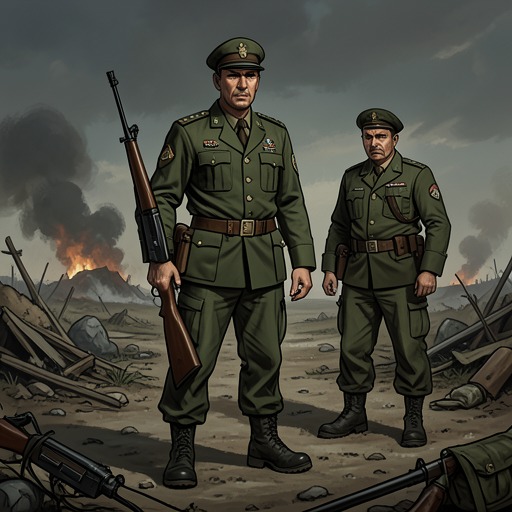
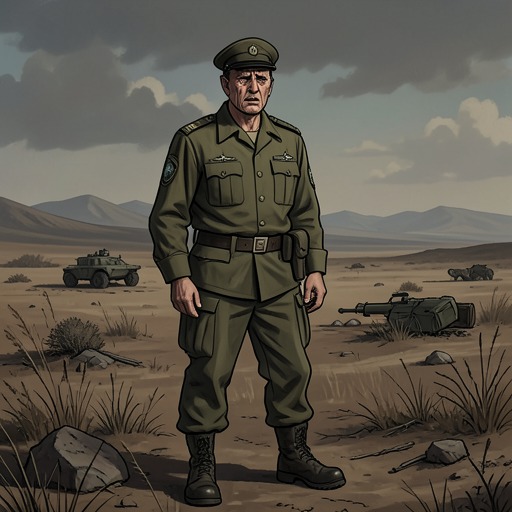
The mine’s population is divided by status and nationality. Japanese prisoners occupy the largest living area; other criminals and prisoners of war are housed separately from both them and the noncriminal population. The last group includes professional miners, military personnel and their families, and ordinary Russian residents. Barbed-wire fences and armed patrols enforce the divisions, while Mamiya’s interpreter pass gives him unusual permission to move between areas for his liaison duties. Near headquarters, the station and a small town of shops, a bar, and an inn stand beside symbols of Soviet authority, including a red flag, an armored vehicle, and a statue of Joseph Stalin at the military hospital.
This organized landscape coexists with extreme arbitrariness. Prisoners who resist can be beaten and thrown into a pit while still alive, and Mamiya remembers hearing their cries. He also explains that the system does not merely tolerate such violence: its labor arrangements and security structure make the prisoners vulnerable to it. The mine’s orderly divisions, passes, quotas, and production figures give institutional form to a world where the loss of a person can be absorbed as an administrative detail.
Mamiya and the Return of Boris Gromov
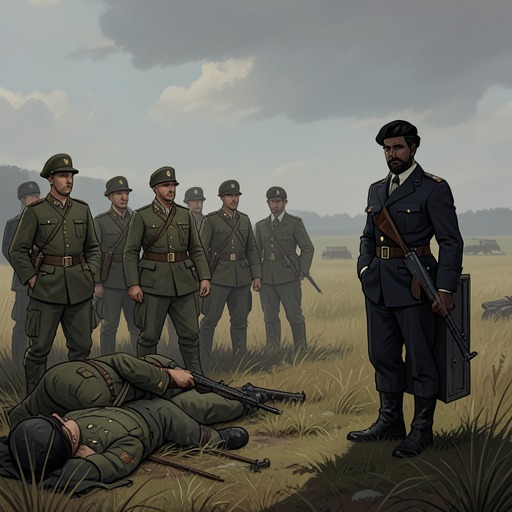
In spring 1947, about a year and a half after he arrived, Mamiya encounters the Russian officer who had ordered Yamamoto’s execution. The former officer is now a prisoner, assigned with other Russians to road repair at the station. Recognizing him brings Mamiya back to the Khalkha River events and to the consequences of the secret mission. Their meeting links the violence that preceded Mamiya’s capture to the camp’s present hierarchy: a man once exercising power over prisoners has himself been reduced to a captive, but his position does not remain marginal for long.
The Russian is Boris Gromov. Although stripped of rank and sentenced to hard labor, he is protected by the possibility that Lavrentiy Beria may restore him to power. Nikolai warns Mamiya that others treat Boris as an honored guest, providing him a private room and access to alcohol and tobacco despite the appearance of punishment. The expectation of Boris’s return makes people wary of opposing him. In this arrangement, formal imprisonment does not erase political influence; the camp’s occupants have to reckon with the possibility that its prisoner may again become their master.
Boris first consolidates control over the Russian guards and allows the Japanese prisoners to manage their own affairs. Their committee wins a modest reduction in labor’s harshness, and for a time prisoners feel safer and more hopeful. The respite is deceptive. Boris uses the period to bring committee members under his influence through inducements and threats. After roughly six months, he has the Japanese committee’s central figure, its colonel, killed by fellow Japanese prisoners. The death is attributed to illness, while fear of informers prevents open discussion. A candidate chosen by Boris takes the colonel’s place.
With the committee changed, the terms of the prisoners’ apparent self-government deteriorate. Production quotas rise in stages, work becomes more dangerous, and accidents increase. The Japanese prisoners are now made to supervise their own labor, but this delegated responsibility does not give them meaningful power over conditions. What had appeared to be autonomy becomes another way to administer forced work, and Boris’s deliberate control supplants the earlier, more openly unpredictable violence.
Extraction, Resistance, and Departure
Boris recruits Mamiya to manage the business side of his operations. His resources include food, clothing, and medical supplies sent to the camp by Moscow and the International Red Cross: he diverts a substantial share into secret stores and sells it. He also sends coal away through the black market, using bribes to arrange transport and payments to secure the cooperation of those guarding the trains. Boris presents the proceeds as funds for secret-police activity, but Mamiya suspects that most of the money is being diverted into Boris’s personal fortune, including foreign accounts and gold. Mamiya accepts the offer because he sees a plan forming, not because he intends to join Boris’s enterprise in good faith.
By late 1947, Mamiya has become indispensable to Boris’s business operations, while The Tartar oversees the violent side of the regime. Boris has made the camp his protected domain and accumulated wealth, even as prisoners continue to die in large numbers. He assesses prisoners according to their usefulness, reduces the rations of those he judges physically weak, and directs food toward stronger workers to increase productivity. When the labor force falls, new convicts arrive in freight cars; some die during transport. The arithmetic of efficiency thus extends from the mine’s quotas to the selection of who is fed and who is allowed to survive.
Mamiya’s objective is to kill Boris, despite his understanding that removing one man may not improve the prisoners’ circumstances. His attempt fails. Boris takes back the pistol after Mamiya misses and tells him that he was not capable of killing him. He then pronounces a curse: Mamiya will never be happy, love anyone, or be loved. Boris does not kill him, but arranges for him to leave the camp for the port of Nakhodka. The camp has defeated Mamiya’s attempt at resistance without ending his life.
A week later, Mamiya is sent by train to Nakhodka and, after further experiences there, reaches Japan early the following year. In his letter to Toru Okada, he presents the story as an account of defeat and describes himself as an empty, isolated figure. His departure closes his physical confinement in the mine, but not its psychological consequences. The camp remains central to his sense that he has lost his life: the violence he witnessed, his failed attempt to kill Boris, and the curse he believes himself to carry persist beyond the journey home.
Narrative Significance
The mine’s routines extend the book’s account of wartime violence into the postwar captivity that follows it. Its coal production depends on bodies treated as replaceable; its divisions and administrative procedures do not mitigate coercion but organize it. The progression from mass death and deprivation to Boris’s calculated system of quotas, food allocation, bribery, and political intimidation shows how control can become more efficient without becoming less violent.
Mamiya’s role as interpreter gives him access to the camp’s divisions and to Boris’s dealings, but it does not make him powerful enough to undo them. His story is conveyed to Toru Okada as a letter, so the mine also reaches the main narrative through an act of testimony: Mamiya cannot recover what he lost, yet he insists that the experience be passed on. The mine’s significance lies both in what it does to its prisoners and in the account that survives it, carrying its unresolved violence into the present of the novel.