Soviet Army
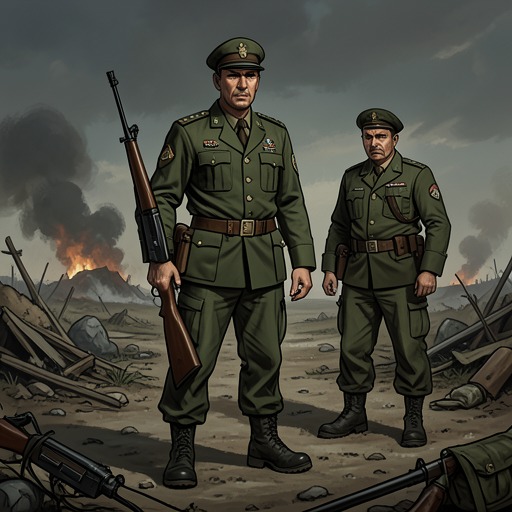
The Wind-Up Bird ChronicleThe Soviet Army is a military force whose presence shapes two connected histories in the novel: the destruction of Japanese power in Manchuria in 1945 and Lieutenant Mamiya’s subsequent captivity in Siberia. Its advance reveals how strategic weakness, inadequate preparation, and the abandonment of civilians and border troops turn imperial claims into catastrophe; its camp system then extends that violence into a regime organized around forced labor and production.
Military Context and Preparation
The earlier border mission led by Lieutenant Mamiya takes place against a background of Japanese concern about a possible war with the Soviet Union. The Kwantung Army’s maps of the Hulunbuir Steppe and the border region near the Khalkha River were crude, and the political sensitivity of the frontier had kept the boundary indistinct. Yet military planners recognized that a conflict would require detailed combat maps showing routes, encampments, artillery positions, water sources, and supplies. The mission’s topographical work thus belonged to a larger effort to prepare for a war that Japanese forces were not equipped to fight on equal terms.
The shortcomings extended to winter equipment. A Japanese army research effort had examined how to equip troops for a hypothetical Siberian campaign, testing clothing and equipment in Sakhalin. Its findings were stark: existing gear would not sustain Japanese soldiers through a Siberian winter, and planners estimated that frostbite could incapacitate roughly two-thirds of front-line infantry. The projected clothing requirements for ten divisions reveal the material scale of the problem, while the research itself underscores the gap between recognizing a military danger and possessing the resources to meet it.
The 1945 Advance and Manchukuo’s Collapse
By August 1945, the Soviet advance toward Hsin-ching was presented as impossible to stop. The Kwantung Army had been depleted as troops and equipment were diverted to the southern war; tanks and anti-tank guns were gone, transport vehicles had largely failed, and weapons and ammunition were insufficient for a general mobilization. Against the well-equipped Soviet forces arriving by rail from the European front, the once-vaunted Japanese army had become, in effect, a paper force. The collapse of Manchukuo was imminent.
Japanese command responded by withdrawing its main forces to the rear, leaving small border garrisons and Japanese civilian settlers exposed. The Soviet advance overwhelmed isolated defenders; civilians suffered mass violence, while border troops confined themselves to a bunker and were destroyed without support. Japanese officials moved their headquarters, and the puppet emperor and his family fled the capital by private train. Many Chinese soldiers serving in the Manchukuo Army deserted or revolted rather than fight the Soviet Army on Japan’s behalf. Hsin-ching was left in a political vacuum, its governing authority collapsing as the invading force approached.
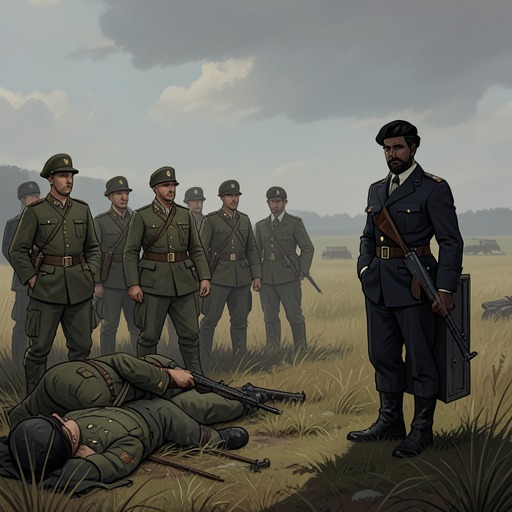
The invasion also determines the fate of the soldiers involved in the zoo executions. They expect to die fighting the Soviet Army, though after disarmament they are instead sent to Siberian coal mines, where three of them die. That expectation links the immediate military defeat to the longer aftermath of captivity: the front’s collapse does not end the story of the defeated soldiers but transfers them into another system of coercion.
Mamiya’s Capture and the Loss of His Former Life
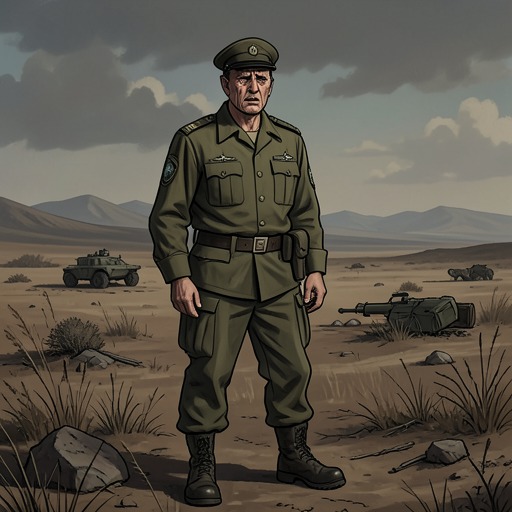
Lieutenant Mamiya recalls losing his hand in a battle with a Soviet tank unit attacking across the border. Captured and sent to a Siberian labor camp, he endures conditions that leave him unable to recover a sense of his former life. He later describes the light he saw at the bottom of a well during his earlier ordeal as the point after which his life became an empty shell; the subsequent years, including captivity and eventual return to Japan, seem to him unreal beside that experience. He also recalls that Corporal Honda had predicted he would survive and return, a fate Mamiya comes to regard not as reassurance but as a curse.
Mamiya’s account complicates any simple distinction between battlefield defeat and survival. He says that after the revelation he associates with the well, he volunteered for the front when the Soviet Army invaded Manchuria and later sought the harshest circumstances in the camp. Yet he could not die, and his survival became part of the deprivation he describes. The Soviet Army is therefore central to the historical sequence that carries him from the border battle into captivity, even as his account emphasizes the lasting inner consequences of what he experienced.
The Siberian Camp System
In the mine where Lieutenant Mamiya serves as an interpreter, Japanese prisoners work alongside other prisoners under severe conditions. Deaths result from hunger, overwork, accidents, disease, cold, and violence. New prisoners arrive by train when the labor force falls; many are already weakened, and some die soon after arrival. Because the ground is frozen, bodies are disposed of in abandoned mine shafts. The camp’s routine makes human loss part of its operating structure rather than an interruption to it.
The mine is described as a strategic facility overseen by political authorities and guarded by the army. Its director is assessed by production figures and authorizes work in dangerous veins to increase output. Prisoners are replaceable in the eyes of the administration: when workers die, more are brought in. The organization’s demands therefore connect political oversight, military security, labor recruitment, and dangerous production in a single system.
Boris Gromov later consolidates control over the camp and its resources. He diverts food, clothing, and medical supplies, sells provisions, and sends coal out through the black market, claiming that the proceeds support secret-police activity. Lieutenant Mamiya becomes responsible for the business side of these operations, while The Tartar manages violence. The camp’s prisoners continue to die in large numbers; Boris assesses their physical potential, reduces rations for those he considers weak, and redirects food to stronger workers to raise productivity. This regime turns scarcity into a deliberate instrument of selection and control.
Narrative Significance
The Soviet Army’s role extends beyond its victory over Japanese forces. Its advance exposes the hollowness of Manchukuo’s military security and the unequal costs of a retreat that protects senior authorities while abandoning civilians and border troops. The later camp narrative shifts the focus from invasion to occupation and forced labor, where state power is experienced through surveillance, violence, rationing, and production targets.
Through Lieutenant Mamiya’s testimony, these military and institutional histories are also tied to memory and survival. The forces that defeat and capture him are part of the concrete history he recounts, but his account resists reducing the aftermath to a straightforward story of endurance: he survives, returns to Japan, and lives for decades, yet describes that life as hollow. The Soviet Army thus marks both a historical turning point and the passage into a captivity whose consequences persist long after the war.