The Difference Between Fact and Truth
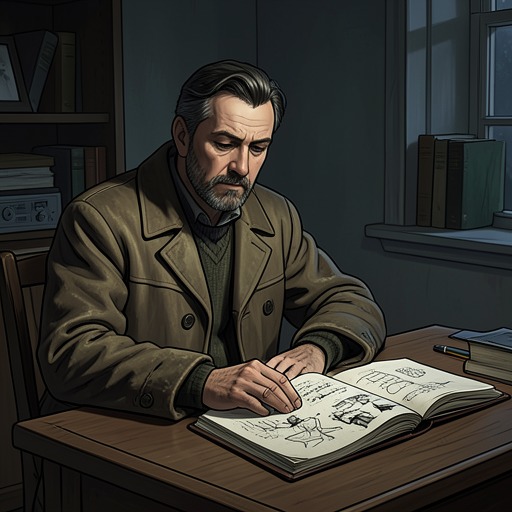
The Wind-Up Bird ChronicleThe Difference Between Fact and Truth is a principle through which Cinnamon reconstructs his family’s obscured past and Toru Okada reads the resulting stories. Their uncertain boundary matters less as a puzzle to solve than as a condition of understanding: a story may be historically unverifiable yet still disclose what an event, or a person, might have meant.
An Uncertain Historical Past
Okada cannot determine how much of Cinnamon’s account of the Hsin-ching zoo is invented. Nutmeg had said that nothing was known about what happened to her father after she last saw him, so the story cannot be wholly factual. Yet its background remains historically conceivable: amid the disorder of August 1945, Manchukuo Army cadets might have been executed and buried at the zoo, and the Japanese officer responsible might later have been executed. Desertion and rebellion among Manchukuo Army troops were not unusual in that period. Even the detail of the murdered Chinese cadets wearing baseball uniforms, while strange, cannot be dismissed as impossible. The account therefore occupies a space between what can be established and what might have occurred.
That uncertainty is not resolved by treating the story as either reliable history or pure invention. Okada considers that Cinnamon may have combined possible historical details with the image he inherited of his grandfather, the nameless veterinarian. The result can carry meaning without supplying proof: its imaginative reconstruction responds to a past whose missing pieces cannot be recovered directly.
Cinnamon’s Stories as Reconstruction
Cinnamon had entered sixteen stories under the title “The Wind-Up Bird Chronicle,” and Okada happened to read number eight. He speculates that the numbering might indicate chronological sequence, though the stories could instead be arranged differently, even running backward or offering parallel versions of one story. Number eight continues Nutmeg’s account of the zoo killings, returning to the same setting on the following day and again placing her father at the center.
For Okada, Cinnamon’s writing is a search for the meaning of his own existence through events that preceded his birth. Since he cannot reach the blank places in that past firsthand, he uses stories to supply possible links. He takes what Nutmeg has repeatedly told him and makes further stories, reshaping the enigmatic figure of his grandfather in another setting. The important question, as Okada understands it, is not simply what the grandfather did, but what he might have done. Cinnamon discovers an answer of a kind by succeeding in telling the story.
The inherited method itself refuses a clean division between fact and truth. Nutmeg’s storytelling, as Okada describes it, assumes that factual accuracy does not guarantee truth and that truth need not be factual. For Cinnamon, deciding which details can be verified is less important than using narrative to approach a past that remains inaccessible. His stories do not close the historical gaps; they give those gaps a form in which they can be considered.
Stories That Change as They Travel
The phrase “wind-up bird” connects Cinnamon’s stories to Nutmeg’s earlier account and to Okada, who has been given the name “Mr. Wind-Up Bird.” Nutmeg used the phrase unconsciously in a story she told Okada at a restaurant in Aoyama, and Okada thinks she probably did not know that he had that name. He cannot rule out that she knew it, however, or that the words had entered her telling without her awareness. The connection may be coincidence, influence, or something the available evidence cannot distinguish.
Okada consequently imagines the mother and son’s story as something they jointly possess, not necessarily a fixed text with a single stable form. Like an oral story, it may absorb changes and grow as it passes between tellers. Under this view, uncertainty is not merely a flaw in transmission: the changing relation among memory, language, and circumstance is part of how the story acquires meaning.
The Reader Inside the Puzzle
Okada finds further correspondences among himself, Cinnamon’s grandfather, and the lieutenant in Cinnamon’s story: a facial mark, a baseball bat, and the cry of the wind-up bird. The lieutenant recalls Lieutenant Mamiya, who was assigned to Kwantung Army Headquarters in Hsin-ching at the time. But the historical details do not match the story: Lieutenant Mamiya served in the mapmaking corps, not as a paymaster, and returned to Japan after the war rather than being hanged. Okada nevertheless cannot shake the impression that he might have been the officer who directed the executions. That impression remains a possibility, not a confirmed identification.
The baseball bat produces another uncertain connection. Cinnamon knew that Okada kept a bat at the bottom of the well, which could explain how its image entered the story. But this does not account for the bat connected to the Guitar-Case Man, who attacked Okada with it and ultimately surrendered it to him after Okada turned it against his attacker. The detail thus belongs at once to a plausible chain of influence and to an unresolved set of events.
The facial mark makes the overlap more personal. Okada bears a mark of the same color and shape as the veterinarian’s, and Nutmeg found him on the streets of Shinjuku because they shared it. Okada wonders whether his presence has entered the family story, or whether the veterinarian really bore the mark; Nutmeg had no apparent reason to invent it. He cannot settle the relationship between the resemblance and the account. The correspondences instead make the story’s truth and the events’ factual status harder to separate, turning interpretation into a three-dimensional puzzle without a single established solution.
Meaning Without Verification
The distinction culminates in the limits of what Okada can know. After considering Cinnamon’s possible sources, his own connections to the story, and the possibility that the narrative changes in transmission, he returns to the computer. Cinnamon’s words live there as stories that can think, seek, and grow, but the screen gives Okada no further explanation. Neither the computer nor Cinnamon tells him more than he has already been told.
The episode leaves the principle open rather than resolving it into a rule for identifying the true version of events. A story can be uncertain as evidence and still be consequential as a way of imagining inherited history, forming identity, and relating people who may have entered one another’s narratives. Okada’s investigation ends not with verification, but with a recognition that the apparent clues remain intertwined.