The Half-Moon
The Wind-Up Bird ChronicleThe Half-Moon is a prediction made by Malta Kano and a recurring image that links the ordinary sky to Toru Okada’s descent into the well. Its significance lies in the moment when a telephone prophecy becomes visible in physical space: the half-covered mouth of the well appears, from below, as a half-moon, turning an uncanny forecast into a point of recognition for the person trapped between surface and depth.
The Prediction
During a telephone conversation, Malta Kano tells Toru Okada that he should soon receive a call from someone whose name begins with O. When he asks whether the caller knows something about Kumiko, she declines to say. Instead, she offers another concrete prediction: before long, a half-moon will last for several days. She tells him to wait, making waiting itself the immediate instruction associated with the forecast.
The prediction is carefully limited. Malta Kano does not explain what the half-moon means or claim that it will reveal anything about Kumiko. Its force comes from the specific image and timing, which Toru later encounters without needing further explanation from her.
The Image at the Well
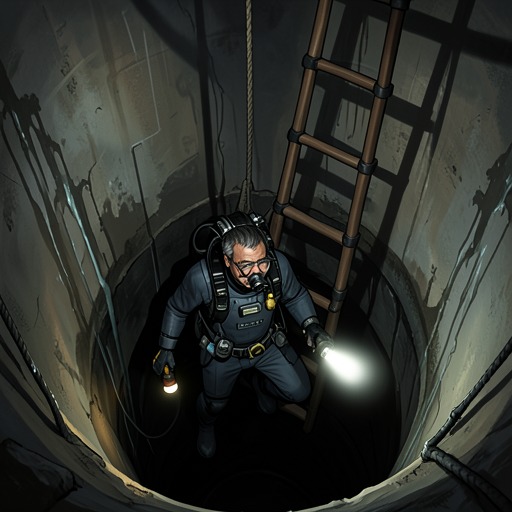
As Toru Okada makes his way down the rope ladder into the well, the descent proves far more difficult than expected. After twenty rungs, fear leaves him frozen in place. Unable to go down or climb back up, he looks toward the opening above: the half of the wooden cover he has left in place cuts the circle of the well’s mouth in two. From the bottomward perspective, the opening resembles a half-moon floating in the dark. The image recalls Malta Kano’s prediction, and remembering it helps Toru regain enough composure to continue; at the twenty-third rung, he reaches the earth at the bottom.
The correspondence is not a view of the actual moon but a shape made by the well and its cover. That distinction keeps the image grounded in Toru’s immediate predicament while allowing the prophecy to seem to reach into it. The sky is reduced to a circular opening, and the practical obstruction of the cover becomes a likeness of the celestial body Malta Kano had named.
Stars Seen from Below
A later passage extends the image beyond the half-moon. At something after five in the morning, Toru Okada can still make out many stars in the daylight from the bottom of the well. Their arrangement fills the faintly glowing slice of sky above him. The sight recalls an earlier childhood experience: while camping on a mountaintop, he had watched a sky so crowded with stars that its vastness unsettled him and made the earth seem only a temporary foothold in space.
The well brings that remembered perception into a changed setting. The stars are visible not from an open mountain but through the narrow, half-moon-shaped opening overhead. The view makes the familiar sky strange again and places Toru beneath a perspective that reverses ordinary assurance: the surface world is distant, while the well’s darkness becomes the vantage point from which the universe’s scale and the uncertainty of human existence press upon him.
Narrative Function
The motif moves from speech to material resemblance and then to an altered view of the world. Malta Kano’s prediction supplies an image before Toru encounters its shape; at the well, remembering the forecast has a concrete effect on his capacity to resume the descent. The later stars do not simply repeat the prediction but enlarge its reach, connecting the half-moon opening to Toru’s earlier discovery of cosmic vastness and instability.
The half-moon therefore belongs both to the sequence of events and to the way those events acquire meaning. It does not resolve the question of Kumiko or explain Malta Kano’s knowledge. Instead, it marks an uncanny correspondence between a warning to wait, a dangerous passage downward, and a sky glimpsed from a place cut off from the surface.