The Missing Links
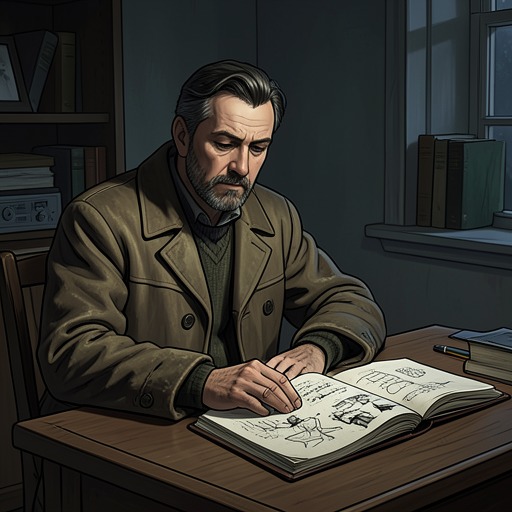
The Wind-Up Bird ChronicleThe Missing Links name both the absent pieces in Cinnamon’s family history and the imaginative work he undertakes to connect them. By making stories from what Nutmeg has told him, he searches for the meaning of his own existence in events that preceded his birth; his method makes narrative a way to approach a past he cannot directly know, without pretending that invention and fact can be cleanly separated.
The gaps in the past
Cinnamon’s stories answer to a particular limit: the blank spots are parts of the past he cannot reach with his own hands. Nutmeg’s repeated accounts give him material, but not direct access to the grandfather whose life he is trying to understand. He therefore uses his own hands to make stories, supplying connections where his knowledge fails. The missing links are not merely forgotten details awaiting recovery; they are the open spaces that make imaginative reconstruction necessary.
The search reaches beyond curiosity about what the grandfather did. Cinnamon is trying to understand what the grandfather might have done, and, through that imagined figure, to find a meaning for his own existence. The distinction shifts the purpose of his writing away from establishing a verifiable record. A story can make a possible past legible even when it cannot certify that past as fact.
Story as reconstruction
Nutmeg’s stories provide the basis for Cinnamon’s own, but he does not simply reproduce them. He takes what he has heard repeatedly and develops further stories, placing the enigmatic grandfather in a new setting. The inherited element is not only family material but a way of telling: the assumption that fact may not be truth, and truth may not be factual. For Cinnamon, sorting every detail into the categories of fact and invention is less important than discovering what becomes intelligible through the act of telling.
That process has a circular quality. Cinnamon seeks an answer to what the grandfather might have done; he finds an answer when he succeeds in telling the story. Narrative does not close the historical gap by supplying proof. It gives shape to possibility, allowing the imagined account to function as a form of understanding without converting it into documented biography.
A changing family chronicle
Cinnamon’s stories use the phrase “wind-up bird” and appear to carry their narrative toward the present in the form of a chronicle, though even the designation remains uncertain. The phrase does not originate with him: Nutmeg had used it unconsciously in a story she told in an Aoyama restaurant, apparently without knowing that Toru Okada had been given the name “Mr. Wind-Up Bird.” The possible coincidence connects Toru to the story shared by mother and son, while leaving open whether Nutmeg already knew of the name and whether it had entered her telling unconsciously.
The uncertainty matters because the family story may not have a single fixed form. It can take in changes and grow through oral transmission, as Nutmeg’s account passes into Cinnamon’s writing and the phrase recurs in both. The Missing Links thus remain more than blanks to be filled once and for all: each retelling can make another connection while also changing the narrative that holds the connections together.
What the links lead toward
In Cinnamon’s story, the wind-up bird’s cry is audible only to certain special people and guides them toward inescapable ruin. The veterinarian’s apparent belief that human will counts for nothing gives this image a fatalistic force: people become dolls on tabletops, their springs wound tight, moving in directions they cannot choose. Nearly all those within range of the bird’s cry are lost or ruined, and most die by plunging over the table’s edge.
This pattern gives the reconstructed family past a direction and a danger. Cinnamon’s imaginative links do not produce a reassuring account in which recovered knowledge restores control. They form a chronicle of constrained movement and ruin, in which people may be caught in forces they do not understand. The stories’ claim is therefore not that possibility can be separated neatly from truth, but that telling can give shape to the consequences and meanings concealed within an incomplete past.