The Miyawaki Family’s Disappearance
The Wind-Up Bird ChronicleThe Miyawaki Family’s Disappearance is remembered first as the sudden loss of a seemingly happy household and then as the long transformation of its home into an empty ruin. May Kasahara’s account, written to Toru Okada, gives the vanished family a double presence: they were neighbors she barely knew, yet the years she spent watching their home made their domestic life part of her own memory. Their departure also left behind a house that seemed to disown the people who had made it a home.
The Family Before Their Disappearance
May recalls the Miyawakis as an ordinary, cheerful family. From her bedroom window, she watched their house across the way: laundry hung outside on fine days, the two daughters were around the home and yard, and their German shepherd was part of the household’s visible life. The older girl took piano lessons and the younger one violin; birthdays and Christmas brought parties and visiting friends. At night, the house’s lights came on and later went out one by one. In May’s recollection, these repeated details made their home look warm and settled, especially beside her own sense of family life.
May did not claim to be close to the Miyawakis. She hardly spoke to them beyond greeting them in the street, and her knowledge of their daily life came largely from observing them at a distance. That distance matters: her account is not an explanation of the family’s private circumstances, but a record of how their visible routines formed an intimate part of the landscape she grew up with. She imagined them as happy and sometimes wished she had sisters like theirs; the household’s ordinary liveliness acquired force precisely because she watched it from outside.
The Sudden Absence and the House Left Behind
One day, May noticed that the family had disappeared, with their dog gone too, while their house remained. For roughly a week, the neighborhood did not recognize that they were missing. The lights’ failure to come on struck May as unusual, but she initially supposed they were away on a family trip. Only after her mother heard neighbors say that the Miyawakis had absconded did May understand that they had run away. Her recollection supplies no definite account of where they went or what circumstances led them to leave at that time; the immediate fact available to the neighborhood was their absence.
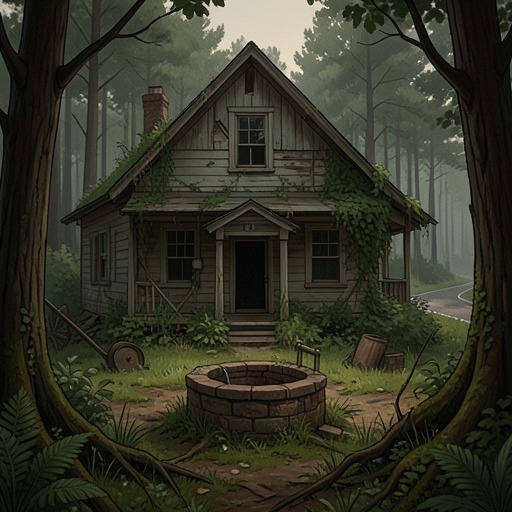
The vacant house seemed to change character as soon as its residents were gone. May had expected an abandoned home to look merely forlorn, but this one appeared, to her, almost self-sufficient—as if it had never known the people whose lives had filled it. She resented the apparent separation between the building and the family: the house had been cared for and made lively by their presence, yet after their departure it seemed to have no connection to them. That response gives the disappearance an uncanny dimension without establishing that the house itself has agency. It records how strongly a familiar place can seem to alter when the people who made it familiar are no longer there.
Years of Watching the Vacant House
The abandoned house remained in view from May’s window for years. She saw it in clear weather and in rain, snow, and typhoons; as time passed, she found it harder to look away. She could spend half an hour at her desk watching it, remembering the laughter, parties, and laundry that had once belonged to the place. Meanwhile, the yard grew over with weeds, and the contrast between its former domestic activity and its subsequent vacancy became a recurring image in her daily life. The house was not simply an episode she heard about and forgot: it became part of the view through which she experienced the passage of time.
May says the family’s disappearance sometimes feels as though a part of her disappeared with them. This feeling does not arise from close personal ties but from the sustained attention she had given their home. The family’s life had entered her memory through repeated observation, so their absence left a gap in her own sense of the neighborhood and of her childhood. The episode thus joins physical disappearance to a less literal loss: an observer can feel bereaved by a life that was never hers and by people she scarcely knew.
Later Recollections and Narrative Significance
In a later letter, May returns to the Miyawaki family as a subject that keeps intruding into her thoughts. She remembers their former home as an ordinary, happy household and finds the contrast with its vacant aftermath difficult to reconcile. She also recalls hearing that debt collectors pursued the family and that they went away and killed themselves; she believes the eldest daughter was the only one who did not die, though she says the daughter’s whereabouts are unknown. This later information changes the remembered disappearance into a family tragedy, while May’s uncertainty about the surviving daughter’s fate preserves the limits of what she knows.
The account’s force comes from the difference between what May witnessed and what she learned later. As a child, she saw the lights stop, the family vanish, and the house remain; only in subsequent recollection does she connect the disappearance with the family’s reported deaths. Her memory therefore moves between an intimate view of ordinary routines and an incomplete understanding of their end. The vacant house becomes the material link between those two kinds of knowledge: it remains visible after the family’s shared life has disappeared, while May’s attention keeps that vanished life from becoming wholly forgotten.
The Miyawaki house also enters the larger narrative as a place Toru Okada later encounters in its abandoned state. Its stone bird statue, overgrown garden, and apparent emptiness belong to the setting he visits, while May’s account supplies the remembered domestic life that cannot be read from the ruin alone. Much later, Toru finds the house demolished and the lot reduced to compacted earth. The progression from inhabited home to vacant house to cleared ground gives the disappearance a spatial afterlife: the place changes, but its history continues to surface through the people who remember it.