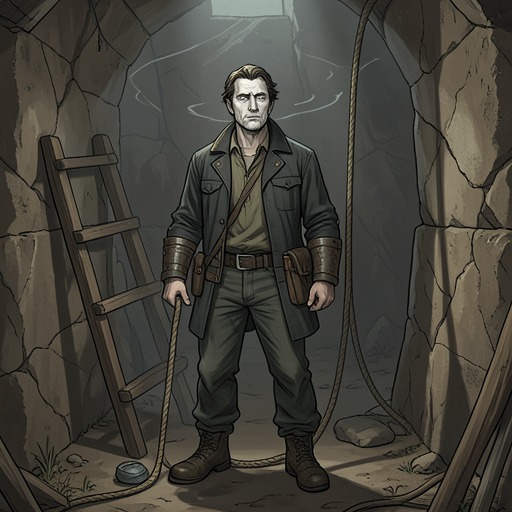
The Well as a Descent into Darkness
The Wind-Up Bird ChronicleThe well as a descent into darkness is a physical journey into the dry well on the vacant Miyawaki property and, for Toru Okada, a chosen retreat for confronting what he cannot understand about his marriage to Kumiko. Its depth first produces bodily terror, then an isolation in which memory grows unusually vivid. The descent carries a central paradox: Toru enters a world cut off from the sun in order to think about reality, and tries to get close to the real by going as far from its everyday surface as possible.
Entering the Well
Toru prepares for the descent with the care of someone who knows that the return depends on the smallest practical detail. He removes the stones holding down the well cover and shifts one of its two wooden half-circles. A pebble falls with a dry thud, confirming that there is still no water below. He ties his long rope ladder to a nearby tree and tests the knot by pulling hard; if it came loose, he might never reach the surface again. The mundane equipment establishes the descent as a physical risk, not merely a figure of speech.
Lowering the ladder does not tell him whether it has reached the bottom. His flashlight beam disappears into the shaft, and the rope seems to continue downward without end. When Toru begins climbing, his tennis shoes slip on the rungs and the pressure of his grip makes his palms hurt. Even after the twenty-rung count, the bottom remains out of sight. The shaft is in central Tokyo, behind the house where he lives, yet the familiar location does not make its depth comprehensible.
At the twentieth rung, terror abruptly arrests him. Sweat pours from his body, his legs tremble, and the force of his own heartbeat drowns out the cicadas above. He cannot go farther down or climb back up. Looking toward the opening, he sees that the remaining half of the wooden cover divides the circle of daylight into a half-moon. The image recalls Malta Kano’s telephone prediction that a half-moon would last for several days. A remembered forecast enters the immediate physical crisis, linking the descent to an order of events that Toru cannot fully control.
A World Apart from the Surface
Once Toru reaches the bottom, he checks the ground with his shoe before stepping off the ladder. The earth is dry and neither especially hard nor soft; scattered stones and an old potato-chip bag are the few objects there. The concrete walls rise like a chimney, broken only by patches of mosslike growth, while the half-moon of light hangs far overhead. He checks the ladder again, takes a breath, and sits against the wall to let his body adjust to the place. His first settled recognition is simple: he is at the bottom of a well.
The opening remains visible, but its light does not reach him. As Toru’s eyes adapt, the darkness permits only partial recognition: he can barely distinguish a hand held close to his face, and other shapes emerge slowly before losing their outlines again. This is not complete blindness but a dense, uncertain darkness in which seeing and not seeing coexist. The well thus withholds clear form even as it seems to invite attention to what cannot be grasped in ordinary light.
That altered visibility changes the force of memory. In the darkness, recollections arrive as vivid, detailed fragments, and Toru turns his attention to the first time he met Kumiko, eight years earlier. The well does not supply an answer about the marriage; instead, its separation from everyday surroundings makes the past feel newly immediate. The descent becomes a passage from physical isolation into sustained recollection.
Distance as a Method of Attention
Toru explicitly rejects the idea that he has gone down simply to hide from the fact that Kumiko may be with someone else. He acknowledges that realizing what was happening crushed him, but says his purpose is to be alone and concentrate on where their relationship went wrong. He had believed that the ordinary problems of two distinct people living together would resolve over time. Looking back, he suspects that he missed something fundamental, a mistake at a basic level that he cannot yet identify.
The well serves this investigation by separating Toru from the conditions in which the marriage was lived. He describes the couple’s beginning as an attempt to build a new house on an empty lot: they wanted little more than shelter and the ability to be together, without extras that might get in the way. In the well, that image of a deliberately simple beginning becomes a point from which to reconsider the distance between their initial hopes and their later estrangement. His explanation is not that the well solves the problem, but that solitude gives him a place to examine it.
This logic reaches its clearest expression in Toru’s appeal to Mr. Honda’s advice: when it is time to go down, find the deepest well and go to the bottom. Toru says that he has come to think about reality and that the best way to do so is to get as far away from it as possible. The statement makes the descent deliberately paradoxical. The well is not an escape from thought but a means of concentrating it, and not an ordinary return to reality but an attempt to approach reality through radical distance from its familiar forms.
Body, Mind, and the Meaning of Descent
The separation that helps Toru think also unsettles his sense of bodily solidity. In the well’s darkness, he feels his body losing density and weight, as if it were being washed away. His mind seems to draw the body into its own territory, and he considers the possibility that the body is only a provisional shell formed through an arrangement of chromosomes. The phrase by which Creta Kano describes herself as a “Prostitute of the mind” no longer seems impossible to him. The descent has opened a space in which mental experience can seem to cross into physical reality, rather than remaining safely confined within thought.
Toru responds by deliberately re-establishing contact with his body: he presses the fingertips of one hand against those of the other, breathing slowly as each hand confirms the other’s existence. He tells himself to stop thinking about the mind and think instead about reality, the world of the body. The gesture is small but decisive. The well’s darkness loosens the distinction between mind and body; Toru’s reciprocal touch gives him a concrete way to resist that loosening without abandoning the depth that brought him there.
The descent therefore holds together opposed movements. It cuts Toru off from sunlight, sound, and ordinary scale, yet draws memory into sharp focus; it makes the body seem insubstantial, yet prompts him to verify his own presence through touch and breath. The well is a place of danger and deliberate attention, isolation and recollection. Its meaning lies not in a simple triumph over darkness, but in Toru’s willingness to enter it so that he can confront what remains unresolved between himself and Kumiko.