The Well at the Hanging House
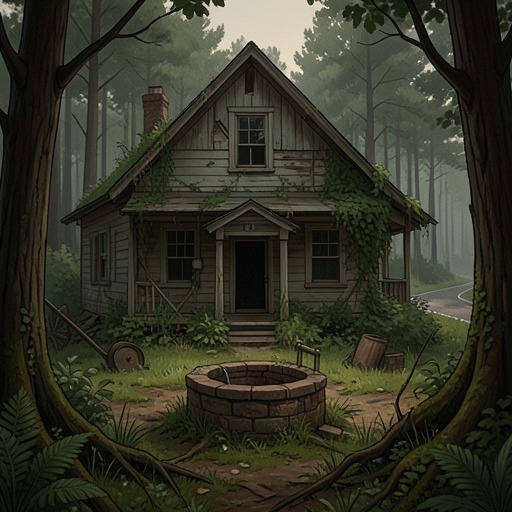
The Wind-Up Bird ChronicleThe Well at the Hanging House is the deep well on the property where Toru Okada descends to enter total darkness and pursue a hidden core of experience. It is at once a physical refuge, a threshold between ordinary awareness and an inward realm, and part of a historical chain linking Toru’s search for Kumiko to Lieutenant Mamiya, Cinnamon, and the wartime past.## Setting and ReturnToru approaches the well from the yard of the property, climbing down as the morning advances toward eleven. The clock in Cinnamon’s carefully ordered room has been moved half an inch back to its proper place; after considering whether to disclose Ushikawa’s visit, Toru chooses to wait and observe what develops. He hopes to learn what about his activities troubles Noboru Wataya and thereby draw nearer to the secret surrounding Kumiko. The descent follows this decision to watch for a while, making the well a place where waiting and purposeful investigation meet.## A Chamber of Deliberate DarknessToru climbs down the ladder, pulls the rope to close the lid, takes several breaths, and settles in the darkness with a baseball bat. He understands the absence of light as essential rather than incidental: the well’s “total darkness” is what, in his thinking, holds the key. His brief cooking-show analogy turns darkness into something almost recipe-like, an ingredient to be chosen in its thickest form, while the bat remains a practical object carried into the enclosed space. The small humor of that comparison does not dispel the severity of the act; it makes his preparation for the dark more deliberate.## Perception, the Mark, and the Inner SelfIn the well, Toru feels warmth in the mark on his cheek and takes it as a sign that he is approaching the core of things. The mark links the physical body to his effort to reach knowledge that cannot be found simply by observing the property from outside. As he sits with his eyes closed, the Bach music Cinnamon has repeatedly played that morning continues to sound in his memory. Silence gradually replaces it, and Toru experiences the darkness within and around him as blending together. The well thus gives physical form to an inward movement: he begins to move beyond himself as the container that holds him.## Historical ConnectionsThe well is not only a private setting for Toru’s search. Toru understands his own experience there as connected to Lieutenant Mamiya’s experience in a well in Mongolia. He places that connection within a broader circle involving Cinnamon’s grandfather, the clairvoyant Mr. Honda, their special duties on the Manchurian-Mongolian border, and a military officer who once lived on the property. Other links run through the mark on Toru’s cheek, which connects him to Cinnamon’s grandfather and to the clients who come to the property. In Toru’s account, these relationships converge on prewar Manchuria, continental East Asia, and the 1939 war in Nomonhan. The connection is consequential but unresolved: the events predate Toru and Kumiko’s births, and he cannot understand why they have been drawn into this chain of cause and effect.## Narrative SignificanceThe well concentrates the novel’s movement between tangible circumstances and uncertain explanation. Its ladder, lid, rope, darkness, and bat belong to a specific place and a repeated physical routine; within that enclosure, music, the cheek mark, memory, and the sense of leaving the self become part of Toru’s experience. The place therefore does not supply a simple answer to his questions. Instead, it brings together his search for Kumiko, his bodily mark, and the older histories tied to Lieutenant Mamiya and the property, making descent itself a means of approaching connections he cannot yet explain.