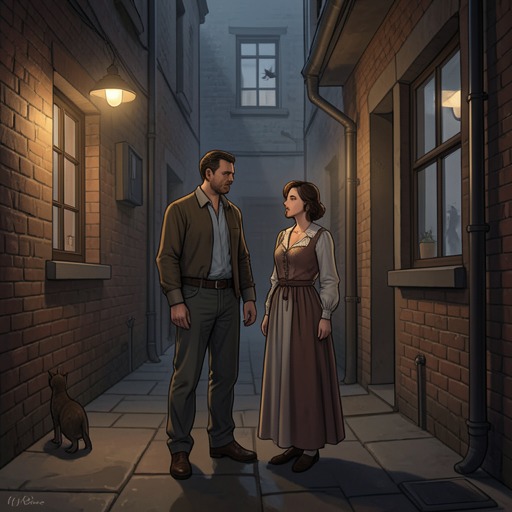
Toru Okada’s final meeting with May Kasahara
The Wind-Up Bird ChronicleToru Okada’s final meeting with May Kasahara is a winter farewell in which intimacy survives without becoming a promise of reunion. Beside a frozen pond, they speak about May’s need for time, Kumiko’s decision to remain in jail, and the possibility of a future child; then May takes Toru’s hand in her pocket and kisses the place where his cheek mark had been. Their parting gives bodily and seasonal form to a relationship sustained by letters and separation, while leaving both characters’ futures open.
Setting and Circumstances
May has taken time off work specifically to see Toru on Monday morning. His intended Sunday visit was delayed by a train accident, so their meeting unfolds a day later than planned. The pond is sealed beneath a thick layer of ice scored by thousands of skate cuts, and the surrounding forest is bitterly cold. May wears a fur-lined coat and a bright-blue knitted hat topped with a pom-pom; Toru arrives in a duffle coat that is not warm enough, with a scarf pulled up to his cheeks and sneakers slipping on the hard snow.
The frozen pond also supplies a small, consequential absence: Toru cannot see the duck people May had hoped to show him. She says they have moved elsewhere since the pond froze and invites him to return in spring, when she can introduce them. The ordinary explanation of seasonal change sits beside May’s matter-of-fact confidence in these unseen beings, preserving the story’s uncertainty rather than resolving it. Her regret at missing this introduction frames the meeting as a visit to a world that Toru can glimpse but cannot fully enter.
May’s Unsettled Future
When Toru asks whether she will stay where she is, May says she probably will, at least for now. She may eventually return to school, or she may not; she briefly mentions marriage only to dismiss it with a smile. What she wants is time to think about what to do and where to go. The answer is not a plan but a decision to defer one, and its calmness distinguishes this meeting from a conventional declaration of departure or a confident promise of return.
May asks whether Toru thought seriously about such choices when he was her age. He recalls that he assumed life would work itself out if he simply continued in the usual way, then recognizes that it did not. The exchange places her deliberate pause against his rueful hindsight: May is seventeen, with what Toru sees as ample potential for change, while Toru speaks from a life in which habitual forward motion has failed to guarantee security. Their conversation does not produce advice that settles her course; it lets her uncertainty remain hers.
Kumiko and the Future Toru Imagines
May asks whether Kumiko has been allowed out of jail. Toru corrects the premise: Kumiko has refused release because she expects to be mobbed and prefers the quiet of confinement. She is not seeing him or anyone else until matters are settled. Her trial is expected to begin sometime in spring, and she intends to plead guilty and accept the verdict. Toru considers the possibility of a suspended sentence or, at worst, a light one, but the immediate reality is that the wife he hopes to see has chosen not to meet him.
Against this separation, Toru says he is thinking of naming a child Corsica if he and Kumiko have one. May likes the name. The remark does not establish that they will have a child; it reveals instead that Toru still imagines a shared future, even while reporting that Kumiko refuses contact and is awaiting trial. The tenderness of the possibility and the uncertainty of its fulfillment remain side by side. May’s warm response receives the hope without converting it into reassurance.
Touch, Memory, and the Parting
Walking through the woods together, May removes her right glove and slips her hand into Toru’s pocket. The gesture recalls Kumiko, who used to do the same when she and Toru walked in winter, sharing a pocket against the cold. Toru holds May’s small hand there, warm against the chill. May observes that everyone will think they are lovers, and Toru agrees that they may. The scene acknowledges their closeness without naming it as a settled romance: the gesture carries the memory of his marriage even as it belongs to May and Toru in the present.
Late that afternoon, May accompanies Toru to the station. They take a bus into town, eat pizza near the station, and wait for a small three-car diesel train. Other people gather around the red-glowing woodstove in the waiting room, but the two remain outside on the platform. Beneath a sharply curved young winter moon, May rises onto her toes and kisses Toru on the cheek, where his mark had been. The kiss is a farewell rather than a claim: it touches a place defined by earlier bodily history while marking the end of this meeting.
May tells Toru goodbye and thanks him for coming all the way to see her. As the train arrives, she asks him to call out loudly to her and the duck people if anything ever happens to him. Toru answers with his own goodbye. The appeal binds human companionship to May’s peculiar, partly inaccessible world, offering care without pretending that she can accompany him back to his life.
Aftermath and Significance
After the train leaves, the moon repeatedly disappears and reappears as the train rounds curves. Toru watches it when it is visible and the lights of small towns when it is not. His thoughts move from May, returning by bus to her factory in the hills, to the duck people asleep somewhere in the shadows, and finally to the world he is heading back to. The departure does not erase the connection; it places May, her imagined companions, and Toru’s ordinary destination in a single sequence of attention, each present and then receding.
Toru’s final whispered goodbye wishes that something may always watch over May. That wish gives the meeting its quiet resolution: he cannot determine where she will go, bring her back with him, or resolve Kumiko’s imprisonment, but he can leave her with an expression of enduring concern. The frozen pond, the absent duck people, the shared pocket, and the moon glimpsed from the departing train make separation tangible while resisting final closure. May remains in the hills, Toru returns toward his own world, and their relationship ends this visit not with certainty but with an invitation, a memory, and a call they may still answer.