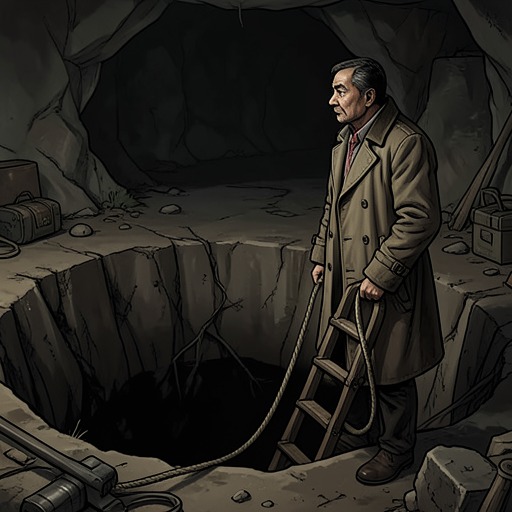
Toru Passes Through the Hotel-Room Wall
The Wind-Up Bird ChronicleBefore dawn, while trapped at the bottom of the well, Toru Okada experiences what he calls not quite a dream but “some kind of something that happened to take the form of a dream.” The episode’s decisive turn comes when the Telephone Woman, who says that remembering her name can help her escape and help him find Kumiko Okada, draws him through the wall of a hotel room just as someone enters. The passage makes the wall between the room and the well physically permeable, but it does not resolve the identities or dangers on the other side.
The Encounter in the Hotel Room
The passage begins with Toru Okada alone in a lobby, where a television shows Noboru Wataya addressing a large audience. Wataya’s polished public manner contrasts with the private, nearly invisible threat Toru associates with him face to face: on the screen, his carefully timed pauses, resonant voice, and expressive gestures make him seem persuasively real. Toru watches as Wataya prepares to announce something that will determine people’s fate. The dreamlike scene thus brings the reach of Wataya’s public influence into the same space as Toru’s private crisis.
The setting shifts to a dark hotel room, where a woman’s voice tells Toru not to turn on the light. He recognizes it as the voice of the Telephone Woman, the enigmatic caller who has made strange calls to him. She remains in the bedroom darkness; Toru hears the sheets move and sees a shadow, but does not identify her by sight. The room’s obscurity sustains the encounter’s central uncertainty: the woman claims to know Toru and says that he knows her, yet she does not know herself.
A Name Offered as a Way Out
The Telephone Woman makes remembering her name the condition of her escape. She tells Toru that he does not need to discover the name as something new; he already knows it and must remember it. If he does, she says, she can get out of where she is and help him find Kumiko Okada. The offer gives Toru a concrete task and a possible means of reaching his missing wife, but its basis is memory rather than the hard facts he demands. She warns that every day he fails to find the name, Kumiko moves farther away.
Her warning is shadowed by another danger. The woman says Toru must leave before “he” finds him, because this unnamed man may kill him; she does not answer when Toru asks who he is. The evasiveness leaves the threat unresolved, while making the hotel room feel less like a refuge than a place where Toru has entered someone else’s perilous territory. The woman’s voice then changes abruptly and becomes seductive, offering forms of intimacy she says Kumiko would never provide. Toru is confronted not with the requested hard facts, but with a shifting mixture of promise, threat, and sexual temptation.
The Wall and the Return to the Well
A knock interrupts the encounter. The woman takes Toru by the arm and urges him to hurry; as the doorknob turns and corridor light breaks into the darkness, she leads him into the wall. Its substance feels like a huge mass of cold gelatin. Toru clamps his mouth shut to keep it from entering, yet experiences the impossible movement as natural even while recognizing that he is passing through a wall to get from one place to another.
The passage is bodily as well as spatial. In the darkness, Toru feels the woman’s tongue in his mouth, smells flower petals, and feels a dull sexual need. Then intense heat gathers on his right cheek. He cannot tell whether it comes from outside or rises within him; he feels no pain, only its presence. The sensations disappear, and he emerges on the other side of the wall at the bottom of a deep well. The transition ends not in escape from confinement but in a return to the place where the episode began.
Narrative Significance
The event is framed as an experience between dream and waking rather than as an ordinary physical journey. Toru insists that it was not a dream, while describing it as something that took a dream’s form; the narrative lets that uncertainty persist instead of explaining the mechanics of the passage. The wall is at once a barrier, a route, and a tactile medium, and Toru’s body registers the crossing before it can be made coherent as an ordinary event.
The encounter also binds Toru’s search for Kumiko to two unfinished acts of recognition: remembering the Telephone Woman’s name and confronting the danger represented by the unnamed “he.” The offer of help gives the crossing a purpose, but no name is recovered and no route to Kumiko is secured in this scene. Toru returns to the well carrying the heat on his cheek as an unexplained bodily trace of passage. The episode therefore opens a connection between the hotel room and the well without settling whether that connection is a dream, an alternate space, or a reality that Toru can enter only through altered perception.