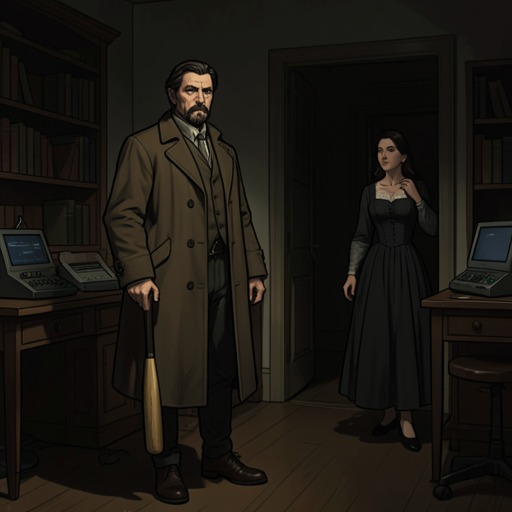
Toru and Kumiko’s growing marital estrangement
The Wind-Up Bird ChronicleToru and Kumiko’s growing marital estrangement is a gradual failure of trust and mutual understanding, not a single rupture. The distance has roots in Kumiko’s childhood separation from her family and the death of the sister who had helped her feel at home; in the present, it takes shape through late work hours, unshared experiences, and secrets that Toru allows to accumulate. By the time Kumiko asks to decide a consequential matter on her own, their marriage is already marked by silences neither partner has fully made legible to the other.
Early Distance and Family History
Kumiko’s difficulty feeling at home with others predates her marriage. Sent from Tokyo to live with her grandmother in Niigata at the age of three, she returned to her parents’ household several years later. The separation had been explained as a response to her supposed poor health, but Kumiko doubted that account and understood the arrangement as a way of managing conflict between her mother and grandmother. Her return was preceded by her grandmother’s distress and volatile behavior, which Kumiko, still a young child, could not make sense of.
After coming back, Kumiko shut herself off from the world. The next several months became a blank in her memory; when she emerged from that period, the family home felt like a new environment rather than a place that belonged to her. She struggled to trust her parents and found it difficult to open up. Her older sister was the exception: she stayed close, comforted Kumiko, read to her, and helped her with school. The sister died of food poisoning the year after Kumiko returned. Kumiko later connected that loss to her enduring guilt and isolation, recalling that the family’s praise of her dead sister and insistence that she take piano lessons left her feeling unable to replace her.
The family’s unequal closeness extended to Kumiko’s relationship with her brother, Noboru Wataya. They were separated in age by nine years, and her years away from the household further limited their familiarity. The account also places Noboru’s upbringing in a household shaped by his parents’ expectations: his father prized academic success and advancement in a competitive social order, while the parents lavished attention on their only son. This family history does not reduce the later marital distance to one cause, but it establishes the isolation and unequal attachments that preceded it.
Silence, Work, and Accumulating Secrets
In the marriage, distance appears first in ordinary exchanges. On an evening when Kumiko came home close to ten, she explained that she had called earlier to say she would be late and would eat outside. They shared a beer, but she seemed tired and preoccupied, answering little as Toru spoke. When he asked whether she was working too hard, she defended her late hours as part of magazine work and emphasized that she was not given as much overtime as some colleagues because she had a husband to go home to. Her words explain the schedule, but the conversation does not resolve Toru’s sense that something may be troubling her.
Toru, meanwhile, recognizes that he has not told Kumiko about his part-time work surveying people for a wig maker. He has already earned money, which remains in an envelope in his pocket, yet the omission has become harder to correct simply because time has passed. He imagines that Kumiko might accept the news casually or ask about May Kasahara, the sixteen-year-old from down the street who involved him in the work. His uncertainty about how to explain their meeting and his reluctance to organize the story help turn an unplanned omission into concealment.
He sees the same pattern in what he has withheld about Creta Kano. He had told Kumiko that Creta, the younger sister of Malta Kano, visited their home, wore clothes in an early-sixties style, and took samples of their tap water. He did not tell her that Creta later made startling revelations and disappeared before finishing her account. Toru regarded the story as too difficult to convey, and worried that Kumiko might object to Creta’s personal confidences and extended visit. Thus two separate relationships become private through different omissions: one involving a new acquaintance and paid work, the other an unsettling visitor whose story Toru does not know how to explain.
Toru does not present the secrecy as deliberate from the outset. Instead, he reflects that secrets are built gradually, as events pass along a channel that makes them harder to disclose. He also wonders whether Kumiko has secrets of her own, while admitting that he is probably the more secretive of the two. In his view, she tends to think aloud, whereas he does not. That contrast leaves the marriage with an asymmetry: Kumiko’s thoughts may be audible as she forms them, but Toru’s silence can make his inner life inaccessible even to himself.
Intimacy and the Unspoken Marriage
The couple’s lack of intimacy becomes explicit through the intervention of a mysterious telephone caller. The caller tells Toru to forget that he is out of work and speaks of a world he has not seen; she also refers to the length of time since he and Kumiko last had sex. Toru does not answer the caller’s probing. The exchange supplies no account from Kumiko herself, but it makes the marriage’s physical distance part of the pressure surrounding Toru and underscores how little he knows, or is willing to say, about the state of their relationship.
The caller’s familiarity also sharpens the contrast between private life and exposure. What Toru has not discussed with Kumiko is spoken aloud by someone outside the marriage, while Toru responds with silence rather than explanation. The scene does not establish how the caller knows what she claims to know; its significance lies in the way her remarks force a private absence into the conversation and leave Toru unable or unwilling to answer.
Kumiko’s Right to Decide and the Deeper Rupture
Later, while discussing her pregnancy and the uncertain order of events, Kumiko resists having her feelings translated into a conclusion by someone else. After one in the morning, she tells Toru that she wants to decide the matter herself and acknowledges that she cannot explain her thoughts and feelings well. Toru answers that the right to decide belongs to her and that he respects it. The exchange contains both separation and recognition: Kumiko describes an area of experience she cannot readily communicate, while Toru accepts that understanding does not give him the right to decide for her.
In her final account, Kumiko describes a deeper form of estrangement from her brother, Noboru Wataya. She says that he took away her freedom and that she became confined by restraints she experienced as part of herself. She also connects what happened to her with what he had done to their sister, who died by suicide. Kumiko distinguishes this harm from bodily injury and describes it as an assault on her inner autonomy. Her account presents her withdrawal not simply as a marital failing but as the consequence of coercive influence and self-confinement that she struggled to escape.
Kumiko also corrects what she had previously told Toru about her relationships with other men: she had not been with only one, but with many. She cannot identify a clear cause, though she speculates that her brother’s influence may have opened something in her and says the two of them were bound together in a dark way. This revelation complicates Toru’s earlier assumption that he understood the limits of what Kumiko had concealed. The marriage’s estrangement is therefore linked to a wider structure of withheld experience: childhood separation, bereavement, her brother’s power over her, and truths Kumiko could not or did not disclose until much later.
Significance
The marriage’s distance is built through repeated failures of access rather than a single argument. Kumiko’s childhood experience of being sent away and losing the sister who had helped her connect with the family offers a history of disrupted belonging; Toru’s growing secrets reproduce silence within the marriage in a different form. Their relationship is further strained by a lack of intimacy and by experiences neither can easily explain to the other. Yet the scene in which Toru recognizes Kumiko’s right to decide preserves a distinction between respecting her agency and claiming to understand her completely. Her later disclosures expose how much remained hidden, without making the marriage’s accumulated silences disappear.