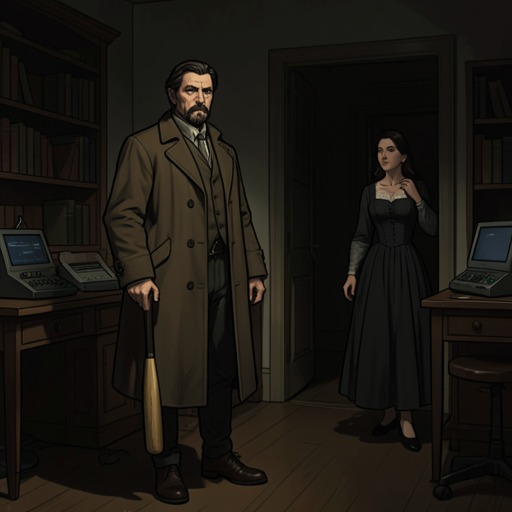
Toru and Noboru Wataya meet
The Wind-Up Bird ChronicleThe meeting between Toru and Noboru Wataya takes place over lunch, but it is no civil negotiation: Noboru arrives with a family position and a ready-made account of Kumiko’s marriage, while Toru insists that the decision belongs to Kumiko and himself. The conversation becomes a confrontation when Toru refuses to let Noboru’s authority substitute for his wife’s voice. His story of the monkeys of the shitty island gives the encounter its governing image: a closed cycle of stagnation that reproduces itself, and a warning that Noboru’s apparent composure does not make him invulnerable.
Setting and First Impressions
Toru arrives at the tearoom ten minutes early, only to find that Noboru and Malta Kano are already seated. Malta wears a red vinyl hat, a short-sleeved white linen jacket, and a collarless cotton top; a small yellow leather handbag rests beside her hat. The conspicuous hat sets itself against the otherwise restrained, immaculate outfit. Noboru, in green sunglasses and a white polo shirt beneath a navy cotton sports coat, has an untouched glass of iced tea in front of him. Malta’s tonic water, too, remains untouched. The tableau is orderly and watchful: both visitors seem to have come prepared, and Toru enters a conversation whose terms they have already begun to arrange.
Before the discussion turns to Kumiko, Toru registers the change in Noboru since they last met more than three years earlier. Media exposure has made Noboru’s face familiar despite their separation, but in person it now appears different: a slick, artificial surface has displaced the muddy, stagnant impression Toru remembers. He reads the new face as a mask, perhaps even a new skin, and compares Noboru’s movements and manner of speaking to a television image separated from its audience by glass. That image establishes the distance between the men before Noboru tries to dictate what Toru should do.
Noboru’s Proposed Settlement
Noboru opens by defining the subject as Kumiko, Toru, and their future. When Toru asks him to be concrete, Noboru says that Kumiko has taken a lover and left Toru; he presents continuation of the marriage as undesirable for everyone involved. His blunt formulation makes a private rupture sound like a settled public fact, although Toru immediately asks how Noboru knows about the alleged lover. Noboru answers that Kumiko told him herself.
Noboru then lays out a practical divorce arrangement. With no children and, in his view, no need for money to change hands, Kumiko would withdraw from the family register; Toru would sign and seal forms prepared by a lawyer. Noboru stresses that this is the final view of the entire Wataya family. The proposed procedure reduces a marriage and a separation to paperwork, while the invocation of the family attempts to turn one brother’s intervention into a collective decision. Toru does not accept that framing merely because it has been presented as final.
Toru Rejects the Proxy Conversation
Toru asks what purpose the meeting serves: whether it is meant to secure his agreement to divorce or to achieve something less explicit. He points out that Noboru has offered conclusions without answering the practical questions that matter to him: where Kumiko has gone, what she is doing, whether she is alone or with the other man, and why she has not contacted her husband. Toru says he will not believe the affair on Noboru’s word alone; he wants to hear directly from Kumiko. The distinction is central to his refusal. Whatever Noboru claims to know, he is not one of the two people who must decide what becomes of the marriage.
Noboru calls the meeting an effort to inform Toru of the situation and explains that he asked Malta to attend as a third party. He says he does not know where Kumiko is or who the other man is, and that even if he did know, he would not tell Toru. He adds that Kumiko is an adult who can do as she pleases and has not contacted Toru because she does not want to speak to him. Toru’s challenge is not answered with new information about Kumiko; instead, Noboru asserts her refusal while controlling access to her. Toru counters that Kumiko apparently wanted to speak with her brother and questions how much she could have told him, given their lack of closeness.
The Monkeys of the Shitty Island
Noboru accuses Toru of blaming someone else for his wife’s departure and says the meeting is a waste of his time. In the silence that follows, Toru asks whether Noboru knows the story of the monkeys of the shitty island. Noboru has never heard it and shows no interest. Toru nevertheless tells of an unnamed island where foul-smelling coconuts, monkeys, and accumulating dung feed an endless cycle: what the monkeys produce nourishes the palms, whose coconuts sustain the monkeys in turn.
Toru makes the fable an interpretation of the man before him. Some forms of shittiness, stagnation, and darkness, he says, propagate themselves in a sealed cycle until they pass a point at which no one can stop them, even if the person involved wants to. The story answers Noboru’s attempt to cast Toru as the source of the problem with a different account of culpability: Toru sees a self-reinforcing darkness in Noboru, not an isolated quarrel that can be tidied away through divorce papers. The tale also gives the scene a circular structure of its own. Noboru insists the meeting is pointless; Toru turns that dismissal into evidence of the stagnation he is naming.
Bluff, Reaction, and Departure
Toru tells Noboru that he knows what is under the smooth, television-ready mask and claims that he and Kumiko both know Noboru’s secret. He warns that he could bring it into the light, insists that being treated as garbage does not make him a sandbag, and makes explicit that he will hit back if someone hits him. The speech is a threat, but its factual basis is unstable: Toru does not actually know what Noboru’s secret is. He can imagine that something is profoundly warped within him, but he has no concrete knowledge to expose. The confrontation therefore turns on a bluff that Toru himself recognizes as such.
Noboru does not answer with his usual televised tactics of sneering, exploiting an opening, or trying to trip an opponent up. He sits silently. His face then reddens unevenly: some patches become deep red, others only faintly so, while the rest turns pale. The mottling suggests a mask losing its smoothness, but it does not reveal what Toru says he knows; the narration makes clear that the secret remains unknown to him. Toru can read the visible effect without possessing the hidden truth he has threatened to disclose.
At last Noboru stands without a word, takes his sunglasses from his pocket, and puts them on. The blotches remain visible beneath them. Malta stays motionless and says nothing; Toru maintains an expression of indifference. Noboru seems about to speak, changes his mind, and walks away into the crowd. Afterward Toru feels exhausted. He declines the waiter’s offer to refill his coffee, while Malta picks up her red hat, studies it for several minutes, and sets it on the chair beside her. The meeting ends without a divorce agreement, an explanation of Kumiko’s whereabouts, or a direct reply from Noboru. Its decisive result is narrower but real: Toru has refused the settlement on Noboru’s terms, and Noboru has left without controlling the final word in their exchange.