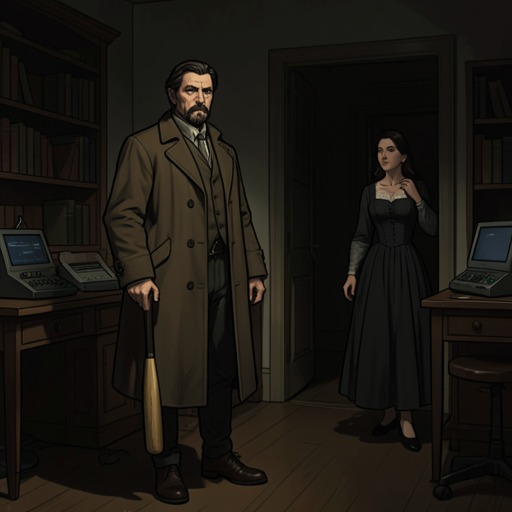
Ushikawa
The Wind-Up Bird ChronicleUshikawa is Noboru Wataya’s private, behind-the-scenes intermediary, sent to Toru Okada with proposals concerning Kumiko and the Miyawaki property. His first appearance makes him both grotesquely comic and disquietingly effective: he talks at length about his name and his low status, yet possesses a key to Toru’s house and carries messages from people who remain out of reach. As a self-styled “carrier pigeon,” he gives the novel a human face for political influence exercised through unofficial channels—and for the limits of mediation when Toru refuses the terms on offer.
Identity and Introduction
When Toru finds him waiting in the dark, Ushikawa is a short, suited man, somewhere between forty-five and fifty, with a bald head, a large nose, thick wire-rim glasses, and tobacco-stained teeth. The narrator’s physical description turns into something more unsettling: Ushikawa seems less like an ordinary person than a figure from a forgotten nightmare. The impression rests not only on his appearance but on a clammy, difficult-to-name strangeness that makes his presence in a familiar home feel invasive.
Ushikawa introduces himself through a story about the name he cannot escape. “Ushi” means “bull,” he says, and the nickname has made him feel a curious closeness to actual bulls. He contrasts the awkward associations of his own surname with the clean, ordinary sound of Okada, and wonders whether a name describes its bearer or gradually shapes him. The speech is expansive and self-mocking, but it also establishes a characteristic of his work: Ushikawa makes himself memorable by turning even his name into a performance.
That performance does not make him harmless. He explains that he entered the locked house with a real key. Its green leather holder resembles Kumiko’s, and he says she gave it to him rather than his stealing it or taking it by force. The key is a concrete sign of his access to Toru’s private space and of his connection to the absent Kumiko; it also lets him arrive as more than a stranger with a message.
Wataya’s Unseen Agent
Ushikawa works for Kumiko’s elder brother, Noboru Wataya, whom he calls “Dr. Wataya.” He describes himself as a kind of private secretary, but distinguishes his position from the polished, camera-facing role associated with a public figure. His assignments are the “shadow” jobs: work kept out of sight, which he jokingly likens to being a fiddler under the porch. He presents his low status as useful to the employer’s clean public image, while insisting that responsibility for Kumiko is an important task because she is Wataya’s only sister.
His account of his function is both candid and evasive. He calls himself a mere messenger, a carrier of slips of paper, and disclaims knowledge of every detail; at the same time, he warns Toru that Wataya possesses a kind of power that grows stronger every day. The gap between the modest role Ushikawa claims and the influence he attributes to his employer gives his visit its pressure. He does not need to threaten Toru directly: he can make Wataya’s reach itself the warning.
The First Proposal and Toru’s Refusal
Ushikawa’s first major purpose is to reopen communication between Toru and Kumiko. He says Wataya is no longer opposed to the possibility that the couple might resume their former relationship and would not insist on a divorce if Toru remained willing to wait. Wataya would also permit Ushikawa to serve as a channel for messages. The proposal is framed as a thaw in hostilities, a renewal of diplomatic relations rather than a demand for immediate reconciliation; Ushikawa acknowledges that Kumiko herself has no present intention of returning.
Toru asks how Wataya learned of his connection to the Miyawaki property. Ushikawa cannot supply a direct explanation. Instead, he praises Wataya’s intelligence and supposed sixth sense, then emphasizes the reality of his growing power. His inability—or unwillingness—to clarify the connection leaves the property’s significance unresolved while reinforcing the imbalance between the brothers-in-law: Wataya seems able to act on knowledge Toru does not know how he acquired.
Toru rejects the offered help. He says he intends to get Kumiko back himself and will make no deal with Wataya. His opposition, he makes clear, goes beyond personal dislike: he cannot accept Wataya’s very existence. He also draws a boundary around the house, telling Ushikawa not to enter again without permission. The exchange exposes the limits of Ushikawa’s role. He can carry the proposal and report the answer, but he cannot make Toru accept a reconciliation mediated on Wataya’s terms.
Property, Money, and a Second Approach
Ushikawa later contacts Toru by telephone at nine-thirty at night. The brief ring, pause, and renewed call serve as his signal; he says he is nearby and wants to speak in person about Kumiko. Toru imagines a self-satisfied expression on the other end of the line and recognizes the appeal’s force: despite his earlier refusal, the subject is one he cannot dismiss. Ushikawa’s method depends on returning with new terms, not simply repeating the first offer.
In the subsequent approach, he asks Toru to sever his connection to the land and withdraw from the deal. He anticipates that Toru may be unable to leave because of a loan, then offers eighty million yen—eight thousand ten-thousand-yen bills—as enough to repay the debt and leave money over. When Toru asks whether the land and building would then belong to Noboru Wataya, Ushikawa accepts that this is how the arrangement would work, while acknowledging that details remain to be settled. The precise sum gives the proposal a transactional clarity, but its object is control of the property: money would turn Toru’s claim and connection to the land into something Wataya could acquire.
Mediation and Narrative Role
Ushikawa also tries to create a direct conversation between Toru and Kumiko through a computer. He says the connection is more complicated than he expected: an ordinary phone line is insufficient, and access requires a special password. He insists that he does not mean to enter Toru’s computer or extract its data. His stated aim is to help the couple speak directly, because, in his view, leaving their relationship unresolved invites misunderstanding. But Kumiko refuses even a telephone conversation, and Ushikawa reports that repeated efforts cannot change her mind. His mediation thus encounters a limit that no key, payment, or persuasive appeal can overcome: the person whose voice Toru most wants to hear will not agree to speak through him.
The scenes build Ushikawa through contradiction. He is physically and socially self-deprecating, funny in his prolixity, and alert to how names and appearances shape a person; yet he has been entrusted with access, negotiation, and the discreet work behind Wataya’s public standing. His “carrier pigeon” image captures both his utility and his constraint. He transports proposals and warnings, but the meaning of those messages is determined by the antagonism between Toru and Wataya and by Kumiko’s refusal to be drawn into direct contact. The result is not a simple portrait of a powerless functionary or an all-powerful fixer, but a go-between whose considerable access cannot make other people yield.