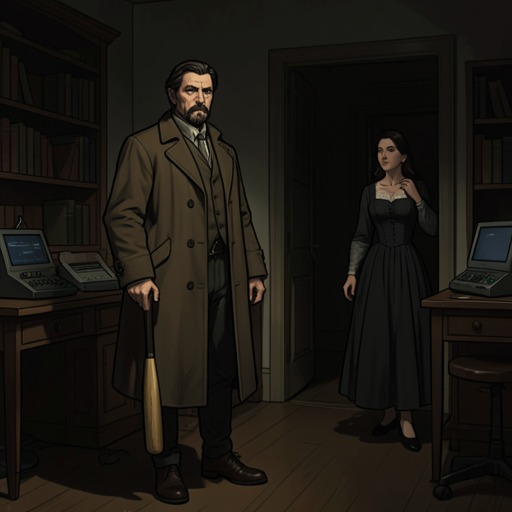
Ushikawa’s first ultimatum and Okada’s refusal
The Wind-Up Bird ChronicleUshikawa’s first ultimatum and Toru Okada’s refusal mark the point at which an investigation of the Hanging House becomes an open contest over who will control Okada’s search for Kumiko. Delivering Noboru Wataya’s offer, Ushikawa proposes that Okada sever his connection with the property in exchange for Wataya’s consideration of helping reunite the estranged couple. Okada refuses both the terms and the source of the promised help, insisting that he will recover Kumiko by his own efforts. The scene makes the conflict plain: a possible reunion is offered as leverage, and Okada chooses independence over a bargain with his adversary.
The offer and its leverage
Ushikawa presents the proposal as the second item of business in a conversation he has insisted on completing. Its immediate background is a weekly-magazine article about the Hanging House, described as a jinxed property in an affluent Setagaya neighborhood where people have met untimely deaths. Wataya read the article and suspected a connection between the house and Okada, his brother-in-law. He had Ushikawa investigate; Ushikawa saw Okada repeatedly using the back passageway to visit the property and concluded that Okada was involved in whatever was happening there.
The article has not yet generated a follow-up, but Ushikawa warns that the embers of publicity could rekindle. Wataya, he says, fears that Okada’s name might surface in an unpleasant connection with the house, creating a scandal at a delicate moment in his political career. Public attention could also magnify the complicated separation between Okada and Kumiko. Ushikawa frames the offer as a way for Wataya to manage both risks: if Okada cuts all ties with the Hanging House, Wataya will give serious thought to bringing the couple back together. The wording promises consideration, not a guaranteed reunion, making the supposed assistance conditional and uncertain from the outset.
Warning and refusal
Ushikawa supplements the inducement with a warning. He suggests that people more dangerous than Wataya may be involved and that Okada could be entering hazardous territory without realizing it. He compares the situation to playing catch in the middle of an expressway: withdrawing, in his account, would both protect Okada and spare Wataya considerable trouble. That warning casts the offer as a mixture of purported concern and pressure, with the continued investigation positioned as a danger Okada should leave behind.
Okada answers that he will get Kumiko back, but will do so himself rather than with Wataya’s help. He acknowledges that he dislikes Wataya, then distinguishes that dislike from a more fundamental rejection: he cannot accept the fact of Wataya’s existence. Consequently, he refuses to make any deal with him and asks Ushikawa to carry that answer back. The response closes off the promised route to reconciliation without abandoning Okada’s aim of finding Kumiko; the goal remains, but he will not let Wataya set its terms.
A boundary at home, and a continuing intermediary
The refusal is also a demand for control of the domestic space where the negotiation takes place. Okada tells Ushikawa never to enter the house again without permission, emphasizing that it is his home, not a hotel lobby or train station. The demand answers Ushikawa’s earlier intrusion in practical terms: whatever role he may have as messenger, he has no right to treat Okada’s home as a place he can enter at will.
Ushikawa accepts the answer as clear and says he will report it to Wataya, but he warns that the matter will not end there. He expects he may have to visit again and asks Okada to become accustomed to his presence, describing himself as someone who cannot simply be swept away. He promises not to let himself into the house again and says he will call beforehand, even proposing a recognizable pattern of ringing once, hanging up, and ringing again. His qualification is revealing: he presents himself as an ordinary person who would prefer not to intrude, yet also as a paid messenger required to obey his employer. The promise to seek entry recognizes Okada’s boundary without removing Ushikawa from the conflict.
Significance of the encounter
The exchange converts Wataya’s concern about a potentially damaging story into a direct attempt to redirect Okada. The Hanging House is not merely the subject of magazine speculation: Okada’s visits to it have become information Wataya can use to exert pressure, tying the mysterious property to the couple’s estrangement and to Wataya’s public ambitions. By rejecting the offer, Okada refuses to trade his connection with the house for a possible intervention in his marriage.
The scene also fixes a distinction between the men’s roles. Wataya remains the powerful figure whose interests shape the proposal, while Ushikawa is the self-conscious, often unwelcome carrier of his instructions. Okada cannot end their dealings with a single refusal, as Ushikawa explicitly says he will likely return; nevertheless, he establishes the terms on which that contact can continue. The ultimatum therefore produces no reunion, but it does make the antagonism explicit and leaves Okada’s effort to find Kumiko his own responsibility.