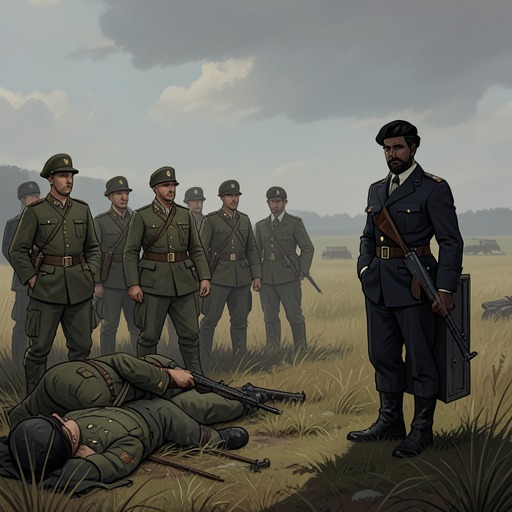
Yamamoto's secret documents
The Wind-Up Bird ChronicleYamamoto's secret documents are the concealed papers at the center of a 1938 military mission across the Khalkha River. Their contents remain unknown, but the orders surrounding them make their importance unmistakable: they must reach headquarters or be destroyed rather than fall into enemy hands. Their disappearance shapes the mission’s outcome, and their burial in the desert leaves both the document and the reasons for carrying it unresolved.
Mission and Strategic Setting
In late April 1938, Lieutenant Mamiya was assigned to command an escort for Yamamoto, a civilian by official description whom Mamiya recognized as a professional soldier. The small party also included Sergeant Hamano and Corporal Honda. Mamiya’s mapmaking duties gave him a reason to accompany the mission: the army needed more precise topographical information for the poorly mapped border region near the Khalkha River. The same terrain mattered to military intelligence, since combat maps had to show not only borders but routes, campsites, artillery positions, water sources, and supplies required for horses and troops.
The border’s uncertain status made such work politically sensitive. The Kwantung Army had reason to avoid provoking a conflict with the Soviet Union or Outer Mongolia while Japan’s forces were committed to the war with China, and it had allowed the frontier to remain indefinite. Yet if fighting broke out, accurate maps would be essential. The documents were carried on an assignment shaped by this unstable overlap between surveying, intelligence, and military preparation, although the account never establishes that the papers themselves were maps or explains their subject.
After five days of preparation, the party traveled by train from Hsin-ching to Hailar, then by truck to a border observation post near the river. During the mission, Yamamoto gave Mamiya a clear instruction concerning the papers in his saddlebag: they were to be delivered to headquarters, and if delivery proved impossible, they were to be burned, buried, or otherwise destroyed. The central requirement was that they never reach enemy hands. He also ordered Mamiya to shoot him if circumstances became desperate and he could not do so himself, underscoring that protecting the document took precedence over preserving Yamamoto’s life.
Disappearance During the Capture
The party’s movement toward the river ended when Mongolian soldiers discovered their camp before they could ford it. Mamiya later awoke to find Yamamoto under guard; Hamano and Honda were absent. The soldiers searched the party and its belongings, inspecting a leather valise that Yamamoto had placed beside his pillow. It contained only cigarettes. Mamiya had seen Yamamoto transfer the document from a saddlebag into that valise, so its absence was an immediate and consequential mystery.
The soldiers searched the rest of the equipment and prisoners but found no papers. They took personal belongings and gathered the party’s pistols, ammunition, maps, compasses, and binoculars for removal. The documents, however, were not among the items recovered. Their absence meant that the mission’s most urgent security objective had been met at least in the immediate sense: the Mongolian patrol did not take them. It did not reveal who had moved them, when they had vanished, or whether Yamamoto knew where they were.
Honda’s Actions and the Documents’ Fate
Corporal Honda later told Mamiya that he had sensed the Mongolians were coming and slipped away from the tent without alerting the others. In the circumstances, he judged that waking the party would not allow them to escape: they were outnumbered and outgunned, and their position was already known. He took the document with him, acting on the order that it must not be captured even at great personal cost. Though his departure could have counted as desertion in an ordinary battlefield engagement, Mamiya understood it as resourcefulness within a special assignment.
Honda watched what followed, then had to travel on foot because he no longer had a horse. He retrieved supplies the party had buried in the desert and hid the document there before setting out after Mamiya. The account does not explain how he located the well where Mamiya had been taken. Once he found him, Honda made a rope from strips of his clothing, pulled him out, found a horse, and brought him across the dunes and river to a Manchukuo Army outpost. The document, meanwhile, remained hidden rather than being returned to headquarters.
Mamiya later said that the papers were probably still buried in the earth near the Khalkha River. He and Honda considered returning to retrieve them, but concluded that there was no reason to do so and that the document should never have existed in the first place. They coordinated their accounts for the army investigation and denied knowing anything about it, fearing responsibility for failing to bring it back. The army questioned them separately, warned them that the matter was top secret and must never be discussed, and excluded it from formal records. The papers thus became not only a lost object but the subject of an enforced silence.
Unresolved Purpose and Significance
The document’s purpose remains undisclosed. Mamiya continued to wonder what might have happened had it reached headquarters and why Yamamoto had not crossed the river alone, where he might have moved more freely. He speculated that Yamamoto could have intended to use the escort as a decoy while escaping, and wondered whether Honda had suspected this. These remain questions rather than established explanations; the narrative offers no confirmation of the document’s contents or of Yamamoto’s plan.
The papers’ journey is defined by a sequence of reversals: a military order makes their delivery essential, capture appears imminent, the valise is found empty, and Honda’s action saves the document from the patrol only by removing it from the official chain of custody. Its presumed resting place near the river links secrecy to burial, while the army’s interrogation and prohibition on speaking turn an uncertain mission into a lasting concealed episode. Because the text withholds what the document contained, its importance rests less on disclosed information than on the lives, decisions, and silences organized around keeping it out of enemy hands.