Yoshitaka Wataya
The Wind-Up Bird ChronicleYoshitaka Wataya is Noboru Wataya’s uncle, a military logistics technocrat whose research and political career connect the Wataya family to the history of Manchukuo and Japan’s preparations for war. Recovered by Toru Okada from a book about military logistics, his biography makes a seemingly obscure relative part of a larger account of how strategic ambitions were constrained by maps, supplies, and the capacity to sustain a campaign. His careful calculations stand against a military culture that celebrated advance and sacrifice even when the means to support them were lacking.
Identity and Historical Setting
Yoshitaka Wataya graduated from the Military Staff College with a specialization in logistics. In 1932, soon after the founding of Manchukuo, he was sent there to assess whether the region could provide reliable supplies of wool and other materials. He was a young technocrat charged with turning a broad strategic concern—Japan’s vulnerability in a potential northern war—into a practical study of resources and production.
The problem had already been recognized within the Japanese army. A research team established at the General Staff Office examined how Japan might prepare for a war with the Soviet Union, particularly a winter campaign. Japanese forces lacked experience fighting in Siberian conditions, and the equipment then available was inadequate for such severe cold. Tests of boots, coats, and underwear on Sakhalin led the researchers to estimate that frostbite could disable about two-thirds of front-line infantry. They also calculated the sheep needed to equip ten divisions and the machinery required to process the wool. Yoshitaka’s assignment in Manchukuo belonged to this same effort to translate strategic possibility into material requirements.
Logistics and Military Doctrine
Yoshitaka treated winter clothing as a logistical problem with consequences for the viability of an entire campaign. Japan’s home islands could not supply enough sheep for a prolonged northern war, so his report argued that Japan would need a stable supply of wool, rabbit pelts, and other materials from the Manchuria-Mongolia region, together with equipment to process them. His approach made the chain between military ambition and its material prerequisites explicit: troops, clothing, raw materials, and processing capacity all had to be considered before a winter campaign could be sustained.
His outlook differed sharply from the doctrine promoted by some military men, who held that the proper path for the emperor’s warriors was to fight with bold self-abandonment, even when poorly equipped, and to advance faster than supplies could follow. Yoshitaka, a methodical technocrat who had spent two years stationed in Berlin, regarded a prolonged war without logistical support as tantamount to suicide. He understood that mechanized warfare and Soviet military expansion had changed the conditions of strategy, while much of the Japanese military remained attached to lessons drawn from its earlier victory in the Russo-Japanese War.
In Manchukuo, he carried out an exhaustive numerical analysis of how long it would take to secure dependable wool supplies. His work was part of a larger effort to prepare for a hypothetical war with the Soviet Union, but the strategic setting was unstable: Japan was already committed to war in China, while disputes over the Manchukuo frontier risked escalation with the Soviet Union and Outer Mongolia. The campaign planners needed more than declarations of resolve; they needed detailed information about terrain, water, transport, and supplies. Yoshitaka’s specialization placed him within that practical side of military planning.
Kanji Ishiwara and the Manchukuo Project
While in Mukden, Yoshitaka sought an introduction to Lieutenant General Kanji Ishiwara and spent an entire night drinking and talking with him. Ishiwara, associated with the staged attack that precipitated the Manchurian Incident and the creation of Manchukuo, argued that Japan’s prospects in an eventual war with the Soviet Union depended on strengthening its logistical position. That meant rapidly industrializing Manchukuo, building a self-sufficient economy, and improving agriculture and cattle production, in part through the organized settlement of Japanese farmers.
Yoshitaka returned to Japan an admirer of Ishiwara’s arguments, worldview, and personal charisma. Their relationship continued for years, including visits after Ishiwara had been recalled from Manchuria and placed in command of the isolated fortress at Maizuru. Yoshitaka’s detailed report on sheep farming and wool processing received high praise from headquarters. The connection shows how a specific supply question—what Japan would need to clothe troops in a northern war—was tied to a broader imperial program of industrial development and resource planning in Manchukuo.
The limits of that program became apparent after Japan’s defeat at Nomonhan in 1939 and the tightening of economic sanctions by the United States and Britain. The research team’s report concluded that Japan could not wage a winter campaign against the Soviet Army with its existing level of preparation. That assessment was one factor in the decision to end the fighting at Nomonhan before it expanded into a full-scale war. In early autumn, Imperial Headquarters accepted a diplomatic settlement that ceded the barren Hulunbuir Steppe to Outer Mongolian and Soviet forces. Yoshitaka’s work therefore belongs to a history in which logistical assessments could expose the gap between military aspiration and the capacity to act on it.
Postwar Career and Family Succession
After the war, MacArthur’s Occupation purged Yoshitaka from public office. He lived for a time in seclusion in his native Niigata; when the purge was lifted, the Conservative Party persuaded him to run for office. He served two terms in the Upper House and later moved to the Lower House. A calligraphic scroll by Kanji Ishiwara hung in his office, a continuing sign of the relationship that had shaped his thinking about Japan’s continental policy.
Yoshitaka served once as a cabinet minister and remained influential among people in his district, though he never became a national political leader. His electoral constituency passed to his nephew, Noboru Wataya. Toru Okada, reading the account of Yoshitaka’s career, recognizes the family connection from the shared surname and the name itself. The discovery shifts the family history into the wider political record: Noboru’s public position is not presented as an isolated rise, but as an inheritance of a political base established by his uncle.
Narrative Significance
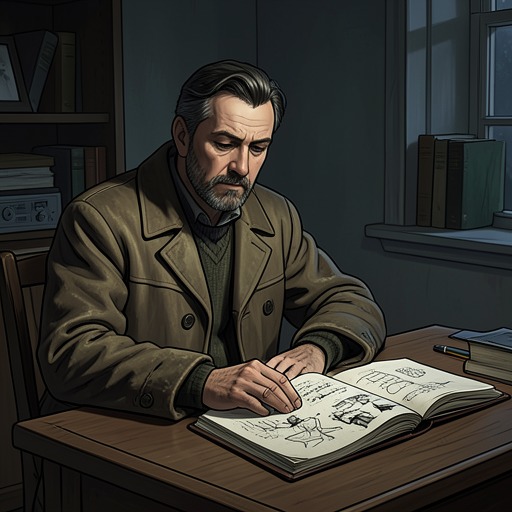
Yoshitaka appears through documentary research rather than as a participant in the novel’s present-day action. Toru encounters him in a book on logistical problems in Manchukuo, and the archival account gives the uncle a sharply defined profile: a planner who counted sheep, estimated equipment, and considered the consequences of fighting without adequate supplies. The narrative’s movement from Noboru’s contemporary political prominence to the details of his uncle’s work connects private genealogy with the institutions and policies that shaped Japan’s wartime history.
His biography also provides a contrast between calculation and ideology. Yoshitaka’s insistence on material preparation does not detach him from the imperial project; his work was meant to secure resources from Manchukuo for a possible war, and he became an admirer of Ishiwara’s plans for the region. Yet the report’s conclusion that Japan was unprepared for a winter campaign registers a limit that declarations of courage could not overcome. The same emphasis on logistical capacity echoes elsewhere in the wartime material Toru reads: campaigns depended on maps and supplies, while a Siberian mine under Boris Gromov was organized around diverted food, clothing, medicine, and coal. Against those later scenes of scarcity and exploitation, Yoshitaka’s calculations reveal logistics as more than background administration: it is one of the forces that determines what armies and governments can do, and whom their plans expose to danger.