Bureaucratic sclerosis
The Wisdom of CrowdsBureaucratic sclerosis names the rigidity that can overtake an organization when the appearance of inclusive decision-making conceals a concentration of authority. In the postwar American corporation, decisions passed through layer after layer of management, while information and responsibility became more diluted at each step. The result was not simply slowness: the structure weakened initiative, muffled dissent, and cut senior leaders off from the local knowledge their organizations needed to adapt.
How hierarchy hardened
The sclerosis took hold within a corporate model that treated integration, hierarchy, and concentrated power as routes to success. Companies often mistook collective decision-making for consensus: instead of making room for conflicting judgments, committees sought solutions that would offend no one. As William H. Whyte warned, consensus could produce the organizational equivalent of a camel—an outcome shaped by compromise rather than by the strongest ideas. Familiarity among group members made the danger worse, because discussion could settle into the familiar and suppress provocative disagreement.
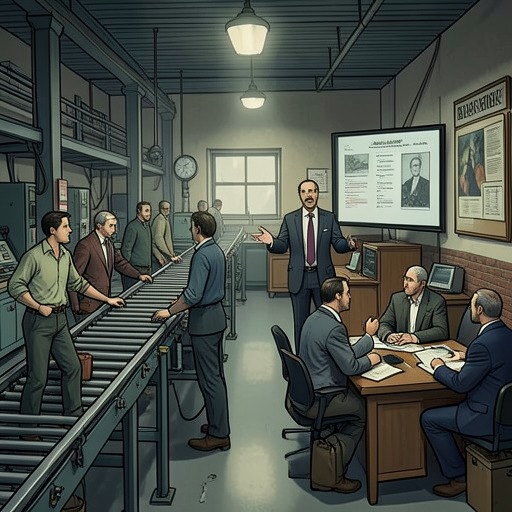
The multiplication of management layers made this consensus-seeking especially costly. At General Motors, even a relatively straightforward design decision about a new headlight was considered in fifteen meetings, and the chief executive attended the last five. The process looked democratic because many people took part, but discussion was not the same as a wider distribution of decision-making power. Each committee vetted a decision before passing it upward; the further it traveled from the front line, the more watered down it became.
In the late 1960s and early 1970s, these arrangements became a form of bureaucratic sclerosis. Managers could pass along subordinates’ advice and treat approval as a substitute for taking responsibility. Subordinates, knowing that a superior controlled what information moved upward, had reason to assume that the superior would check it. When authority was not genuinely delegated, employees lower in the hierarchy had little incentive to show initiative. Formal layers multiplied, but ownership of the work did not.
Information lost in the chain
The structure also made the flow of information fragile. Every manager could become a bottleneck, and every superior a possible obstacle or future adversary. A chart from an unnamed company, reproduced in Thomas J. Peters and Robert H. Waterman’s In Search of Excellence, mapped 223 different bureaucratic paths that a new product idea might have to traverse before acceptance. With so many steps between executives and workers in the field, senior leaders could no longer be confident that their picture of the corporation resembled its reality.
A factory-floor episode at a General Motors plant in Van Nuys, California, makes that separation concrete. Two assembly-line workers repeatedly failed to install the bracket that held a car’s sunshade. The omission meant that, at the end of the line, the carpet had to be torn out so the bracket could be welded into place. When a supervisor showed the workers the repair, one learned only then what the part she had been welding for two years actually did. The defect was not a lack of effort alone: essential information about how one task fitted into the finished car had not reached the people doing it.
The same structure discouraged candor further up the ladder. A 1962 study of young executives found that those most anxious to advance communicated problem-related information less accurately. Another study, of fifty-two middle managers, linked upward mobility with withholding news of failures; successful executives were less likely to disclose fights and budget problems. In a system where advancement depended on pleasing superiors, accurate reporting could become a career risk. Bad news was therefore liable to arrive late, softened, or not at all.
The resulting information deficit was compounded by a lack of cognitive diversity among top managers and by weak competitive pressure. Ford’s late-1950s investment of hundreds of millions of dollars in the Edsel, for which there was no consumer market, illustrated the cost of decisions insulated from outside perspectives. As Japanese and West German firms began offering better products faster in the early 1970s and responding more closely to consumers, American hierarchies proved ill suited to the rapid organizational and product changes competition demanded. The quintessential American car of the decade, Ford’s Pinto, was introduced in 1971; it was ugly, had a feeble four-cylinder engine, and could sometimes explode when hit from behind. Ford nevertheless sold a million Pintos during the decade, but the success did not prevent the larger decline. American corporate profits, market share, and productivity growth fell sharply; by the decade’s end Chrysler and Lockheed needed government bailouts, and Ford appeared at risk of needing one as well.
Command, coordination, and comparison
The underlying failure was not that corporations had no means of coordination. They could issue orders. The difficulty was that command and control could not effectively run an entire company: it consumed time, demanded information top executives should not have to process themselves, and drained initiative from managers and workers. When coordination emerged without being dictated from the top, a company could become lighter and more flexible. But concentrated power and excessive management layers made that kind of coordination harder, while creating a reason for people to order others about simply because the hierarchy had given them authority to do so.
The comparison between Ford and Toyota illustrates the organizational cost of accumulated layers. At Ford, more than fifteen managerial levels separated the chairman from a factory-floor supervisor; at Toyota, there were just five. The contrast speaks to more than the distance between two job titles. Each additional level could delay information and weaken the connection between a decision and the conditions it was meant to address. The problem was therefore both structural and practical: an organization burdened with layers struggled to learn quickly from its own work.
A related lesson appears in the book’s discussion of the U.S. intelligence community before September 11. Dividing work among agencies could provide specialization, diverse analysis, and local knowledge; decentralization itself was not the defect. What was missing was a way to aggregate both information and judgments across agencies. The author’s distinction clarifies the corporate case as well: dispersed knowledge is valuable only if the organization can make it collectively useful. A centralized authority that sifts everything risks losing the advantages of independent perspectives, but decentralization without routes for sharing and synthesis leaves important knowledge stranded.
Reopening decision-making
The proposed alternative is not disorder, nor the abolition of coordination, but a genuine distribution of decision-making power. Decisions about local problems should be made as far as possible by people close to them, whose experience gives them knowledge that cannot always be transmitted as a neat report. Rather than automatically filtering every problem up the hierarchy and every solution back down, organizations can begin from the possibility that local expertise will yield workable answers more effectively than managerial distance.
That principle also changes what counts as employee involvement. Many companies claimed to push authority downward, but fewer than 2 percent of American companies, according to estimates by Blasi and Kruse, made real use of what they termed high-performance work systems. In the best-performing companies identified by Nitin Nohria, William Joyce, and Bruce Roberson, employees and managers were empowered to make more independent decisions and encouraged to improve both operations and their own work. Decentralization, in this account, is not a slogan about flatter charts; it gives people meaningful responsibility for the environments they know.
Even the expectation of control can matter. In a study, one group working on puzzles and proofreading amid loud, random noise was given a button that could turn off the sound; another group had no such control. The group with the button solved five times as many puzzles and made fewer proofreading errors, although nobody pressed it. The difference lay in knowing the option existed. Read alongside the factory-floor examples, the experiment suggests why a real share of authority can improve performance: people who are not powerless in their own working conditions may engage more fully with the task and with the information it produces.
Bureaucratic sclerosis is thus a failure to connect organizational scale with organizational intelligence. Meetings and layers can create the appearance of participation while weakening the movement of information, judgment, and responsibility. Decentralization can restore initiative and use local knowledge, but it must be paired with ways to share what individuals and teams discover. The decisive contrast is not between hierarchy and any structure at all; it is between a system that merely sends decisions upward and one that lets distributed knowledge inform collective action.