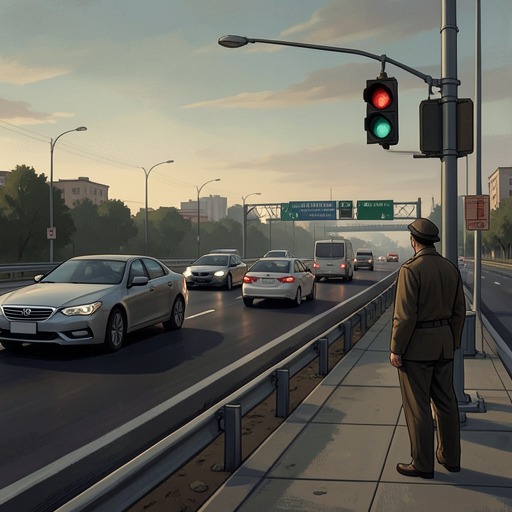
California PATH program
The Wisdom of CrowdsThe California PATH program is presented as a research initiative that tested whether automation and vehicle-to-vehicle communication could make highway traffic more orderly by removing the delays and variability introduced by human drivers. Its four-day trial near San Diego showed that automated cars could travel in close, synchronized formation at highway speed, but the proposed dedicated-road system remained costly and difficult to imagine drivers accepting.
The Traffic Problem
Traffic flow depends on the interaction of individual drivers. In a simulation devised by Mitch Resnick, cars moved smoothly when they departed at evenly spaced intervals and traveled at equal speeds. Once their speeds varied and drivers had to react to one another by braking or accelerating, jams emerged; even a small amount of randomness in position and speed was enough to produce trouble. A radar trap could have a similar effect by forcing sudden deceleration and making speeds less uniform.
This creates a tension in the value of diversity. Varied perspectives can improve collective decisions, but varied driving behavior makes coordination on a highway harder. The PATH researchers investigated whether making vehicles more alike in their movements could address that specific coordination problem—not by persuading each driver to react better, but by automating the reactions themselves.
The I-15 Experiment
In August 1997, researchers from the California PATH program took control of a seven-and-a-half-mile stretch of I-15 near San Diego. They brought eight Buick LeSabres, each automated with steering and gas-pedal controls, motion sensors, radar, and a radio communication system. The equipment cost a couple of hundred thousand dollars. It allowed the cars both to drive themselves and to exchange information about speed and acceleration fifty times per second.
The vehicles traveled together in a platoon, coordinating their speeds by radio. With driver reaction delays removed, a change in one car’s speed prompted the others to adjust immediately. The LeSabres moved just twenty-one feet apart, maintaining precise synchronization. Over four days, they traveled hundreds of miles at 65 miles per hour with real passengers and without an accident. The experiment thus offered a concrete demonstration of a highway where vehicles acted not as isolated drivers but as a coordinated system.
The Proposed Highway System
The researchers’ vision required more than automating cars. Dedicated highways would use magnetic markers buried four feet apart to help vehicles read the road and stay in the correct lane. Cars entering the highway would join a platoon and travel together to an exit, with each platoon presumably assigned to a particular off-ramp.
The infrastructure would be expensive: equipping roads would cost at least $10,000 per mile, in addition to the expense of outfitting vehicles. In return, an automatic highway might double or triple capacity, eliminate traffic jams, reduce the need to build new roads, and cut the time people spent in gridlock. The prospect was therefore not simply greater convenience; it suggested that intensive coordination might use existing road space more efficiently.
Limits and Significance
The experiment’s success did not make the system an easy prospect for adoption. Drivers could be uncomfortable surrendering control of their cars, and more reluctant still to entrust their lives to a computer. The comparison with airplanes underscored the difference: aircraft already flew on autopilot, but nearly everyone had personal experience driving. The proposed highway also raised a political objection, since it seemed to require government orchestration of how people moved along the road.
The PATH trial is consequently both an example of engineering coordination and a study in its limits. It showed that synchronized automation could suppress the small reaction delays that help turn variable traffic into a jam. Yet a technically successful, highly organized system could still face resistance because it demanded new infrastructure, altered drivers’ relationship to control, and depended on a conspicuously top-down design. The experiment made the promise of a perfectly organized highway visible without resolving whether people would choose to live with one.