Coherent flow
The Wisdom of CrowdsCoherent flow is a traffic state in which vehicles move together as a steady collective stream, allowing more cars to pass a given point each minute even when each driver is traveling below their preferred speed. Developed in the work of Dirk Helbing and Bernardo Huberman, the concept reverses the usual intuition that a faster-moving individual car means better traffic: under the right conditions, restraint at the level of each vehicle can improve the movement of the whole road. It also supports a practical alternative to fully automated highways, combining driver-assistance technology with more intelligent control of when cars enter the highway.
Definition and Collective Efficiency
Helbing and Huberman described coherent flow as traffic moving as one, like a “solid block.” Its measure of success is not whether each driver can accelerate or change lanes freely, but whether the stream as a whole achieves an optimal pace, with the maximum number of cars passing a particular point every minute. In this state, a driver may make less individual headway than desired, yet the road carries more traffic efficiently.
That distinction matters because the conditions that seem to benefit one vehicle can hinder the group. With too few cars on the road, drivers change lanes, accelerate suddenly, and brake. Each may gain ground temporarily, but these interruptions disrupt steady movement and can leave the crowd traveling more slowly overall. Coherent flow therefore is not simply a matter of reducing the number of cars; it depends on organizing movement so that vehicles can sustain a stable, collective rhythm.
How the Flow Breaks Down and Forms
Two conditions are important to achieving coherent flow: drivers must be discouraged from repeatedly slowing down and speeding up, and the stream of vehicles entering the highway must be smoothed. The timing of entry matters alongside the number of cars. A randomly spaced sequence of vehicles can disrupt the road, while arrivals timed to fill gaps can help traffic settle into a more stable pattern.
The concept thus shifts attention from isolated drivers to relationships among vehicles. A car entering at the wrong moment can interrupt a developing stream; an appropriately timed entry can fill available space and help sustain it. This makes traffic performance a coordination problem: the relevant outcome depends not only on how many vehicles use the road, but on how their movements are fitted together.
Driver Assistance and On-Ramp Control
Helbing and Martin Treiber proposed driver-assistance systems as one way to smooth traffic. Using miniature radar and sensors, such systems would help keep cars evenly spaced, warn of hazards ahead, and alert drivers to dangers behind them that might otherwise remain hidden in blind spots. By helping drivers maintain steadier movement and avoid abrupt braking, the technology could support the conditions needed for coherent flow.
The proposal did not require every car to carry the system. Helbing and Treiber argued that equipping only 10 or 20 percent of vehicles could eliminate much stop-and-go traffic. Automakers were already working to incorporate the technology into future models, making this part of the approach more immediately plausible than a wholly automated highway.
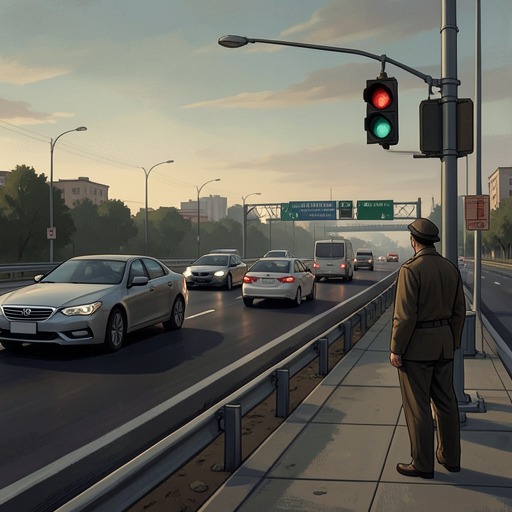
A second measure would make more sophisticated use of on-ramp stoplights, which already existed across Europe and the United States. In the United States, these lights generally operated on a simple timed cycle, allowing another car to enter about every thirty seconds. Helbing and Huberman’s work suggested instead tracking approaching traffic and timing each release for a moment when there was room for the entering car and its presence could fill a gap.
That adjustment might require drivers to wait at an on-ramp for several minutes, an initially aggravating cost. Helbing’s argument was that the delay could shorten total travel time for everyone by preventing a disruption to the highway’s overall flow. The trade-off is central to the concept: a brief constraint on individual movement can make the shared system work better.
Alternative to Fully Automated Highways
The practical case for coherent flow appears against the backdrop of a more comprehensive proposal: dedicated highways equipped with magnetic markers buried four feet apart. Cars would read the markers, remain in the correct lane, and travel in platoons together until reaching their exits. Such a system could cost at least $10,000 per mile, in addition to the expense of equipping cars, but a smoothly running automatic highway might double or triple capacity, eliminate traffic jams, and reduce the need to build new highways.
The difficulty was not only financial. Drivers could be uncomfortable giving up control of their vehicles and handing their safety to a computer. A government-orchestrated highway also seemed like a top-down answer at a time when people were more attracted to bottom-up solutions. Coherent flow offered a less sweeping alternative: improve coordination among ordinary cars through partial technology and better-timed entry, rather than requiring every driver to surrender control to an automated roadway.
Significance
Coherent flow makes traffic efficiency a property of the crowd rather than a simple sum of individual advantages. Lane changes and bursts of speed may help particular drivers, yet collectively destabilize the stream; measured movement and timed arrivals can instead make the road carry more vehicles. Its proposed remedies likewise divide coordination between vehicles that assist their drivers and infrastructure that regulates entry, without making comprehensive automation a prerequisite.
The concept’s practical promise lies in this balance. Driver-assistance systems could steady some cars without needing to equip all of them, while responsive on-ramp signals could help fit new vehicles into the traffic already on the highway. A driver may initially experience the system as a restriction, especially when held at a ramp, even as the collective result is less stop-and-go traffic and a shorter total journey. Coherent flow therefore offers a concrete example of how individually limited movement can produce a more effective shared system.