Francis Galton
The Wisdom of CrowdsFrancis Galton is the unlikely starting point for the book’s case that groups can make remarkably accurate judgments. In 1906, the elderly British scientist went to a livestock fair in Plymouth expecting little from ordinary people’s estimates; after an ox-weight contest, the crowd’s average was within one pound of the animal’s actual dressed weight. The result challenged the assumptions that had shaped much of Galton’s career and supplied a vivid example of collective intelligence.
Scientist and Convictions
At eighty-five, Galton was still driven by the curiosity that had made him known for research on statistics and heredity. The annual West of England Fat Stock and Poultry Exhibition drew farmers and townspeople to assess cattle, sheep, chickens, horses, and pigs. For Galton, a fair devoted to livestock made sense: it displayed the results of breeding, a subject he had long considered central to the health of society.
His interest in breeding was bound up with a deeply elitist view of human ability. Galton believed that only a small minority possessed the qualities needed to keep society healthy, and he had devoted much of his career to measuring physical and mental capacities in support of that conviction. At the 1884 International Exhibition in London, his Anthropometric Laboratory tested visitors’ eyesight, hearing, color sense, judgment of eye, and reaction time. The results reinforced his contempt for the intelligence of the average person and his belief that power should remain in the hands of a select few.
The Plymouth Experiment
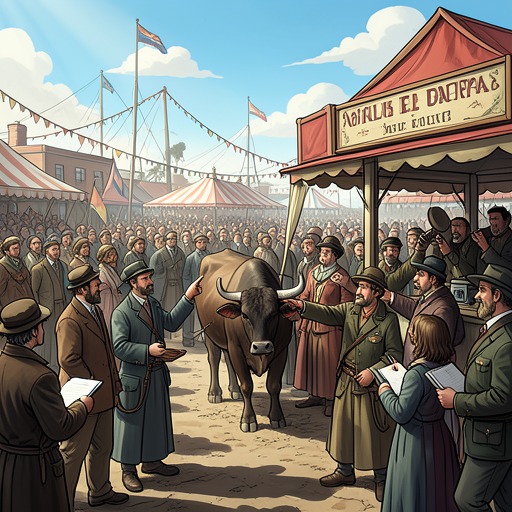
At the 1906 exhibition, Galton came upon a competition to estimate the weight of a fat ox after it had been slaughtered and dressed. For sixpence, each entrant received a numbered ticket on which to write a name, address, and estimate; the most accurate guesses would win prizes. Eight hundred people entered, including butchers and farmers with relevant experience as well as people without specialized knowledge of cattle.
Galton saw the mixed crowd as a possible analogue for a democracy, where voters with very different abilities and interests each have a say. He turned the contest into an impromptu statistical test, borrowing the tickets after the prizes had been awarded. Of the guesses, thirteen were illegible and discarded; he arranged the remaining 787 from highest to lowest, examined their distribution, and calculated their mean. That average represented what the assembled crowd would have estimated if it were a single person.
The answer overturned Galton’s expectation. The crowd estimated that the dressed ox would weigh 1,197 pounds; the actual weight was 1,198. Rather than demonstrating the unreliability of ordinary judgment, the result made the crowd’s combined estimate almost exact. Galton later described the outcome as more creditable to democratic judgment than he would have expected.
From Surprise to Collective Intelligence
The book uses Galton’s experiment to introduce a broader claim: under the right circumstances, a group can be more intelligent than its smartest member, even when many participants are not especially informed or rational. The ox estimate is not presented as proof that any crowd will always be right. Its force lies in the particular conditions of the task: many people made separate estimates, and a simple aggregation—the average—turned those judgments into a result that closely matched the truth.
The account connects that mechanism to four conditions for wise crowds: diversity of opinion, independence of judgment, decentralization, and aggregation. Diversity supplies different perspectives; independence helps prevent people from merely copying one another; decentralization allows participants to use their own or local knowledge; and aggregation makes separate judgments count toward a shared outcome. When a large, diverse, independent group has some relevant information, the errors in individual estimates can cancel out, leaving more of the information behind.
Galton’s surprise therefore has a double significance. It unsettled the assumptions of a scientist who had set out to measure and rank human capacities, and it furnished the book with an example of how a crowd’s strength can arise from the combination of judgments rather than the dominance of a chosen expert. The episode does not make expertise or intelligence irrelevant; it shows why individual limitations need not determine the quality of a group’s answer.