General Electric
The Wisdom of CrowdsGeneral Electric serves as a case study in the possibilities and limits of decentralizing a large company. Jack Welch sought to make it a “boundaryless corporation”: one that reduced internal barriers, brought more perspectives into problem-solving, and moved decision-making closer to the people with relevant knowledge. The company’s example supports the case for organizational flexibility, without making its chief executive’s judgment infallible.
Decentralization and the Flow of Knowledge
The rationale for decentralization begins with the value of local and tacit knowledge: experience tied to a particular job or setting that is difficult to transmit in a summary. People closest to a problem may be best positioned to devise a workable solution, while specialization allows different parts of an organization to develop distinct expertise. The challenge is to let that knowledge remain grounded in local circumstances while making it useful to the organization as a whole.
That balance is not automatic. Decentralized units can develop valuable information that never reaches other parts of the system. The distinction is between decentralization alone and decentralization paired with ways to aggregate information and judgments. General Electric’s reforms under Welch are described against this wider organizational problem: loosening boundaries was meant not merely to grant independence, but also to bring perspectives into contact.
Welch’s Boundaryless Corporation
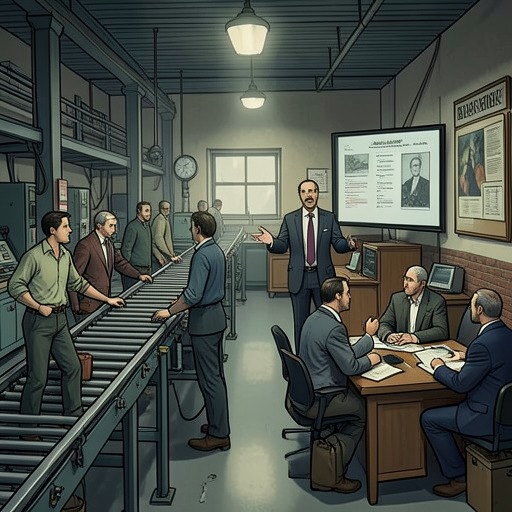
Welch’s most important initiative as chief executive was to transform General Electric into what he called a “boundaryless corporation.” He tried to make the company’s boundaries with outside markets more permeable and broke down barriers between its divisions, arguing that interdisciplinary work could foster diversity. He also sharply reduced the layers of management between senior leaders and the rest of the company.
The effort extended to relations between managers and subordinates. In “Work-Out” sessions, managers faced often stinging public criticism from the people they managed. The format challenged the assumption that information and criticism should travel only up a hierarchy: subordinates were given a forum to question those above them, making disagreement part of the company’s working process.
The book does not portray the initiative as a complete transformation. Welch did not succeed in everything he attempted. On some decisions, including whether to spend tens of billions of dollars on acquisitions, he appeared to disregard opposing views and rely on his own unwavering convictions. The contrast sets a limit on the idea of boundarylessness: structural openness can create opportunities for challenge, but does not ensure that a leader will accept it.
Hierarchy, Participation, and Organizational Learning
The case for distributing decision-making power is contrasted with the rigid, multilayered corporations common in the United States in the 1970s. At Ford, more than fifteen managerial layers separated the chairman from a factory-floor supervisor; at Toyota, there were five. In a General Motors plant in Van Nuys, California, a worker had installed a bracket for two years without knowing that it held the car’s sunshade. When workers repeatedly missed the bracket, the resulting repair required tearing out the carpet and welding the bracket into place. The episode shows how organizational distance can separate a task from knowledge of its purpose.
A rigid hierarchy can also obstruct information as it moves upward. One company chart reproduced in Thomas J. Peters and Robert H. Waterman’s In Search of Excellence mapped 223 different bureaucratic paths an idea for a new product might have to travel before approval. When executives are separated from workers by many layers, they may have difficulty knowing whether their picture of the corporation reflects conditions on the ground. Incentives can deepen the problem: studies described in the book found that executives more anxious to advance communicated problem-related information less accurately, and that upward mobility was associated with withholding reports of trouble from a boss.
Decentralization, in this account, is not simply a way to make employees feel included. The closer decision-making is to people with relevant knowledge, the more likely the organization is to use that knowledge; participation also gives workers greater responsibility for their working environments. General Electric’s reduction of layers and its Work-Out sessions thus belong to a broader argument for real decision-making authority, rather than participation without power.
Performance, Limits, and Significance
The company’s boundarylessness helped General Electric flourish in contrast to many older American industrial corporations. Yet the evidence does not support a story in which organizational reform makes executive decisions consistently correct. Evaluating CEOs is difficult, and the book notes that roughly two-thirds of mergers destroy shareholder value. Even widely acclaimed executives can make consequential mistakes; business success is not reliable proof of extraordinary judgment.
Gary Wendt illustrates the danger of turning a record of success into a prediction of future performance. He was regarded as an exceptionally smart executive while running GE Capital under Welch, whose division generated substantial cash. When Wendt took over the troubled finance company Conseco in 2000, he received $45 million upon signing and the opportunity to earn a $50 million bonus. Conseco’s stock price tripled during his first year as investors anticipated a turnaround, but two years later Wendt resigned abruptly. Conseco went bankrupt, and its stock traded for pennies. The episode does not show that Wendt suddenly lost his intelligence; it shows the limits of treating past success as a guarantee.
General Electric’s significance in the book therefore lies in the organizational practices associated with its flexibility, not in an image of the infallible corporate leader. Reducing layers, opening divisions to interdisciplinary work, and making room for criticism can help a company use dispersed knowledge and adapt. But decentralization must be joined to communication and aggregation, and a company’s arrangements cannot eliminate the uncertainty of judgment at the top.