Hong Kong University
The Wisdom of CrowdsThe University of Hong Kong was one of eleven laboratories in the World Health Organization’s international effort to identify the cause of SARS. Its scientists independently isolated a likely viral candidate, then contributed to the shared investigation that established the coronavirus as the disease’s cause. The episode presents the university not as the work of a lone discoverer, but as a participant in collective research whose speed and authority depended on open exchange across laboratories.
Role in the SARS investigation
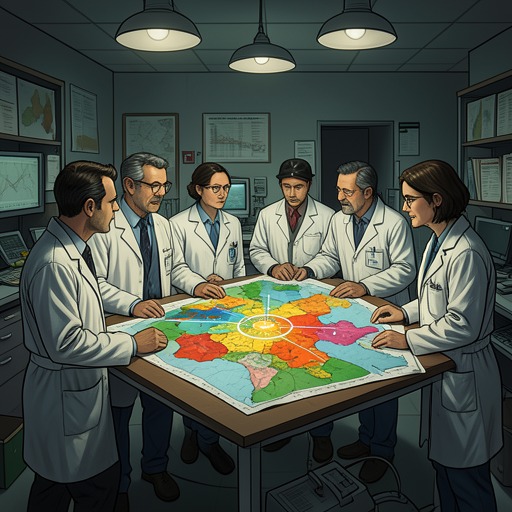
In March 2003, as reports of a severe respiratory disease spread from Guangdong Province to Hong Kong and Hanoi, the World Health Organization organized eleven laboratories from countries around the world to investigate the virus. The University of Hong Kong joined the project alongside laboratories in France, Germany, the Netherlands, Japan, the United States, Singapore, Canada, the United Kingdom, and China. Beginning on March 17, the labs held daily teleconferences, posted electron-microscope photographs, analyses, and test results to a WHO website, and regularly exchanged virus samples.
The collaboration was designed to pursue the cause of the disease while the WHO also tracked its spread. Because SARS was known to pass from person to person, identifying its pathogen could enable testing and perhaps a vaccine. For the University of Hong Kong, the work therefore took place within a shared, urgent investigation: each laboratory could examine evidence while making its findings available for comparison and scrutiny elsewhere in the network.
A finding tested across laboratories
On March 21, scientists at the University of Hong Kong had isolated a virus that appeared to be a likely candidate. On the same day, researchers at the Centers for Disease Control in the United States separately isolated a virus that looked under an electron microscope like a coronavirus—a surprising possibility, since coronaviruses generally cause serious illness in animals but milder effects in humans. Over the following week, laboratories in the network detected the coronavirus in samples from a wide range of people diagnosed with SARS, while teams in Germany, the Netherlands, and Hong Kong began sequencing it.
The University of Hong Kong’s early isolation was important, but it did not by itself establish that the virus caused SARS. The case grew stronger through parallel work on shared samples, comparison of results, and the elimination of other candidate viruses. In early April, monkeys infected with the coronavirus in a Netherlands laboratory developed full-blown SARS; by April 16, only a month after the collaboration began, the laboratories were confident enough to announce that the coronavirus caused the disease.
Collective discovery and scientific authority
The account distinguishes between first spotting a virus and demonstrating that it caused SARS. Cynthia Goldsmith, an electron microscopist at the Centers for Disease Control and Prevention lab in Atlanta, first spotted the coronavirus, but the causal claim depended on weeks of work by laboratories around the world. The University of Hong Kong was among the teams that helped test and substantiate that claim. The discovery was consequently attributed to the laboratories collectively, not assigned to one institution or researcher; the work that ruled out alternative viruses also helped narrow the field.
The network had no director who dictated what each laboratory would study, which samples it would use, or how its work should be divided. The WHO brought the laboratories together, and they agreed to share relevant data and speak each morning, but they worked out the practical division of labor themselves. That arrangement let separate teams investigate at the same time, multiplying the collaboration’s speed and effectiveness. The University of Hong Kong’s contribution thus exemplifies a form of coordination in which shared procedures and information connected independent work without replacing it with top-down control.
The episode also shows how scientific claims acquire standing. The coronavirus caused SARS regardless of when the WHO announced the result, but in scientific practice the claim became established as other researchers scrutinized and accepted the evidence. That community judgment enabled laboratories across the world to begin work on possible tests and vaccines on the premise that SARS was caused by a coronavirus. The university’s role belonged to this wider process: research became a contribution to common knowledge through evidence that others could examine and use.
Significance of the collaboration
The SARS project contrasts the reach of international collaboration with the ordinary limits of researchers’ working relationships. Researchers tend to work near their immediate colleagues; the account notes that academic researchers spend only a third of their time with people outside their immediate work group and only a quarter with people outside their university. The worldwide laboratory network showed how communications technology could make cross-border research both practical and productive, while allowing researchers to contribute distinct expertise.
The investigation also represents science as collective not only because laboratories explicitly collaborate, but because research depends on the open circulation of results. Published findings and available data allow other scientists to check conclusions, construct new hypotheses, or avoid unproductive avenues. In that system, the University of Hong Kong’s early isolation of a candidate virus mattered in combination with the network’s subsequent tests and exchanges: discovery was neither simply a solitary insight nor an automatic sum of disconnected observations, but a claim made credible through coordinated scrutiny.