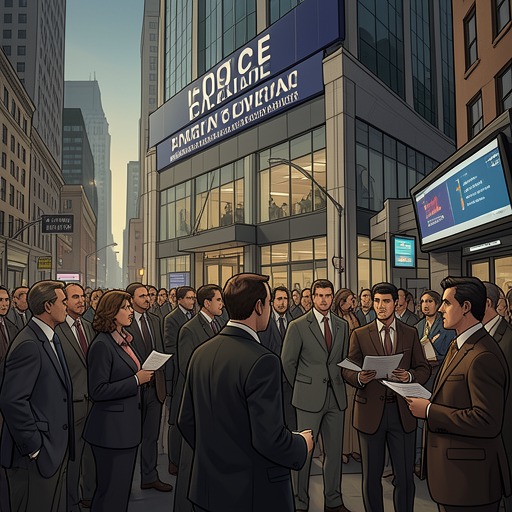
Keynesian beauty contest model
The Wisdom of CrowdsThe Keynesian beauty contest model explains why stock-market decisions can become recursive: investors try to anticipate not only what an asset is worth, but what other investors believe it is worth and what they think the crowd will believe in turn. Its importance lies in showing how a market’s capacity to aggregate judgment can weaken when participants rely too heavily on one another. Imitation can transmit useful information, but when it replaces independent analysis, the market’s collective judgment loses the diversity that helps make it intelligent.
The Contest of Expectations
John Maynard Keynes illustrated professional investment with a newspaper competition: contestants chose six of the prettiest faces from a hundred photographs, and the prize went to whoever chose the faces closest to the competitors’ average preferences. The challenge was therefore not simply to select the faces one personally found most attractive. It was to predict what other contestants would select.
The model’s recursive logic does not stop at guessing the average investor’s view. An investor may try to anticipate what the average investor thinks the average investor thinks, and then continue to add another layer of expectation. Once judgments are organized around these higher-order guesses, it becomes difficult to return to the underlying question of what an asset is actually worth. The market becomes a contest in predicting other people’s predictions.
Independent and Dependent Judgment
The account contrasts the stock market with an ordinary market for apples. A buyer deciding what an apple is worth can draw on personal preference, the quality of the particular apple, the grocer’s asking price, and prior shopping experience. Buyers and producers make many separate calculations; the resulting price reflects those independent decisions.
Stock valuation, by contrast, often involves dependent decisions. Some investors act independently, choosing what they believe are the best companies on the expectation that the market will eventually recognize their value. Others seek investments they believe both attractive and likely to appeal to other investors. Still others concentrate on anticipating the crowd’s preferences. The market is not governed exclusively by any one of these approaches: it is an unstable but often relatively stable mixture of independent and dependent judgment.
How Dependence Inflates a Bubble
Bubbles and crashes occur when that mixture shifts too far toward dependence. In the bowling-stock bubble, investors read the rising prices of American Machine and Foundry and Brunswick as evidence that everyone believed bowling was the next major trend. The stocks’ apparent popularity made them more attractive, and the resulting demand seemed to confirm that they were desirable. Buying shares could appear safe because an investor expected someone else to take them later.
As prices kept rising, the incentive to examine the companies independently diminished. The diversity of opinion that a healthy market requires gave way to a shared conviction: everyone believed bowling was the next big thing because everyone else appeared to believe it too. The cycle shows how a price can cease to be merely a reflection of judgments and become evidence that helps produce further judgments.
The pattern does not mean that bubbles begin with nothing real behind them. Bowling was a popular American pastime in the 1950s; biotechnology changed the pharmaceutical industry; and the Internet was a transformative technology. A bubble can begin as a reasonable attempt to profit from a powerful trend, then turn into something different as investors increasingly trade on what others are doing. The longer a rise continues, the less obviously speculative it can seem. During the Nasdaq’s ascent, leaving in 1998 would have meant missing a 40 percent gain; leaving before 1999 would have meant missing an 85 percent gain. Such gains make it harder to distinguish a bubble from a new normal in real time.
The Market’s Need for Independent Voices
The model does not imply that all reliance on others is harmful. Some piggybacking on collective judgment is inevitable and can be useful: if groups are often intelligent, a stock price may indeed be right. The danger arises when everyone relies on the group and nobody contributes new judgment. The beauty contest can select the genuinely most attractive faces only if some contestants actually consider which faces are most attractive, rather than all guessing what the others will choose.
The discussion connects this vulnerability to Mark Granovetter’s account of collective behavior. A crowd with enough people whose actions remain independent of the crowd is less likely to tip into a riot. Applied to markets, investors who refuse to buy merely because others are buying make a bubble less likely to swell. The more participants treat investment as a prediction of other investors’ expectations, the less robust the market’s judgment becomes; independent assessment helps preserve its capacity to learn.
A Model of Information and Its Limits
The beauty contest is therefore both an account of market behavior and a warning about information aggregation. Markets can collect dispersed judgments, but their success depends on participants adding information rather than merely echoing what the price or the crowd appears to say. The transition from apple prices, grounded in many relatively independent evaluations, to rising bowling shares, each rise reinforcing the next, makes this condition visible.
The model also qualifies any simple celebration or condemnation of imitation. Learning from other people can improve judgment, just as cascading groups in classroom experiments can choose the better alternative more often than any individual. But when sequential choices encourage later decision-makers to suppress private information, the group may lose the very evidence that could correct its course. In markets, the corresponding safeguard is not the elimination of shared expectations but the continued presence of investors who assess value independently. Their judgments keep collective intelligence from collapsing into a contest in which everyone watches everyone else.