Open Science
The Wisdom of CrowdsOpen science is the practice of publishing scientific findings and making data available for inspection, so that knowledge can be tested, challenged, and put to new use beyond the group that first produced it. In the book’s account, openness is not an ornament added to scientific work: it is the mechanism that lets individual ambition and rivalry generate a common body of knowledge. The arrangement depends on communication, recognition, and trust—and is vulnerable when commercial interests reward secrecy instead.
Publication as a scientific institution
Science is collective not only because researchers sometimes collaborate directly, but because it depends on an institutionalized exchange of information. A scientist who publishes a discovery enables others to reconsider the data, dispute the conclusion, or use the results to frame new hypotheses and experiments. The gain is not merely that information travels farther: each researcher’s work becomes material from which other researchers can build. Even unsuccessful hypotheses can help by showing colleagues which paths need not be pursued.
The book traces the institutional form of this principle to the seventeenth-century scientific revolution. In 1665, the Royal Society published the first issue of its journal, Philosophical Transactions. Its commitment to circulating discoveries widely and freely marked a significant break with secrecy as the default. Henry Oldenburg, the Society’s first secretary and the journal’s editor, argued that withholding discoveries impeded progress. He helped persuade scientists to relinquish sole ownership of their ideas in return for recognition as their originators.
That exchange rests on a distinctive feature of knowledge: unlike a material commodity, it is not consumed when another person uses it. Wider circulation can increase its potential value by multiplying the people and purposes to which it is available. The book describes the emergence of open science as a transformation of knowledge about the natural world into something increasingly nonproprietary—a public good communicated broadly rather than reserved to an exclusive few. Open publication thus gives scientific work a route from an individual result to a resource available to the community.
Competition, recognition, and shared knowledge
Open exchange does not eliminate self-interest or competition. Scientists seek attention and recognition from the very peers with whom they must also cooperate. That tension can be productive: researchers have reason to offer new ideas rather than merely repeat established ones, and a critic can gain standing by exposing flaws in another researcher’s work. But neither originality nor criticism can sustain a career in isolation from colleagues’ discoveries, evidence, and responses.
The system makes recognition serve as a reward for disclosure. In the book’s account, scientists publish because recognition brings attention and influence, and because it lets a discovery enter the larger body of scientific knowledge. Their pursuit of individual standing can therefore benefit the community: the route to personal distinction passes through making an idea available to others. Scientific work is competitive and cooperative at once, with openness providing the condition that allows those impulses to reinforce rather than simply cancel each other.
Recognition also has an epistemic role. A discovery’s author may claim that a result establishes a conclusion, but other scientists must examine the work and accept that the evidence supports the claim before it becomes part of the shared fund of knowledge. The book distinguishes this communal acceptance from the underlying truth of a natural phenomenon: the coronavirus caused SARS before the World Health Organization announced that finding. Yet in scientific practice, the claim acquired standing as an established explanation through scrutiny and acceptance by researchers beyond the laboratories that first produced the evidence.
SARS and distributed discovery
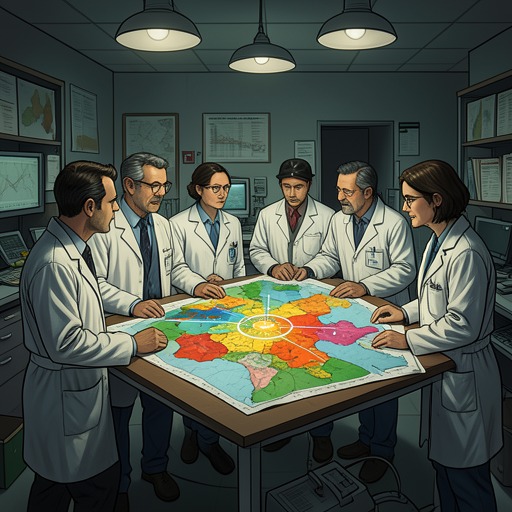
The book’s SARS example makes the collective character of scientific discovery concrete. After receiving a report in early February 2003 that 305 people in Guangdong Province had developed a severe respiratory disease and five had died, the World Health Organization responded to the emerging outbreak with surveillance and an international search for its cause. On March 15 and 16, it contacted eleven laboratories in countries around the world and asked them to investigate the virus together. The laboratories began the collaborative project on March 17.
The participants shared results through daily teleconferences and a WHO website, where they posted electron-microscope photographs, analyses, and test results. They also exchanged virus samples, enabling one laboratory to check and learn from another’s work. Because labs could study the same samples at the same time, they could multiply the speed of investigation. Early candidates were tested and discarded; evidence accumulated across sites rather than depending on a single laboratory’s judgment.
On March 21, scientists at Hong Kong University had isolated a promising candidate, while scientists at the Centers for Disease Control in the United States separately isolated a virus that appeared under the electron microscope to be a coronavirus. That identification was initially surprising because coronaviruses were associated with serious illness in animals but generally mild effects in humans. Over the following week, laboratories detected the coronavirus in samples from many people diagnosed with SARS; researchers in Germany, the Netherlands, and Hong Kong began sequencing it. In early April, infected monkeys in a Netherlands laboratory developed full-blown SARS. By April 16, a month after the collaboration began, the network of laboratories was confident that the coronavirus caused the disease.
The search resists assignment to a single discoverer. Cynthia Goldsmith, an electron microscopist at the Centers for Disease Control and Prevention laboratory in Atlanta, was the person who first spotted the coronavirus. But spotting it was not by itself proof that it caused SARS. That conclusion depended on weeks of work across laboratories, including the elimination of other possible causes. The WHO’s account described the network as having collectively discovered the coronavirus. The organization had convened the participants, but no superior dictated which viruses or samples each lab should examine or how they should exchange information. The laboratories agreed to share relevant data and speak each morning, then worked out the division of labor themselves. Openness here was not only a general scientific ideal; it was an operating arrangement that made parallel investigation and mutual checking possible.
Trust, scrutiny, and the limits of openness
Open science distributes the work of evaluation, but it does not mean that every scientist independently repeats every experiment. Results should in principle be replicable; in practice, most researchers rely on other scientists’ reports rather than reproducing all the evidence for themselves. A hypothesis succeeds in the community partly because researchers find it credible, not because each one has personally tested it. Once an experiment is well established, an unsuccessful attempt to reproduce it may initially lead a researcher to question their own technique rather than reject the accepted result.
That reliance is not presented as proof that scientific truths are merely matters of opinion. Experiments can be replicated, and fraud can be exposed. Rather, it shows that scientific knowledge depends on communication and a continuing supply of shared results, as well as on an implicit trust that other researchers report and handle data fairly. Even an effort to test a result rests on many other conditions and observations that the tester has not independently verified. Openness makes scrutiny possible, but the community cannot function by repeating every step from the beginning; researchers must use judgment about what to trust and what warrants further examination.
The book consequently locates scientific authority neither in one eminent investigator nor in a small committee empowered to pronounce on every claim. A result enters common knowledge through the responses of a wider community, whose acceptance remains provisional and can be revised. There are no literal ballots and no market prices attached to ideas, but the process still relies on collective judgment. The SARS network illustrates one concentrated episode of explicit collaboration; the broader scientific system extends the same dependence through publication, criticism, and reuse across researchers who may never work in the same room.
Commercial pressure and the future of the exchange
The arrangement is not secure simply because open publication has served science well. A growing share of research and development is funded by corporations, whose economic interests may favor protecting information rather than disseminating it. This creates a tension with the scientific tradition of sharing results for recognition and wider use. Public funding, especially for basic research, can insulate science from some commercial pressure. Patents also impose limits on what others may do with an invention, but require the inventor to publish its details, thereby preserving one channel through which information enters circulation.
The conflict becomes especially visible when a company funds a study and then demands that its results be suppressed because they are unwelcome. Such a demand reverses the logic established by the early scientific journal: instead of surrendering exclusive control in return for recognition, the sponsor seeks to control whether findings become known at all. The book does not claim that commerce and science have never coexisted; it emphasizes that their interests can diverge over the treatment of information.
Open science therefore names both a historical achievement and a continuing institutional choice. Its effectiveness rests on scientists’ capacity to publish, inspect one another’s work, and build on results outside the control of their original authors. Recognition helps motivate disclosure, while shared standards and trust allow researchers to use findings they have not personally reproduced. When those conditions hold, private ambition can enlarge collective knowledge; when secrecy or suppression takes precedence, the chain linking discovery to scrutiny and further discovery is at risk.