Plymouth
The Wisdom of CrowdsPlymouth is the setting of the episode that gives the book its central demonstration: at a country fair in 1906, Francis Galton found that hundreds of people, pooling no formal expertise, could judge an ox’s dressed weight with striking accuracy. The place matters not as a portrait of the town but as the ground for a reversal: Galton arrived skeptical of the public’s ability to judge and left with evidence that a crowd could be wiser than he expected.
The Fair and Its Contest
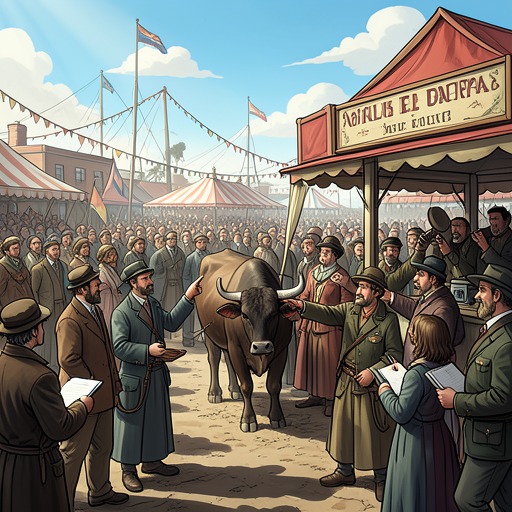
In the fall of 1906, the eighty-five-year-old Galton left his home in Plymouth and went to the annual West of England Fat Stock and Poultry Exhibition. Its stalls displayed cattle, sheep, chickens, horses, and pigs for local farmers and townspeople to appraise. Galton’s interest in livestock reflected his long-standing preoccupation with measurement and breeding, and with the qualities he believed determined whether a society could thrive.
At the exhibition, a fat ox stood at the center of a weight-judging competition. Participants paid sixpence for a numbered ticket, wrote down their names, addresses, and estimates, and competed for prizes. They were asked to predict the animal’s weight after slaughter and dressing, not its weight alive. The contest made individual guesses countable and comparable, turning a fairground wager into material Galton could analyze.
From Public Guess to Statistical Test
Eight hundred people entered. Some were butchers and farmers, plausibly practiced at judging livestock; others had no special knowledge of cattle. Galton saw the mix as resembling a democracy, where people with very different abilities and interests each cast one vote. He regarded the contest as a way to test the judgment of ordinary people, whose capacities he had generally distrusted.
After the prizes were awarded, Galton borrowed the tickets and examined the estimates. Thirteen were illegible, leaving 787 usable guesses. He arranged them from highest to lowest, graphed their distribution to see whether it formed a bell curve, and calculated their mean. That average represented the answer the crowd would give if its members’ judgments could be combined into one.
The Result and Plymouth’s Significance
The crowd estimated that the dressed ox would weigh 1,197 pounds. Its actual dressed weight was 1,198 pounds: an error of just one pound. The result sharply contradicted Galton’s expectation that a mixture of a few intelligent people, many mediocre ones, and many foolish ones would yield a poor answer. Instead, the aggregate judgment was nearly exact.
Galton later called the result more creditable to democratic judgment than he had expected. The episode makes Plymouth more than the location of a striking coincidence: it is where an experiment designed by a skeptic produced evidence for the intelligence of a diverse group. The book uses the scene to introduce its broader claim that, under the right circumstances, groups can make remarkably intelligent decisions without being led by their most exceptional members.