Theory of the firm
The Wisdom of CrowdsTheory of the firm, as developed across the book’s organizational examples, asks how people can work together without losing the knowledge and judgment distributed among them. Its central problem is structural: specialization and local autonomy can make an organization more capable, but only if information and judgments can also travel across its parts. Neither rigid centralization nor fragmentation alone solves that problem; effective firms need ways to connect what people know locally to what the organization must decide collectively.
Firms, Markets, and Coordination
The book situates the firm within a classic question in economic organization. Its references to Ronald Coase’s The Firm, the Market, and the Law, Oliver Williamson’s work on markets and hierarchies, and histories by Alfred Chandler Jr. point to the problem of why production and coordination take place inside firms rather than solely through market exchange. The discussion’s practical emphasis is not that one form always wins, but that organizational arrangements carry costs and shape how people communicate, make decisions, and respond to information.
The broader argument treats coordination as a task that can be accomplished through more than commands from above. A firm brings people together to make them more productive and intelligent than they could be separately. Yet hierarchy can frustrate that purpose when messages must pass through many layers, when employees have little reason to report unwelcome information, or when decision-makers are distant from the work they oversee. A firm’s structure therefore matters not just for assigning authority, but for determining which knowledge becomes available to action.
Local Knowledge and Information Flow
A central principle is that people close to a problem often possess knowledge that cannot readily be summarized or transferred: experience tied to a particular job, place, or situation. Drawing on Friedrich Hayek’s account of tacit knowledge, the book argues that organizations should not assume every problem must be sent up a hierarchy before a solution can be devised. People with relevant local knowledge may be better placed than senior managers to find workable answers.
Decentralization helps preserve that knowledge and encourages specialization and independent judgment. But it has a corresponding weakness: useful information discovered in one part of an organization may never reach other parts. The pre-September 11 U.S. intelligence community illustrates the distinction. Its agencies had specialized perspectives, but lacked a real means of aggregating information and judgments. The book argues that simply putting one authority at the center could ease coordination while sacrificing the diversity, autonomy, and local knowledge that specialization supplies. The institutional need was not centralization for its own sake, but aggregation: making dispersed knowledge collectively useful.
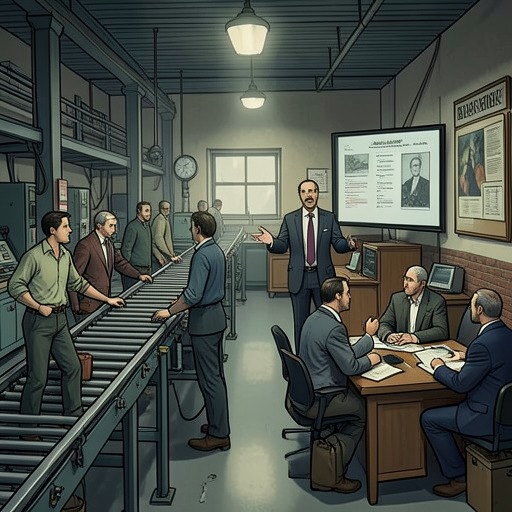
The same tension appears in corporate hierarchy. At Ford in the 1970s, more than fifteen managerial layers separated the chairman from a factory-floor supervisor; Toyota had five. In a General Motors plant in Van Nuys, California, a worker had installed a sunshade bracket for two years without knowing what part of the car it served. Such distance is more than an inconvenience: when workers cannot see how their tasks fit into the process, the organization wastes knowledge that could help prevent mistakes and improve work.
Bureaucratic pathways also impede the movement of ideas upward. A chart reproduced in In Search of Excellence showed that a new product idea at one unnamed company had to pass through 223 possible paths in its bureaucracy before acceptance. The book links such structures to incentives that discourage candid reporting: studies of executives found that anxiety about promotion correlated with less accurate communication of problem-related information, while successful managers often withheld news of fights and budget problems. A firm may possess relevant facts yet fail to act intelligently when its structure makes sharing them professionally risky.
Distributed Authority and Collective Work
The book’s alternative is to distribute meaningful decision-making authority while retaining the ability to coordinate. Decisions about local problems should, as far as possible, be made by people close to them. This principle treats employee involvement not as a gesture of goodwill but as a way to use experience that centralized management cannot fully possess. The book notes that genuine high-performance work systems were uncommon in American companies, even as studies of successful firms found that employees and managers were empowered to make more independent decisions and seek improvements.
Autonomy can also change how people engage with their work. In one study described in the book, participants who could turn off loud, recurring noise solved five times as many puzzles and made fewer proofreading errors than those without that option. No one in the empowered group actually pressed the button; its availability alone mattered. The example supports a broader claim that control over one’s working environment can affect performance even when the power is not exercised.
Decentralization can support coordination as well as initiative. The Toyota Production System trains frontline workers in a wider range of skills and expects them to understand the production process from the bottom up. Rather than isolating workers on a conventional assembly line, Toyota organizes teams with responsibility for their production process. Any worker can pull a cord to stop the line when a problem needs fixing. The cord is rarely pulled, but its presence gives workers a recognized means to intervene, while the team-based system lets them coordinate without constant resort to orders and threats. In the book’s account, this approach reduces the need for supervision and transaction costs while allowing managers to focus elsewhere.
Institutional Design and Its Limits
The cases do not establish that decentralization is always sufficient. Its benefits depend on whether the organization has channels that allow information, concerns, and judgments to circulate. In the intelligence example, agency autonomy and specialization generated distinct perspectives, but without effective aggregation those perspectives did not become a shared assessment. In the NASA Mission Management Team’s review of the debris strike, engineers’ concerns and their request for images of the orbiter wing did not receive a serious hearing. The team’s discussion was hierarchical in practice: its leader posed questions and others answered, while members were not systematically invited to comment. These failures show how formal membership or access to information does not guarantee that a group will use its members’ knowledge.
The book therefore frames organizational intelligence as a matter of matching structure to the work: preserving local expertise while creating reliable means of combining what different people know. The theory of the firm, in this account, is not a simple choice between market freedom and managerial control. It is an inquiry into how institutions distribute authority, create incentives to speak, and connect specialized knowledge. A firm succeeds at collective work when its organization lets people act on what they know and makes that knowledge available beyond the person or team that first acquired it.