Toyota Motor Corporation
The Wisdom of CrowdsToyota Motor Corporation serves as the book’s clearest industrial example of decentralization working as a system rather than as a slogan. In contrast with American companies burdened by layers of management and command-and-control habits, Toyota trained frontline workers to understand production broadly, organized them into teams responsible for their own process, and gave any worker the power to stop the line when something needed fixing. The line-stopping cord was rarely pulled; its importance lay in making authority available where the problem could be seen. That combination of local knowledge, initiative, and coordination is the central significance of Toyota’s model in the book.
Organizational Structure and Contrast
The comparison is made concrete through management layers. In 1980, five levels separated Toyota’s head from a factory-floor supervisor; at Ford, fifteen levels stood between the chairman and the factory floor. The contrast is not merely a matter of corporate size or organizational chart. The book argues that when decisions must climb through many layers and instructions travel back down, coordination consumes time, demands information from executives who cannot possess all the relevant detail, and weakens the initiative of workers and managers. Toyota’s shorter chain provides a contrasting structure, one more compatible with action informed by people close to the work.
The difference also helps explain why decentralization is not simply the absence of coordination. A company still needs its separate activities to fit together. Toyota’s example shows that coordination can arise through shared responsibility and an understanding of the production process, rather than relying only on managers issuing orders. The book’s larger argument is that good organization must preserve the specialized knowledge gathered in particular jobs while making it useful to the organization as a whole.
The Toyota Production System
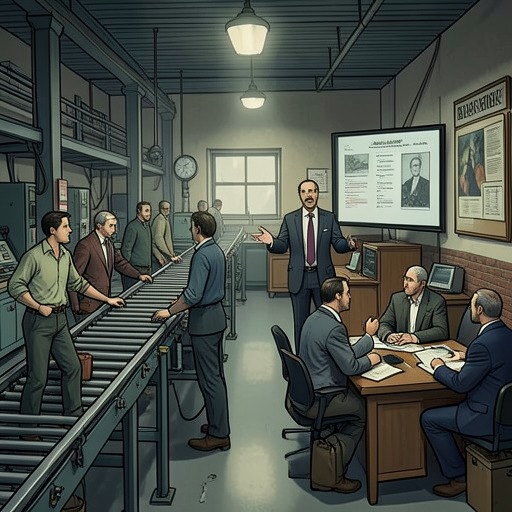
At the core of the Toyota Production System is the expectation that frontline workers will be trained in a wide range of skills. They are also expected to understand how production works from the bottom up, so they can respond to the process as a whole rather than attend only to a narrow, isolated task. In place of the classic assembly line, where each worker may be confined to one part of a vehicle and separated from the people around them, Toyota uses teams that are effectively in charge of their own production process.
The stop cord gives this arrangement a visible form. Any worker who sees something that needs to be fixed can pull it and halt the production line. The book stresses the seeming paradox: the cord is rarely pulled, yet its availability matters. As in an experiment where people performed better simply because they knew they could control an irritating noise, having the power to intervene can change how workers engage with their conditions even when they do not exercise that power. Toyota’s arrangement therefore joins practical authority with a less visible effect: responsibility is present in the everyday organization of work, not reserved entirely for managers.
Local Knowledge and Coordinated Work
The reasoning behind Toyota’s system connects to a broader claim about decentralized organizations: people closest to a problem are often best positioned to find a workable solution. Local and tacit knowledge—knowledge acquired through experience in a particular job or setting—may not travel easily upward in a hierarchy, but it can be crucial to efficient decisions. Giving workers authority to address problems where they arise allows that knowledge to be acted upon without requiring every solution to be filtered through a chain of command.
In Toyota’s teams, decentralization is also presented as a means of improving coordination. When workers understand the larger production process and can respond to its needs, the company can rely less on constant orders and supervision. This reduces the costs of directing and monitoring work and leaves managers freer to concentrate on other responsibilities. The point is not that management disappears, but that coordination can be supported by informed, capable workers rather than produced solely by top-down control.
Significance and Limits
Toyota stands in the book as a counterexample to the assumption that factories require tightly controlled, narrowly divided labor. The traditional assembly line might appear to make centralized coordination natural, but Toyota’s transformation of auto production suggests that even industrial work can benefit from broader skills and frontline responsibility. Its model is especially relevant as more work depends on service and intellectual labor, where treating employees as interchangeable cogs is poorly suited to the knowledge the work requires.
The book’s claim is not that every corporate decision should be decentralized or that hierarchy can be abolished. Some decisions, such as who will be fired, remain concentrated at the top. Rather, different problems call for different arrangements, and coordination and cooperation are often susceptible to decentralized solutions when workers hold the knowledge needed to address them. Toyota’s production system makes that principle tangible: authority is distributed close to the work, while the shared process and team structure connect individual decisions to the company’s collective task. The cited account of the system is James P. Womack, Daniel T. Jones, and Daniel Roos’s study, The Machine That Changed the World: The Story of Lean Production.