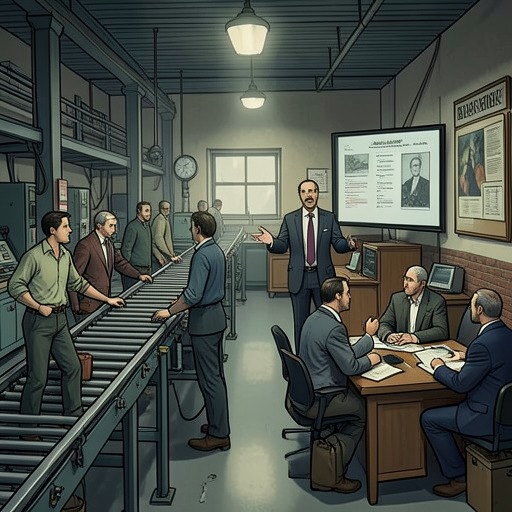
Transaction costs
The Wisdom of CrowdsTransaction costs are the work required to make cooperation function: finding information and people, bargaining over terms, deciding what to do, monitoring performance, and enforcing agreements. The concept explains why firms do not outsource every task, why one-off teams can be difficult to assemble, and why organizational design must weigh the costs of coordination against the benefits of autonomy and diverse knowledge.
Definition and the firm
The economist Ronald Coase offered what the book calls the oldest and still the best answer to why firms exist rather than outsourcing everything. A company that relied on separate outside providers would have to spend time and effort finding suitable people, negotiating prices, checking that promises were kept, and settling what each party was owed. Coase called these burdens transaction costs, including search and information costs, bargaining and decision costs, and policing and enforcement costs.
A company can reduce such costs by keeping work within an established organization. If a worker’s email fails, calling the office technician is easier than finding and contracting with an outside company. Keeping employees on hand can also be more efficient than searching for talent anew whenever a project arises; planning future work is simpler when a corporation can draw on thousands of employees. Large, long-horizon investments illustrate the point: it is difficult to imagine anyone but a corporation financing a semiconductor plant that costs $2 billion and will not begin production for three years.
The trade-off between in-house work and outside alternatives
Reducing transaction costs does not mean that a firm should do everything itself. Keeping work in-house makes coordination quicker and avoids bargaining, but it can cut the organization off from alternative suppliers and ideas. Outsourcing can be worthwhile when the wider range of available contributors is more valuable than the effort required to arrange each deal.
The book uses its own publishing arrangement to show the trade-off. Its author did not work for Doubleday as a full-time writer; instead, he signed a contract to produce a book the publisher would sell. Doubleday could theoretically employ writers on staff, avoiding repeated negotiations with authors and agents. It nevertheless left the door open to many writers because it believed that doing so improved its chances of publishing interesting books. Multibook deals offer one way for publishers and authors to reduce the repeated work of negotiating one book at a time.
A company’s choice also depends on what it values most. Zara could have a factory in China cut and dye its fabric, which might cost less, but that arrangement could undermine the company’s distinctive ability to respond quickly and precisely to consumer demand. In the book’s account, Zara places speed and control above sheer cost. The broader point is not that in-house production is always superior, but that firms compare the costs of contracting with the value of flexibility, control, and access to alternatives.
Collective action and the cost of assembling groups
Transaction costs also illuminate the difficulties of collective action. Doing work in-house can mean limiting the number of outside information sources and alternatives available to an organization. In exchange, it offers quicker action and avoids repeated bargaining. Firms therefore face a trade-off between drawing on a wider field of knowledge and coordinating action within a stable structure.
A temporary team assembled for a single job makes the costs particularly visible. Such a group can select people for complementary abilities, such as planning, safecracking, or handling explosives, and the one-off project gives members an incentive to perform. But putting the team together takes work; members may pursue their own interests rather than the group’s; and, because they do not know one another, they can expend considerable effort establishing each other’s bona fides. Unlike ordinary businesses, jewel thieves cannot use contracts to ensure that members fulfill their responsibilities.
No organizational form removes these costs altogether. The book describes companies such as Zara as trying to combine the institutional coherence of a conventional corporation, the close working relationships of small groups, and access to outside workers and thinkers. Transaction costs help explain why the practical choice is often a blend of organizational forms rather than a simple decision between hierarchy and the market.
Coordination, local knowledge, and information flow
Reducing the need for supervision can itself lower transaction costs. Toyota’s production system trains frontline workers in a broad range of skills and gives them responsibility for understanding and improving the production process. Rather than isolating each worker at a narrow task, Toyota organizes workers into teams that manage their own production process. Any worker can pull a cord to stop the line if something needs fixing; the cord is rarely pulled, but its availability matters. The example presents coordination as something workers can accomplish through knowledge and initiative, not only through orders and enforcement.
Decentralization can likewise make local knowledge useful. People close to a problem may have experience that is difficult to summarize or transmit to distant managers. The challenge is to let individuals specialize and develop such knowledge while still connecting it to the wider organization. In the book’s account, good organizational design avoids automatically filtering every problem up a hierarchy and every solution back down: people with local knowledge may be best placed to find workable and efficient answers.
Yet distributing responsibility is not enough if information cannot travel or judgments cannot be combined. The book contrasts the intelligence community before September 11, where separate agencies held fragmented information without an effective means of aggregating their assessments, with the general need to make specialized knowledge collectively useful. It also describes NASA’s Mission Management Team as failing to hear the Debris Assessment Team’s concerns adequately: the engineers’ request for images of the shuttle wing did not receive serious consideration, and the meeting’s structure limited debate. These cases show that organizational costs include the obstacles to sharing and assessing information, not merely the price of formal contracts.
Why the concept matters
Transaction costs explain both the usefulness and the limits of organization. Formal arrangements can save the repeated effort of searching, bargaining, monitoring, and enforcing, but hierarchy may also restrict alternatives, local knowledge, and dissent. Conversely, relying on independent contractors or loosely connected groups can widen access to expertise while making coordination and trust more burdensome.
The concept therefore belongs to a larger question about how groups act together. The relevant comparison is not simply whether a task is cheaper inside or outside a firm. It is whether an arrangement’s costs of coordination and control are worth paying for its speed, information, flexibility, and reliability. An organization works well when it reduces needless bargaining without sacrificing the knowledge and independent judgment that cooperation is meant to bring together.