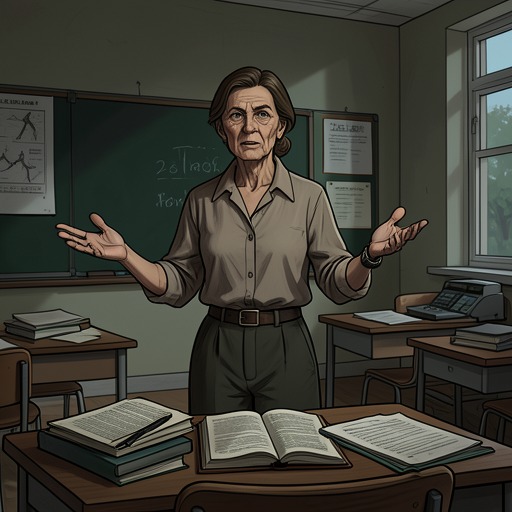
Ernie Holm and Helen Holm
The World According to GarpErnie Holm and Helen Holm share a father-daughter bond formed through abandonment, solitary parenting, and the wrestling rooms that become Helen’s childhood refuge. Ernie raises his only child after her mother leaves without explanation, while Helen grows up both deeply attached to her father and alert to the possibility of finding the mother she has lost. Their relationship brings the novel’s recurring concerns with care and absence into intimate focus: Ernie can provide warmth and stability, but he cannot answer the question Helen carries about her mother.
Identity and Background
Ernie arrives at Steering as its new wrestling coach, bringing a past as a two-time Big Ten wrestling champion at the University of Iowa. He has spent fifteen years coaching high schools across Iowa while raising Helen by himself. Tired of the Midwest, he moves East partly to secure what he regards as a classy education for his daughter, whom he calls the brains of the family. His pride in Helen is plain, even as the account distinguishes what he says about her intelligence from what he keeps to himself about her looks.
Helen’s childhood is shaped by her father’s work and by the absence of her mother. When Helen was born, her mother, a nurse, gave up nursing to become a full-time parent. After six months she wanted to return to nursing, but there were no day-care centers in Iowa at the time. The strain of full-time motherhood and life as an ex-nurse gradually distanced her from Ernie; one day she left, giving him no explanation and leaving him to raise their daughter alone.
Growing Up in the Wrestling Room
Ernie’s profession supplies more than a living: it gives Helen a place to grow up. She spends her childhood in wrestling rooms, which are padded and warm, and thus described as safe for children. Books keep her from boredom there. Ernie, however, worries that her studiousness cannot continue to be nourished in what he sees as a vacuum, and suspects that she has inherited a disposition toward boredom.
That worry echoes a sensitivity Ernie himself has to people who are bored. It also helps explain the attention he gives Helen’s inner life: he does not only provide a safe place beside the wrestling mats but thinks about whether that place can sustain her. The account does not suggest that he can remove the limitations of their circumstances; instead, their closeness is built through the ordinary years of his work and her presence in the rooms where he coaches.
The Absent Mother
Helen’s bond with Ernie coexists with a persistent search for the mother who disappeared. She keeps watch for nurses, hoping to encounter her absent parent, while Ernie makes no attempt to find his former wife. His handling of the loss is not simply a matter of explanation or closure: he offers Helen a story that leaves open the possibility of recognition. In it, a pretty nurse may appear not knowing where she is or who Helen is, yet may be curious to find out.
The imagined reunion is tender but unresolved. Ernie’s story gives shape to a hope he cannot fulfill himself, and Helen remains on the lookout for the nurse who might be her mother. The contrast between his failure to search and his willingness to tell this fable makes the relationship complicated: he does not erase Helen’s longing, but he helps her imagine what a meeting might be like.
That possibility briefly enters the real world when Helen mistakes Jenny Fields for her mother. Ernie tells Jenny that his daughter thought she was her mother and explains that Helen has not seen her mother in quite a while. The encounter links Helen’s persistent hope to Jenny, whose nursing presence has significance elsewhere in the story, but it does not establish that Jenny is Helen’s mother. Ernie’s remark instead makes the depth and duration of Helen’s absence unmistakable.
Care Across Generations
Ernie’s history of raising Helen alone provides a context for the care she later gives others. After the family’s car accident and during recovery at Dog’s Head Harbor Hospital, Helen spends much of her convalescence in Duncan’s room, reading to him. She can speak, though she says little, and the account notes that she has only two stitches in her tongue. Her quiet presence and reading make care a practical, sustained activity rather than an explanation of what has happened.
Helen also recognizes that the family’s needs are divided. She tells Jenny that they knew their stay would be necessary but temporary; later, she hopes Jenny can nurse Garp while she calms herself by nursing Duncan. The account says that Jenny could deal with Garp better than Helen could during this period. Helen’s reliance on Jenny does not diminish her own role: she tends to Duncan while accepting help for herself and for the wider family.
Significance of the Relationship
The relationship between Ernie and Helen is defined by both security and a lasting absence. Ernie’s coaching gives Helen a warm, padded place to grow up, and his move East reflects his intention to give her a better education. Yet he cannot replace the mother who left, and he does not seek her out. Helen’s watch for nurses and Ernie’s imagined story preserve the possibility of reunion without resolving it.
Later, Helen’s care for Duncan provides a quiet echo of the family life she knew with her father: attention is expressed through presence, reading, and the work of keeping another person company. Across these episodes, the father-daughter bond is neither reduced to Ernie’s provision nor defined solely by their shared loss. It is a relationship in which protection and affection coexist with what neither parent nor child can repair.