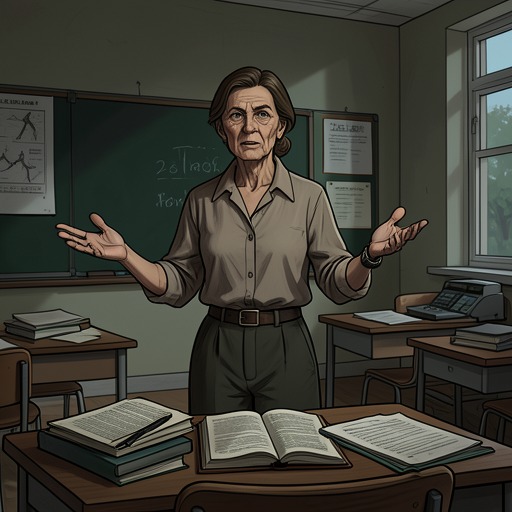
Helen Garp’s lifelong widowhood and grief
The World According to GarpHelen Garp’s lifelong widowhood and grief shape the long aftermath of Garp’s death: she never remarries, preserves the objects and records through which he remains present, and understands herself as the mother of three children who survived him. Her bereavement is neither a simple retreat from intimacy nor a grief that fades into the past; it becomes a lasting condition of memory, anger, work, and care for the family’s history.
The Making of a Widow
Helen’s attachment to Garp is marked by the fact that his death came while she still had a life ahead of her. She would later say, bitterly, that he had died too young and left her to spend so much of her life alone. She also said he had spoiled her for seriously considering life with another man. Her widowhood, then, was not merely a social status: in Helen’s account, it was the consequence of a particular marriage and a loss that continued to shape her choices.
Her grief did not erase her capacity for other relationships. Helen had lovers, but never remarried. The distinction matters: the narrative does not describe her as having withdrawn from all intimacy, but shows that no later relationship displaced Garp. Each lover encountered his continuing presence in her memory and in the facts she kept around herself. Her life after his death could include new attachments, but it remained organized in relation to the one she had lost.
Memory Kept in Objects
At the Steering mansion, which Helen rarely left, Garp’s books, Duncan’s photographs of him, and his wrestling trophies surrounded her. These were not incidental possessions in the account of her widowhood. They made memory part of her daily environment: the absent husband was recalled not only inwardly but through books he had written, images made by their son, and objects associated with his athletic life. The collection held different versions of Garp together, as author, father, and wrestler.
That material remembrance also stood against the biographers who waited for Helen to die so they could claim access to Garp’s life. She protected his letters, the unfinished manuscript of My Father’s Illusions, and most of his journals and jottings. To those seeking the private remains behind the public author, she gave the principle Garp himself would have used: “Read the work. Forget the life.” Her guardianship thus joined grief to a deliberate boundary: she preserved his papers without allowing biographical curiosity to take possession of him.
Anger, Work, and Continuing Ties
Helen’s grief could turn into anger rather than sorrow. She explained only once that Garp’s death was, in a sense, a kind of suicide, then clarified that she meant he had made people too angry. The remark recast his death through the conflicts of his life, without suggesting that he had literally killed himself. It also shows how Helen’s memory remained unsparing: love did not require her to soften her judgment of what his actions had brought about.
She built a distinguished life of her own at the Steering School, becoming one of its most respected teachers while retaining her sarcastic view of the institution. Her work and friendships did not cancel bereavement, but they gave it a setting beyond the private house. She had a few friends there, including Dean Bodger and the scholar Donald Whitcomb; her long friendship with John Wolf endured despite her only partial forgiveness of his role in making Garp successful. These relationships show Helen living among others while continuing to reckon with what Garp’s fame and death had done to her.
Helen remained especially close to Roberta Muldoon. The two women sometimes went together on Roberta’s outings in New York City, and as they grew older they presided, with increasingly eccentric authority, over the Fields Foundation. Their sharp running commentary became a small attraction at Dog’s Head Harbor. When loneliness or boredom overtook Helen at Steering, she went to stay with Roberta at the old estate. After Roberta died, Helen appeared to age twenty years. That reaction makes clear that her later life contained further attachments and losses, even as Garp’s absence remained its defining wound.
The Family That Survived Him
Helen continued to think of herself as a widow with three children: Duncan, baby Jenny, and Ellen James. All three survived her and wept copiously at her death; they had been too young and too astonished to grieve as fully for Garp. This understanding of family extends beyond biological parenthood. It includes Ellen, whom Garp took into the family, and makes Helen’s later identity inseparable from the people who carried the household forward after his death.
The family’s memory of loss also appears in Duncan’s art. In his best-known series, Family Album, he painted from photographs he had taken as a child after his eye accident: Roberta, his grandmother Jenny Fields, his mother swimming at Dog’s Head Harbor, and his father running on the beach with his jaw healed. In large group portraits, critics recognized Walt in a blank face or in a small repeated figure turned away from the camera. These paintings do not restore the dead, but give absence a place within images of family. Helen’s continued life amid photographs and Garp’s belongings belongs to the same work of keeping the lost present without pretending that they have returned.
Later Life and Death
Helen lived a long life and, very late in it, complained to Duncan that she had outlived all her favorite contemporaries. She then suffered a sudden illness affecting the body’s mucous membranes and died in her sleep. The ending gives her own death a quiet finality after a lifetime marked by survival, remembrance, and successive bereavements.
Her long protection of Garp’s papers and her insistence on reading the work rather than mining the life leave her with an active role in shaping his legacy. Yet her grief is not reduced to that guardianship. She also taught, wrote respected articles of her own, maintained friendships, loved her children, and endured the deaths of those close to her. The enduring significance of her widowhood lies in this double movement: Garp remained central to the life she built after him, but that life continued to belong to Helen.