Pension Grillparzer
The World According to GarpPension Grillparzer is the Viennese hotel at the center of Garp’s embedded story, “The Pension Grillparzer.” It first appears as a struggling Class C pension that wants a B rating, inspected by a family working for the Austrian Tourist Bureau; its uneasy guests and the grandmother’s imagined menace turn an ordinary lodging assessment into a comic, increasingly ominous encounter. Years later, the narrator returns to find the pension fallen from the ratings altogether. The altered establishment holds together the story’s concerns with performance, death, and the erosion of the past.
Setting and first inspection
The narrator’s father works for the Austrian Tourist Bureau as a spy assessing hotels, restaurants, and pensions. The narrator’s mother decides that the family should accompany him on these missions. The children are instructed to be civilized but troublesome: they make unusual requests, create difficulties, and report their observations to their father in the car. The pension belongs to this system of scrutiny, in which a family’s everyday behavior becomes an instrument for testing hospitality and service.
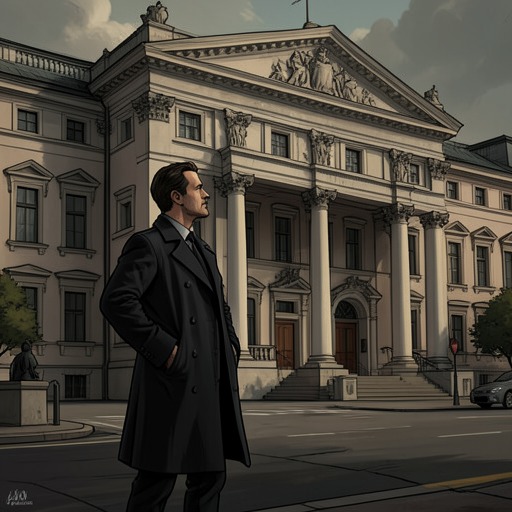
The family drives inconspicuously to the dark, dwarfed corner of Planken and Seilergasse, searching for a Class C pension that wants to be a B. With no place to park, the narrator double-parks while his father makes a note. From the car they peer up at the building: just four slender stories between a pastry shop and a Tabak Trafik. The cramped exterior gives the inspection a deliberately modest stage; the family first approaches the place not as travelers seeking comfort but as evaluators deciding whether its claims can withstand examination.
The pension’s name also anchors the story’s title, which Garp has chosen for the tale he is writing. Within that embedded fiction, the narrator recounts events from his family’s life, while the hotel becomes the site where its professional and private worlds meet. Its modest dimensions contrast with the outsized fears and strange figures that gather around it.
Guests, rating, and the menagerie
Before the family arrives, the pension has already become an object of the grandmother’s fearful imagination. She expects a place frequented by men disguised as animals, pictures guests dying in their beds, and fears an assailant in a foul bear suit. Robo counters hopefully that the supposed monster may be a real bear, which he finds less frightening than the ghoul his grandmother imagines. At the hotel, the father observes that there are no bears; the grandmother remains wary of the possibility that there may be men.
The inspection eventually brings the family face to face with the pension’s other guests, a menagerie whose disruptions have upset the evening. In the breakfast room, the father confronts Herr Theobald, the proprietor, and appears ready to reveal that he is a Tourist Bureau spy. Among those present are men who walk on their hands, and one of them remarks that the father is the only person there who never makes fun of him. The scene complicates the inspection: the guests are not simply evidence of disorder but people exposed to ridicule, while the father’s professional judgment is linked to his conduct toward them.
Herr Theobald asks the grandmother to believe that the guests meant no offense. He explains that these are hard times, that he needs the B rating to attract more tourists, and that he cannot bring himself to throw out Circus Szolnok. The dream man rejects this appeal to the proprietor’s heart, saying that Herr Theobald is afraid of his sister and would not dare remove the circus. Another guest adds that if the proprietor had dreamed of doing so, the dream man would know it. The rating thus depends on more than the building’s physical qualities: it is entangled with the proprietor’s economic need, loyalties, and fear.
Return and decline
After the narrator’s parents have died, he gives up smoking and takes up traveling again. He returns to Pension Grillparzer with his second wife; with his first wife, he had never got as far as Vienna. The return makes the journey to the hotel a measure of changed circumstances: the narrator revisits a place linked to childhood and family only after the people who first brought him there are gone.
The pension has not kept its B rating for long and, by the time of his return, has fallen out of the ratings altogether. Herr Theobald’s sister is now in charge. The narrator describes her former tart appeal as replaced by a sexless cynicism, and notes her bronze-dyed hair and shapeless appearance. She does not recognize him and becomes suspicious of his questions, apparently concluding that his detailed knowledge of her former associates means he is with the police. The narrator’s return therefore yields no simple restoration of the past: even the person who once belonged to the pension’s world cannot recover his place there through recognition.
The old guests have also dispersed. The Hungarian singer has gone away, another woman having been thrilled by his voice. The dream man has been taken to an institution after his dreams turned to nightmares and his nightly howls woke the pension. Herr Theobald’s sister links his removal almost simultaneously with the loss of the B rating. The story leaves the pension diminished in both its official standing and its former company, while its remaining custodian treats the narrator’s questions as a threat.
Narrative significance
The hotel’s career gives the embedded story a structure of return and subtraction. On the first visit, its Class C status and aspiration to a B rating set a comic administrative problem in motion; in the breakfast room, that system collides with the complicated lives of the guests and the proprietor’s attachment to Circus Szolnok. On the later visit, the rating has disappeared, the guests are gone, and the sister who runs the place does not remember the narrator. The pension’s changing status registers the passage of time through concrete losses rather than through an abstract account of aging.
The story also lets a place hold contrasting kinds of uncertainty. The family arrives under the father’s rational, written inspection, while the grandmother’s fearful expectations and the guests’ unsettling presence make the pension seem governed by dreams as well as by ratings. The later report of the dream man’s nightmares brings the imagined and the institutional into contact without turning the hotel into a supernatural location: the pension is a working establishment, yet its guests make ordinary categories of order and safety feel unstable.
For Garp’s larger narrative, the embedded story offers an early view of his imaginative method. His mother finds the tale unreal in relation to what she has spent more than a year doing, while Helen later identifies its conclusion as a glimpse of the world according to Garp. Pension Grillparzer is where that fiction gathers its recurring materials—comedy, vulnerable outsiders, dreams, and death—without making them cancel one another. The return to the unrated hotel completes the story’s movement from a family’s lively inspection to a place altered by time and bereavement.