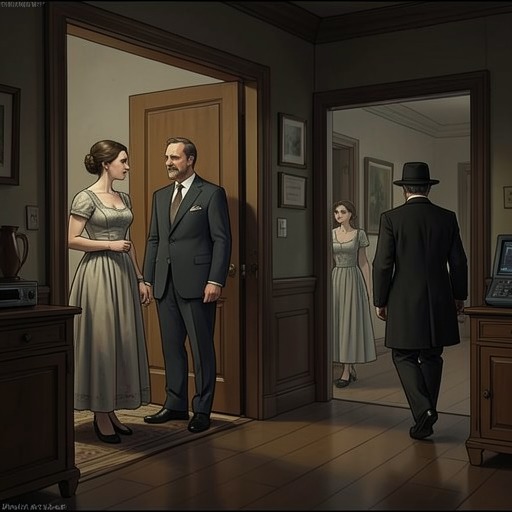
Sally Devlin
The World According to GarpSally Devlin is the woman running against New Hampshire’s incumbent governor while Jenny Fields and Roberta Muldoon help organize her campaign. Presented as educated, idealistic, and kind, she becomes a target of partisan suspicion and, after Jenny’s assassination, of a gendered judgment that treats visible grief as proof of political incompetence. Her brief but consequential role shows how the public can welcome a woman’s candidacy while policing the emotions that accompany it.
Candidacy and Political Climate
Devlin’s campaign unfolds amid a local backlash against the attention Jenny Fields and Dog’s Head Harbor have drawn. The New Hampshire press depicts divorced women arriving from New York as agents of sexual and political disruption, attaching fears of promiscuity, socialism, alimony, and so-called Group Female Living to the community. Dog’s Head Harbor is described as a center of this alleged movement and branded the den of the radical feminist Jenny Fields. These accusations form the hostile atmosphere around the campaign rather than evidence about Devlin herself.
The incumbent governor contributes to that atmosphere by claiming that venereal disease has increased and associating it with women he calls Liberationists. The narration identifies him as a liar. Against him, Devlin appears educated, idealistic, and kind, while barely restraining her anger at the causes and attitudes represented by his administration. Jenny and Roberta are involved in her campaign, along with what Jenny calls teams of New York divorcees. The contrast is between Devlin’s rooted local life and the outsider image her opponents exploit: she has lived in New Hampshire for fifteen years, and her children have attended school there, yet supporters of the incumbent largely disregard those facts.
Public Image and the Reception of Garp’s Novel
The political climate overlaps with a dispute about how women and feminism are represented in T. S. Garp’s fiction. In the only New Hampshire newspaper with statewide distribution, Garp’s novel is called the new feminist Bible, while a West Coast reviewer describes it as a hymn to moral depravity and sexual danger. A popular magazine publishes a dissenting feminist review of The World According to Bensenhaver, arguing that the novel upholds a sexist view of women as prey and of men as their protectors. The book’s reception thus supplies another contested public language through which women’s independence and men’s authority are debated.
Jenny is also persuaded to review her son’s novel. She calls it his best because it takes its most serious subject, but criticizes repeated male obsessions that could weary women readers; she nevertheless judges him a good, still-developing writer whose heart is in the right place. These competing assessments do not establish Devlin’s views on the novel. They show instead that her campaign takes place within a wider struggle over feminism, public authority, and the interpretation of women’s lives.
Jenny Fields’s Assassination and the Memorial
After Jenny is assassinated, Garp watches the news from his landlady’s television in Vienna. The broadcast shows an election event at a New Hampshire shopping plaza, a few miles from Dog’s Head Harbor. Pickup trucks circle the lot, carrying men in hunting clothes who appear to represent local interests opposed to those associated with the New York divorcees. Devlin is visible as the woman challenging the governor, but the campaign setting is now overshadowed by the murder of the person who helped her campaign.
At Jenny’s memorial, Devlin speaks quietly about why Jenny mattered beyond her public notoriety. She says the murder itself is senseless, then points to Jenny’s patience and generosity toward women in difficulty: anyone who has ever received help from another person, she argues, should feel terrible about what has happened. The speech connects Jenny’s political significance to acts of personal assistance. It also makes Devlin’s response to the assassination publicly legible: she is not merely a candidate commenting on an event, but someone whose grief is bound up with the loss of a generous ally.
Grief Recast as Political Failure
As Devlin tries to continue her speech, emotion overwhelms her, and she cannot find her place on the page. Garp hears the women around him respond with a collective sob; Roberta’s shoulders shake beside him, and another woman grips his shoulder. The scene gives Devlin’s grief a communal setting, linking the loss of Jenny to women who feel connected through having received help from her. Devlin does not leave the platform when someone tries to assist her.
The aftermath turns the episode into a measure of unequal standards. A cab driver dismisses Devlin as an idiot and says she could not be governor if she could not control herself. Garp recognizes the pattern: Devlin’s public display of grief is treated as proof against her competence, and he imagines that the incumbent may have framed her loss of composure as characteristically feminine. The text does not confirm that the governor made this remark; it shows Garp reading the political consequence of the scene. Devlin’s sympathy for Jenny becomes the occasion on which opponents and observers recast feeling as incapacity, while Garp is left ashamed not only of the cab driver’s judgment but of the wider public that accepts it.