Seabrook Gymnasium and Field House
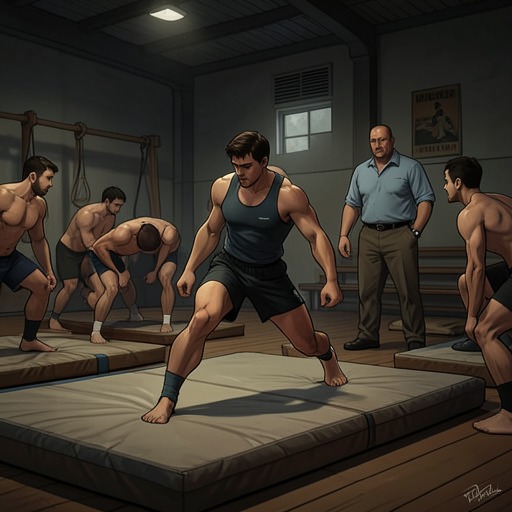
The World According to GarpSeabrook Gymnasium and Field House is Steering School’s immense athletic complex and one of the novel’s defining recurring locations. Named for athlete and World War I flying ace Miles Seabrook, it houses an elaborate memorial to athletic and military prowess, a world of strenuous competition that Jenny Fields distrusts, and the padded wrestling room that shapes Garp’s life. Its meanings converge in the room where Jenny enrolls her son, where Garp and Helen first become lovers, and where Garp is ultimately shot dead.
Setting and Memorial
On a gray, icy December day, Jenny crosses Steering’s winter campus toward a gym she has never visited in her fifteen years at the school. From among the playing fields, hockey rinks, and tennis courts, the building looms over her like a battle she had not anticipated. The scale of the athletic grounds makes her feel like an outsider entering a powerful institution whose importance to her son she has not understood.
The entrance displays a triptych of Miles Seabrook, whose name also belongs to the adjoining stadium and ice hockey rinks. A photograph presents him as a football player, and a locked trophy case preserves his moth-eaten jersey beneath a sign identifying it as his actual shirt. Another image shows him as a hockey goalie, scarred and heavily padded, while posted scores commemorate Steering’s annual contests against Bath Academy. In the third portrait, Seabrook wears a flight suit; the narrative notes that he shot down sixteen German planes before the Germans scored on him. Dusty medals, ribbons, and the remains of his last hockey stick extend the display into an altar to the warrior-athlete.
Jenny’s Encounter with the Gym
The memorial’s celebration of protection troubles Jenny. As a school nurse, she has seen football and hockey players injured despite helmets, masks, straps, and pads; her memories of soldiers, including Garp’s father, make the protection offered by military uniforms seem just as illusory. The building therefore embodies not simply athletic achievement but Jenny’s suspicion that masculine institutions honor danger while pretending to guard against it.
She avoids the arena-sized spaces where contests are underway and searches the darker corridors for offices. The smells intensify her alienation: disinfectant recalls hospitals and the infirmary, while the sweat and forced exertion of generations of boys make the building seem saturated with competition and disappointment. Near a weight room she hears iron crashing and strained exertion. After seeing a bleeding, vomiting wrestler leave a corridor, Jenny steps into the wrestling room, where the warm, yielding mats and walls make the space feel like a padded cell. The coach’s command to shut the door closes her into an environment whose heat and physical intensity she finds disorienting.
Yet the room also changes her sense of safety. When Jenny returns to it alone after meeting the coach, Ernie Holm, she turns off the lights and heaters, removes her shoes, and walks across the mat. Though wrestling appears violent, the contained, padded room feels safe to her. She tests the mat by dropping to her knees; the physical space, rather than her passing impression of Ernie, accounts for her sense of reassurance. Her response complicates the gym’s earlier image as a dangerous machine: its padding and enclosure can signify shelter as well as impact.
Enrollment and Garp’s Family Life
Jenny’s visit culminates in a practical decision: she tells Ernie that she has come to sign her son up for wrestling. The enrollment brings Garp into the sport and into the room that becomes central to his identity. The building thus marks a change in Jenny’s relationship to Steering athletics: she has entered a world she did not know mattered and chosen to let her child take part in it.
Years later, Garp brings his young son Duncan to the same wrestling room and rolls him around on its mat, telling him that this is where his father wrestled. Helen adds that it is also where Garp did everything, recalling their first rainy night together in the locked, empty gym. On the warm crimson mats stretching wall to wall, she had told him that he had finally got her; Garp, sprawled on his back, wondered which of them had got the other. The room therefore holds two generations of meaning: it is both the place Garp associates with his own childhood sport and the setting of his beginning with Helen and, in turn, the conception of their son.
The complex also frames Garp’s public milestones. During his graduation, heavy rain turns the campus into a sodden landscape, and diplomas are handed out beneath a great crimson tent erected in front of the gym. The speeches are nearly lost beneath rain beating on the canvas; the ceremony is hurried, and people leave without lingering. Set against this dismal commencement, the building serves as a fixed marker for Garp’s departure from school and the beginning of life beyond Steering.
The Wrestling Room and Garp’s Death
Garp’s connection to the gym persists into adulthood. He returns to Steering as a wrestling coach, runs from Buster’s Snack and Grill to the gym, and prepares for practice in its steamy trainer’s room. He coaches the boys in the same heated environment where he wrestled, watches the time clock, and directs drills. Helen has an established place in the room too: she sits in a corner where she is unlikely to be knocked down, reading while practice proceeds. Their ordinary routines give the room a lived-in domestic familiarity, not merely the function of a school facility.
That familiarity is shattered when Bainbridge Percy enters disguised in a Jenny Fields nurse’s uniform, with a gun. During practice, the first shot forces the whistle from Garp’s mouth and sends the time clock flying; the second strikes his chest. Helen tackles Bainbridge before she can fire again, and the wrestlers help subdue her. The mats that once signified cushioning and the whistle and clock that organized practice become the immediate surroundings of an irreversible attack.
Dean Bodger enters holding Garp’s ski hat, but Garp understands that this is no rescue: the world is not safe. Able to move only his eyes, he looks toward Helen as she tries to smile back. The final scene returns the reader to the gym’s earlier associations with protection, family, and the beginnings of life, now made inseparable from violence and death. The room that welcomed Garp as a boy and held his first intimacy with Helen becomes the place where his life ends, while its stunned boys, his wife, and the dean bear witness.