T. S. Garp
The World According to GarpT. S. Garp’s life turns the making of stories into a way of confronting danger, desire, and loss. Raised by Jenny Fields, he grows from a disciplined but ungifted student into a novelist whose imagination is shaped by competition and by the people he loves. He wants a world safe for children and adults alike, but the violence and bereavement he cannot prevent become the material he must eventually learn to write. His career and his death remain bound together: Garp expects an early end, dies at thirty-three, and leaves others to argue over what his life meant.
Identity and Early Formation
Garp’s unusual initials follow him through school. When teachers ask what they stand for, he first claims they are simply initials; when they do not believe him, he sends them to his mother. Jenny Fields gives the teachers a piece of her mind. The episode captures both the public awkwardness of his name and the forceful maternal presence behind it.
He is not a naturally gifted student, but he learns how to choose courses and teachers. Jenny remembers many of his studies and acts as a drillmaster, giving him discipline and routine rather than effortless academic brilliance. Garp trusts her, and her practical guidance helps him do well. His education is thus a shared undertaking: his direction depends in part on a mother who treats disciplined preparation as a form of care.
As a young man, Garp is already unusually prepared for the solitary habits of a writer. When Jenny takes him to Europe, he is eighteen and thriving in his own imaginative world. He has grown up with a mother for whom solitude is ordinary, and neither of them initially regards his lack of friends as remarkable. Ernie Holm, reserved and polite, becomes the first friend Jenny has ever had. The family’s comfort with being alone gives Garp independence, but also makes social isolation easy to overlook.
Wrestling and the Decision to Write
Garp’s path into writing begins in an empty stadium. After a javelin has been used on a frog, its point streaked with gore, Helen Holm provokes his imagination. Her challenge to become a real writer gives shape to an ambition he had not yet claimed. Garp announces the two identities that will define him: he is a wrestler, and he is going to be a writer.
Competition remains part of his creative character. Garp’s beginnings as a writer are linked to a sense of rivalry, and a later competitive surge helps him break through a writing slump. He is also sensitive to rejection, with an ego that stores insults to and refusals of his work. Helen has a formidable self-esteem of her own; the account suggests that this helps prevent his injuries of pride from turning their marriage into mutual resentment.
Garp’s first novel gives him at least one of the identities he says he wants. He is a writer, a husband to Helen, and a father to Duncan; when a second child is expected, he anxiously feels Helen’s belly for a kick. Although he and Helen agree that a girl would be nice, he hopes for another boy. His domestic happiness is careful and deliberate, yet it does not end his struggles with lust or his anxiety about what can happen to the people he loves.
Imagination, Family, and Fear
Garp’s storytelling instinct is powerful, but he does not mistake invention for understanding. While working on “The Pension Grillparzer,” he can make one imagined incident follow another and feel that the pieces fit. He remains uncertain, however, about what the dream and its desperate entertainers mean, how their fates belong to one world, or what ending would make their story natural. Rather than force a conclusion, he decides he does not yet know enough and stops until he can understand more. The pause marks a central discipline in his art: narrative fluency is not, by itself, a reason to pretend that the story has found its meaning.
Family life later brings a different creative difficulty. Garp feels so full of his fortunate life with Helen and the children that he fears he can write only about himself. Looking far beyond his own experience seems to invite pretension; his imagination feels dim, and when people ask how his writing is going he answers with a cruel imitation of Alice Fletcher, whose difficulty finishing a novel has become an uncomfortable point of reference. His uncertainty is not simply a lack of material. It is the fear that intimate knowledge will narrow his art, while distance from it will make his work false.
His deepest wish is to make the world safe for children and adults. To Garp, the world is unnecessarily perilous, and his concern becomes a persistent source of vigilance. Yet safety is not something he can secure by wishing or watching. The contrast between his protective hopes and the dangers that enter his family’s life gives his later writing its painful proximity to experience.
After a collision involving the Volvo and a Buick, Garp sees Duncan’s face streaming with blood and hears the boy’s wail. He tries to bellow too, but his voice comes out as little more than a whimper; the sound frightens him, and he realizes he cannot speak. During the family’s recovery at Dog’s Head Harbor, his gentleness toward Helen and Duncan seems inexhaustible. For a year he speaks softly and never grows impatient with them. Jenny recognizes that the three need a year to nurse one another.
Writing returns cautiously. Garp begins with long plot outlines and speculation about characters, avoiding the husband, wife, and child he thinks may be central. He turns first to a detective, an outsider to the family, approaching the terror at the heart of his book through someone distant from his own anxiety. He then draws closer to the painful material: Duncan’s eye has been lost, and the boy wears a black patch against his summer tan. Garp takes a deep breath and begins a novel. The movement from the detective’s distance to Duncan’s visible injury makes writing a gradual approach to what he has feared to face.
Jenny Fields, Responsibility, and Return
The death of Jenny Fields changes Garp’s relation to his mother from sonship into responsibility. Her estate is tremendous, and she has made him executor of her final wishes, including the mansion at Dog’s Head Harbor for wounded women. He also takes on the practical work of caring for another person: after Jenny’s funeral, he travels north to Steering with the real Ellen James asleep in his care. He understands that Jenny’s talent lay in having the right instincts and doing what was right, and decides he will try to be more like her. He hopes, though, that the connection between this lesson and his writing will come to him later.
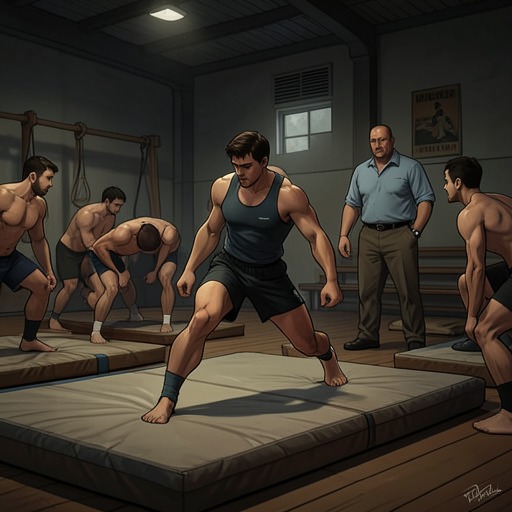
Garp offers himself as Ernie Holm’s replacement in the Steering athletic department, asking to coach wrestling without pay because money does not matter to him. The school has to admit that he can do a decent job; without someone to replace Ernie, a strong program would begin to slump. Coaching extends Garp’s care beyond his immediate household and brings him back to wrestling, the identity he had named alongside writing as a young man.
At a gathering of fewer than one hundred Fields Foundation fellows and guests in the sun room of Jenny’s estate, Garp reads “The Pension Grillparzer.” He introduces it as the first and best thing he ever wrote, while admitting that he does not know how he thought it up. He now understands the story as being about death, though he says he knew little about death when he wrote it; he knows more now and is writing nothing. He points out that seven of its eleven major characters die, another goes mad, and another runs away with a different woman, leaving the listeners with poor odds of survival. The old story has acquired a meaning through the losses that came after its composition.
After the reading, Garp suddenly starts writing again. The return comes not through a declaration of mastery but after he has publicly joined an early story about death to his later knowledge of it. Writing again suggests that lived grief has not solved the problem of invention; instead, it has given him a new way to approach the work.
Death and Narrative Legacy
Garp has long suspected that he will die young. In his writing he compares himself with his father and describes himself as a one-shot man, imagining brevity as a family resemblance and a personal knack. The prediction becomes grimly literal: Garp dies before he can be moved from the wrestling room, at thirty-three, the same age Helen is. Ellen James is just entering her twenties, Duncan is thirteen, and little Jenny Garp is nearly three. Walt, who has died, would have been eight.
Helen later says, bitterly and only once, that Garp’s death was a kind of suicide in the sense that his whole life was a suicide. She subsequently clarifies that she meant he made people too angry. Her remark offers not a simple explanation for his murder but a judgment about the anger his life and public presence aroused. The difference between the first, apparently inward description and her later explanation leaves the statement deliberately unsettled.
After Jenny’s death, Garp has tried to repeat her final words on an airplane crossing the Atlantic, testing whether they might serve him as last words too. That effort shows how he turns other people’s endings into language he can carry and possibly use. His own death, at the age he had anticipated, leaves that search unfinished. Across his life, writing moves between imaginative construction and the pressure of actual loss: he first makes stories before he fully understands death, later reads them differently, and returns to the page only after living through grief.