The Pension Grillparzer (short story)
The World According to Garp“The Pension Grillparzer” is T. S. Garp’s developing short story about a family of Austrian Tourist Bureau inspectors and the unruly company gathered at a small Vienna pension. Its importance lies not only in what happens within the fiction, but in how Garp learns to make a story: he finds a setting that focuses his imagination, recognizes when he does not yet know enough to continue, and eventually completes a work whose comic disorder opens onto death. The story also becomes an early expression of the imaginative vision that Helen Holm will later recognize in his writing.
Conception and Setting
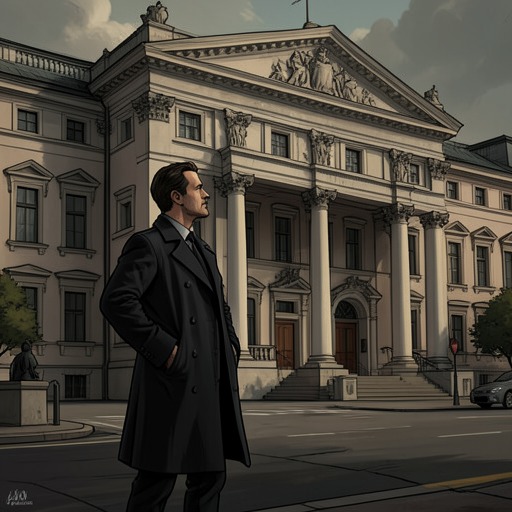
At first Garp is unsure how to tell Charlotte that he is trying to write. He worries she will consider him too young, and he shares neither the story nor the uncertainty surrounding it. Changing its title to “The Pension Grillparzer” gives him his first firm satisfaction: the name directs his attention toward one small, sad pension in Vienna, where much of the important action can take place. The setting helps him begin to imagine the characters as a connected group rather than as disconnected inventions.
Among those characters are a family of classifiers and other residents of the pension, including a circus that is not very good and has nowhere else to stay. In the story’s imagined world of ratings, their situation amounts to a C experience. This classification gives the story a comic organizing idea: people and places are assessed, yet the pension’s awkward collection of guests resists any simple measure of worth. Garp has found a setting and a group, but not yet the larger explanation that will make their lives belong to the same world.
The story’s opening frame draws on a family assignment. The narrator recalls traveling with a father who works for the Austrian Tourist Bureau as a covert inspector, accompanied by the narrator’s mother and brother. They are instructed to test the courtesy and standards of restaurants, hotels, and pensions: they should create difficulties, make unusual requests, remain civilized but troublesome, and report their observations to their father in the car. The mother complains that a hotel hairdresser is not available in the morning but that suitable recommendations are offered elsewhere; the father answers that the hotel does claim to have a hairdresser and records the discrepancy in a large pad. The family’s method turns travel into a performance of inspection, and the father’s notes make the comic details part of an official-looking record.
Development and Creative Stalling
Garp’s first progress is real but tentative. The new title helps him focus on the fictional pension and its inhabitants, yet he senses that the imagined pieces have not acquired a persuasive connection. He can invent one event after another, but invention alone does not tell him what the events mean or how they should end. Rather than force an explanation, he decides to stop until he knows more. The pause is part of the story’s making: Garp learns that narrative instinct includes knowing when not to proceed.
He puts the story aside and turns toward observation. He studies Vienna, watches Charlotte, and notices what his mother does, while acknowledging that he still lacks the overall vision he needs. He imagines this vision arriving through time and contact with the real world, and treats the waiting as a discipline comparable to training for another wrestling season: repetitive work that may prepare him for a capacity he does not yet possess. The story’s early interruption thus records not a completed artistic method but the beginning of one, founded on patience, attention, and the recognition of limits.
In July, Garp returns to the work during what he experiences as the beginning of a sustained writer’s trance, a state in which the world seems to fall under one encompassing tone of voice. He works through August on the conclusion. At the same time, Jenny Fields is finishing the manuscript of her own book, so mother and son are separately approaching the completion of works that will change their lives. Their parallel labor does not mean they can easily discuss their writing: Garp has been reluctant to share his project with either Charlotte or his mother, and Jenny worries that her life story might upset him because much of it is also his.
Vienna, History, and Death
Garp’s surroundings begin to feed the story’s emerging concerns. When he is not writing, he visits the Schönbrunn Zoo, where damaged and partly restored buildings give him the impression that wartime Vienna remains present in the city. He reads historical accounts of Vienna under Nazi and Russian occupation, finding that the city’s history is connected to the death themes developing in his fiction. The writing process makes apparently separate materials seem related: the zoo’s ruined structures, the city’s past, and the imagined pension all enter a field of association.
From those observations Garp develops a parallel between a city’s history and a family’s history. Both hold closeness and affection, but death eventually separates those who belong together. Memory, in turn, keeps the dead present. This becomes a statement about the work he hopes fiction can do: the writer must imagine people and places with enough personal vividness for fictional memory to carry the force of lived recollection. The story’s movement toward death therefore grows out of Garp’s attention to Vienna and its damaged buildings, rather than appearing only as an isolated plot device.
The first major image of death in the story comes through a dream assigned to its oldest character, a grandmother. Garp guesses that making her the dreamer may mean she will be the first to die. At this point he has more than an atmosphere of mortality: he has a possible connection between the dream, the desperate entertainers, and the fate of the story’s characters. But he still does not know what that connection means or what ending can bring them into one coherent world. The gap between a striking image and a completed design is central to the story’s early development.
Completion, Readers, and Reception
Once he finishes “The Pension Grillparzer,” Garp tells Jenny that he wants to return to Steering and see Helen. He plans to send her the story so she can read it before he arrives. On the flight home he rereads the manuscript, hoping Helen will accept him; on the same journey, Jenny reads it too. She finds the story rather unreal beside the life story she has spent more than a year writing, though she admires her son’s imagination. She later describes it as the kind of story she would expect from a boy without a proper family. Her response distinguishes imaginative invention from autobiography, even as the two books are being written side by side.
Helen’s judgment gives the conclusion a different weight. She considers the story a good beginning, and later says that its ending offers a glimpse of the world according to Garp. The story’s close thus matters beyond the resolution of its own events: in Helen’s view, it makes visible an emerging way of seeing. This recognition helps explain why Garp expects more from the work than income. He hopes it will persuade Helen to live with him and perhaps marry him, joining his literary ambition to a personal future he wants to build.
Garp’s expectations for publication are modest. He anticipates that the story will first appear in a serious magazine that almost nobody reads, and that it will not earn enough to buy him a good car. Years later, when he is better known, it will receive a more attentive publication and appreciative notice, but during his lifetime it remains a poor source of money. Its early submission to the magazine favored by his former teacher Tinch brings a terse rejection: the story is called only mildly interesting and is said to do nothing new with language or form. Garp and Tinch are both puzzled by the verdict. The dismissal contrasts with Helen’s recognition of the ending and with Garp’s own private hopes, underscoring the distance between artistic possibility, a reader’s response, and the immediate judgments of editors.
Significance in Garp’s Development
The story’s formation gives a concrete shape to Garp’s early idea of literary work. A title and a single setting first steady his attention; a family of inspectors, the pension’s odd residents, and an unwanted circus supply a provisional cast; a dream, historical observation, and the problem of death press him toward a larger design. When that design is not ready, he waits. When he returns to the page, he draws together materials that had seemed separate and finishes a conclusion through which Helen can glimpse the outlook of his later work.
Its mixed reception is part of this significance. The story offers little financial reward and initially receives an unenthusiastic editorial response, yet it earns a personal and interpretive importance that those measures do not capture. For Garp it is both a completed short story and a means of reaching toward Helen; for Helen its ending is an early revelation of his imaginative world. Its comic rating system and displaced entertainers coexist with an increasingly serious concern for death, separation, and memory, establishing the contrast between absurd circumstance and sorrow that defines the work as Garp’s first sustained act of literary creation.