Opening of the story
Introduction of the Titan
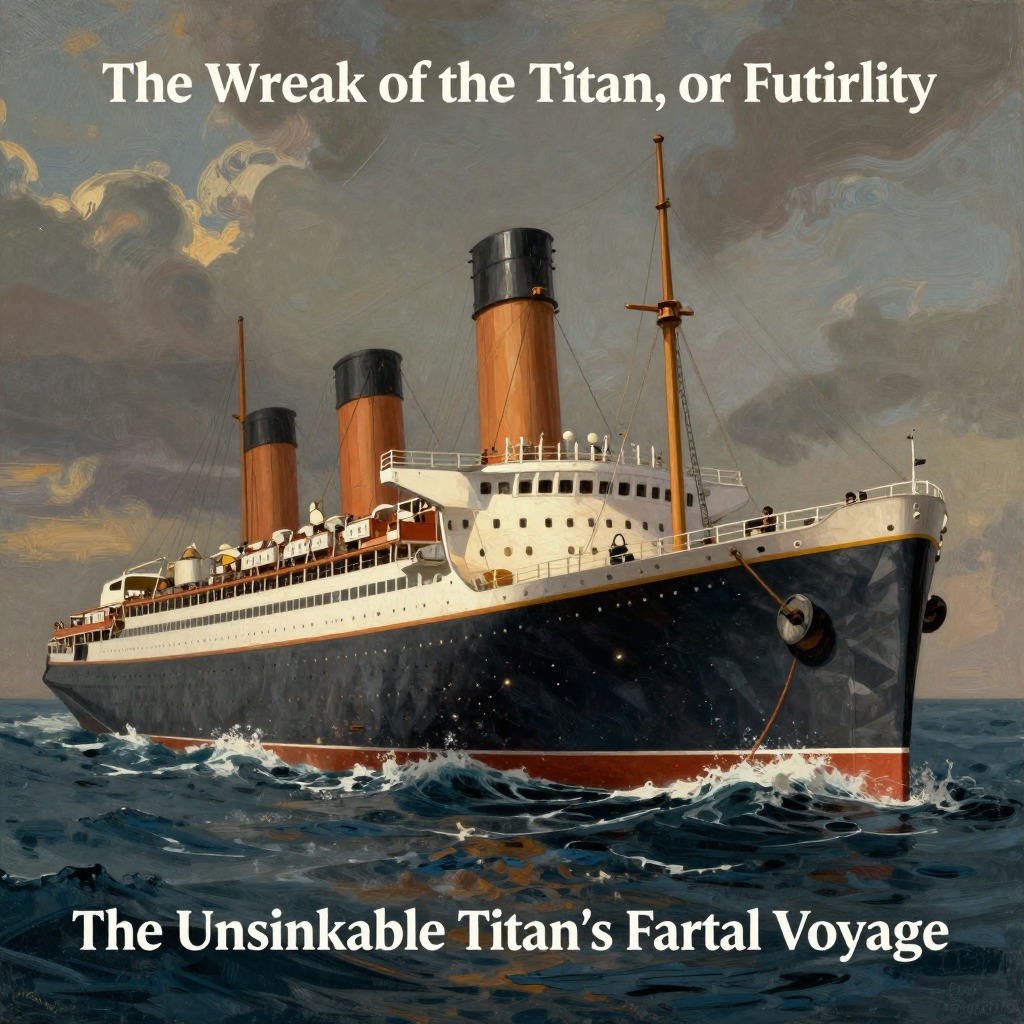
The narrative opens with a detailed description of the steamship Titan, the largest and most advanced vessel ever built. She is eight hundred feet long, of seventy thousand tons displacement, and equipped with every modern convenience, including two brass bands, orchestras, a theatrical company, physicians, and chaplains. Her design incorporates nineteen water-tight compartments, and it is claimed that with nine compartments flooded she would still float, making her practically unsinkable. The ship carries only twenty-four lifeboats, sufficient for five hundred people, and each berth is equipped with a cork jacket. The company announces a controversial rule: the Titan will steam at full speed in fog, storm, and sunshine, based on the reasoning that at full speed she can better withstand collisions and be more easily steered. This policy sets the stage for the impending disaster.
Early in the story
Departure from New York
Eight tugs drag the Titan to midstream and point her nose down the river. The pilot is dropped east of Sandy Hook, and the real voyage begins. The ship's engines start, and she moves slowly to sea. Below deck, coal-passers and stokers work in the inferno of the engine room, while on deck sailors set triangular sails to add propulsion. The passengers disperse according to their tastes: some sit in steamer chairs, some pace the deck, others listen to the orchestra or read in the library. The decks are cleared, watches are set at noon, and the never-ending cleaning-up begins. This departure establishes the routine of the voyage and the contrast between the luxurious passenger experience and the harsh labor below.
Early in the story, during the first day at sea
John Rowland's encounter with Myra Selfridge
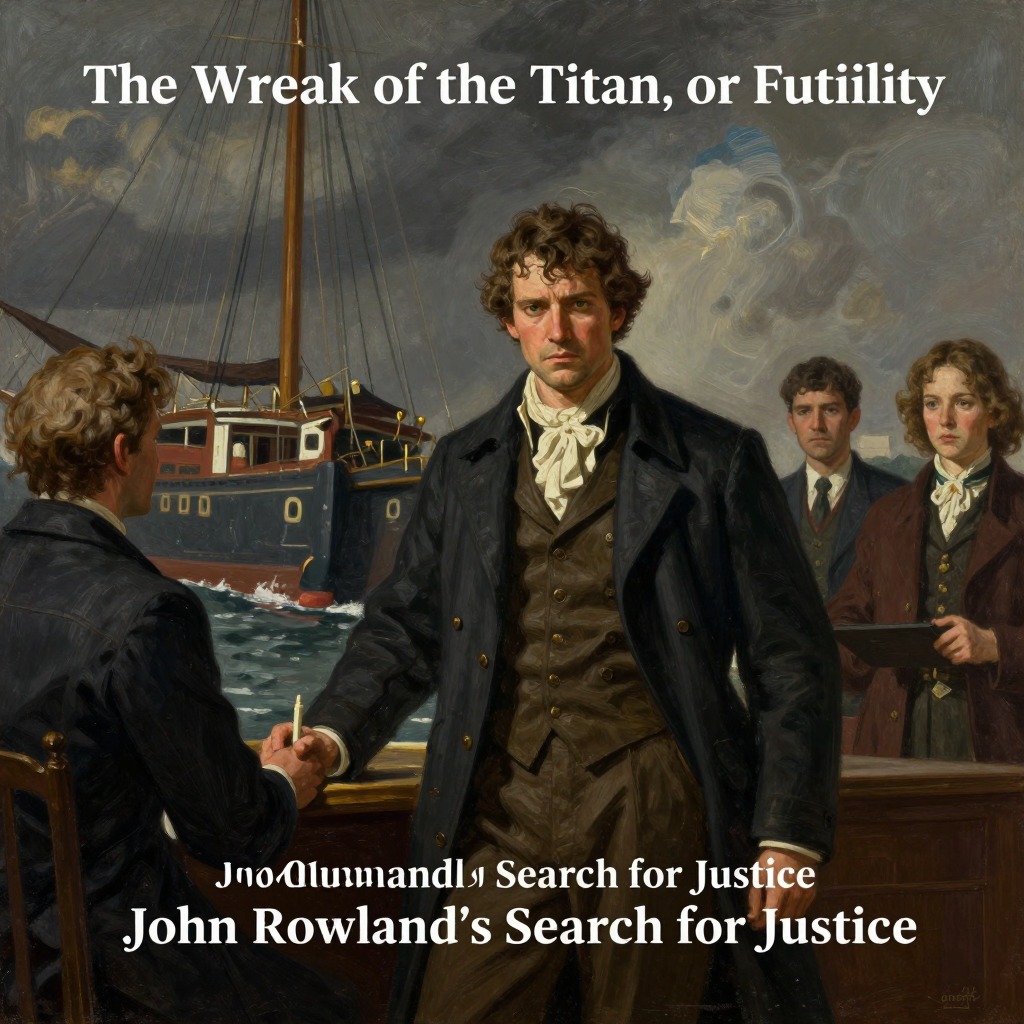
A gang of sailors, headed by a six-foot boatswain, comes aft on the starboard side to paint. Among them is John Rowland, a slight-built man of about thirty, black-bearded and bronzed but watery-eyed and unsteady. As he approaches a group of ladies, his gaze rests on one—a sunny-haired young woman with blue eyes. He starts, turns aside, and raises his hand in an embarrassed half-salute before passing on. The young woman, Myra Selfridge, is equally affected, showing surprise and terror. She catches up a little child from the deck and hurries into the saloon. This encounter reveals the past romantic relationship between Rowland and Myra, and his subsequent social disgrace and alcoholism.
Early in the story, immediately after the encounter
Myra Selfridge's confession to her husband
Myra Selfridge, agitated, tells her husband George Selfridge about seeing John Rowland on the ship. She describes him as a common sailor, dirty and dissipated, and expresses fear that he might seek revenge, possibly by stealing their child. She recounts their past relationship: Rowland was a rejected admirer who became angry when she ended their courtship, partly because of his atheism and drinking. She mentions his talk of an 'immutable law of chance' and a 'governing balance of events.' George Selfridge dismisses her fears, saying Rowland is harmless now. This conversation establishes the backstory of Rowland's disgrace and the couple's perception of him as a threat.
First night at sea, around midnight
The night watch and the collision with the Royal Age
At midnight, a vicious half-gale blows from the northeast, and the Titan charges through a fog-bank at full speed. The first officer takes the deck, and lookouts are posted. John Rowland is assigned to the crow's-nest, still drunk from the previous day. At about 1:30 AM, Rowland cries out that something is ahead. The first officer orders the wheel hard aport, but before the ship can turn, a deep-laden ship, the Royal Age, appears directly in the Titan's path. The Titan cuts the smaller ship in half. The first officer does not reduce speed, and the Titan continues on its course. The crew is ordered to clear away the wreckage and keep the passengers unaware. This event is the first major disaster of the voyage and sets up the central conflict.
After the collision, later that night
The captain's attempt to bribe Rowland
After the collision, the captain of the Titan, pale-faced and intense, gathers the watch in the chart-room. He interviews each man privately, offering them money for their silence. When Rowland's turn comes, the captain offers him one hundred pounds. Rowland refuses, declaring he will speak of the 'wholesale murder' at the first opportunity. The captain tries to intimidate him, but Rowland reveals he is a graduate of Annapolis and knows admiralty law. The captain then offers him a position on the bridge, but Rowland refuses. The captain, realizing Rowland cannot be bought or intimidated, decides to drug him to discredit his testimony. This confrontation establishes Rowland's moral stance and the captain's desperate measures.
The morning after the collision
Rowland's encounter with Myra Selfridge's child
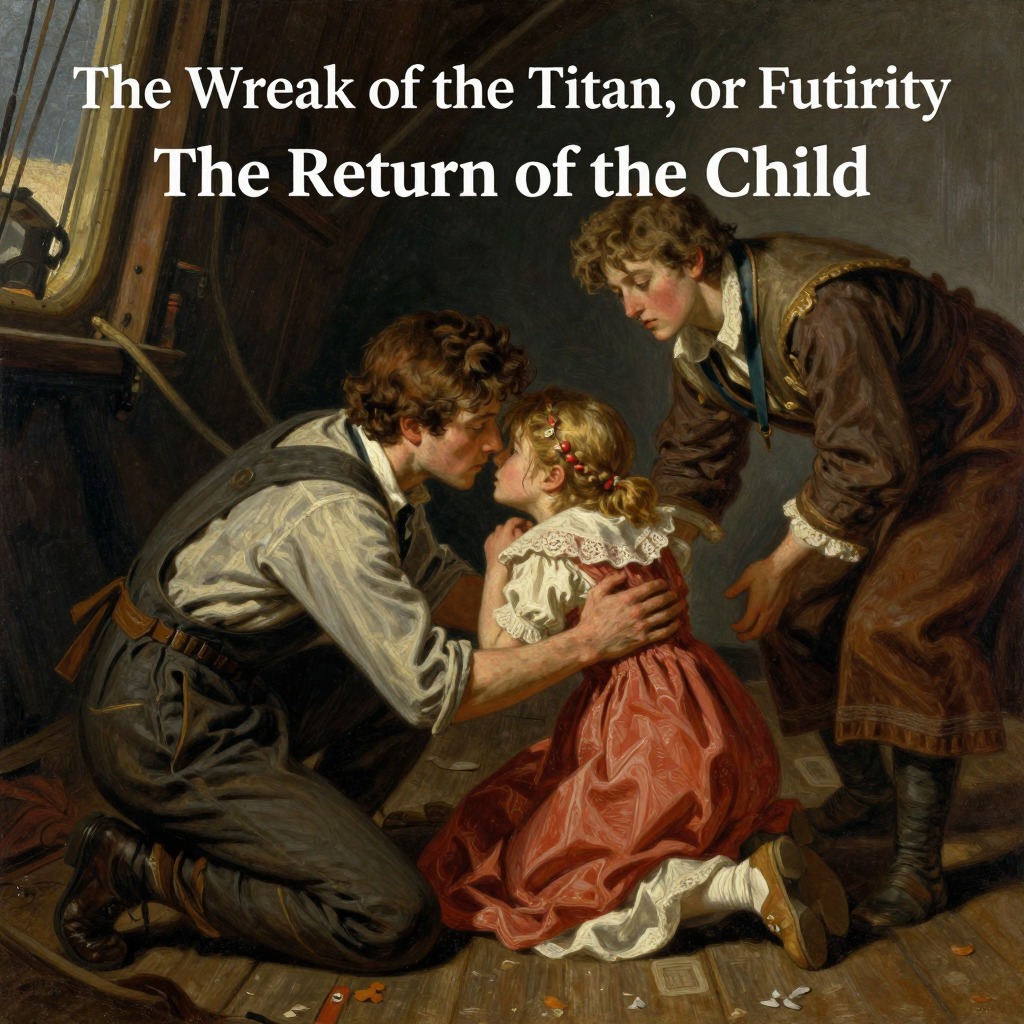
The next morning, Rowland is scrubbing the starboard taffrail when a little girl, Myra Selfridge, runs into the enclosure and clings to his legs. He lifts her and, in jest, holds her over the rail, asking if he should drop her to the fishes. At that moment, Myra Selfridge appears, snatches the child, and stares at Rowland with dilated eyes before disappearing. Rowland realizes the child is hers and that she is married. This incident is later misinterpreted by Mrs. Selfridge as an attempted murder, leading to a complaint to the captain. The captain, already wary of Rowland, uses this as further justification to keep him out of sight.
Later that day, during supper
The drugging of Rowland
The captain and boatswain conspire to drug Rowland. The boatswain is instructed to drop a substance into Rowland's drinking pot while the port forecastle is empty. However, a fight breaks out in the forecastle during supper, and Rowland's tea is dashed from his hand before he has taken three swallows. He procures a fresh supply and finishes his supper, unknowingly consuming only a partial dose of the drug. The captain and first officer plan to have Rowland on the bridge lookout that night to observe his ravings and discredit his testimony. This partial dosing leads to Rowland's hallucinatory experience but also allows him to retain some lucidity.
The second night at sea, around 8 PM
Rowland's drugged bridge watch
Rowland is ordered to take the starboard bridge lookout out of his turn. The first officer engages him in a conversation about navigation theories, testing his coherence. As the drug takes effect, Rowland experiences hallucinations: the deck fittings transform into monstrous shapes, and he sees a garden from his past. He struggles to maintain his sanity, speaking aloud about his lost love and the law of cause and effect. The captain, first officer, and boatswain watch him from a distance. Meanwhile, little Myra Selfridge, sleepwalking, makes her way to the upper deck and approaches Rowland. This scene is the climax of the drugging plot and sets up the iceberg collision.
During Rowland's drugged watch, shortly after Myra's arrival
The iceberg collision
As Rowland holds the sleepwalking Myra, a shout from the crow's-nest warns of ice ahead. The captain springs to the engine-room telegraph and turns the lever, but it is too late. The Titan's bow lifts as it rides up onto a field of ice, rising to a hundred feet high. The ship crashes down on its side, and the engines and boilers break loose, puncturing the hull. The Titan begins to sink, and the passengers and crew are thrown into chaos. Rowland, still holding the child, is thrown from the bridge onto the iceberg. The ship sinks within minutes, with nearly all of its three thousand people lost. This is the central disaster of the novel.
Immediately after the sinking, through the night
Rowland's survival on the iceberg
Rowland finds himself on the iceberg, bleeding from a head wound and still holding little Myra. He examines the wreckage and finds no intact boats. He calls out for the child's mother, but there is no response. He wraps the child in his coat and takes shelter in the wrecked bridge. He finds a bottle of whisky in his pocket, which he decides to keep for medicinal purposes. He spends the night in agony, tormented by thoughts of the woman he loves and the child's mother. The drug still affects him, and he eventually falls asleep. This scene establishes Rowland's isolation and his commitment to protecting the child.
The next morning, at daylight
The fight with the polar bear
At daylight, Rowland steps out onto the ice. He sees a polar bear approaching, attracted by the scent of food. He has only a jackknife for a weapon. The bear attacks little Myra, knocking her unconscious with a blow. Rowland engages the bear in a desperate fight, suffering a crushed arm and broken ribs. He manages to stab the bear in the eye, killing it. He then tends to the child's wounds, using bear fat as a bandage, and constructs a shelter from the wreckage. This fight demonstrates Rowland's courage and his transformation from a broken man to a protector.
The next three days on the iceberg
Rowland's delirium and recovery
Rowland suffers from fever and delirium for three days, with lucid intervals during which he tends to the fire, cooks bear meat, and cares for the child. His arm swells and becomes infected. He uses the last of his matches to rekindle the fire on the evening of the third day. He regains his sanity but is weak and in pain. He contemplates their chances of rescue, realizing they are adrift on a floating iceberg far from shipping lanes. This period of suffering and recovery marks a turning point in Rowland's character, as he begins to focus entirely on the child's survival.
Evening of the third day on the iceberg
Rowland's prayer and the rescue
As the moon rises, Rowland, feeling utterly alone, prays to the God he has denied, begging for the child's life and the mother's safety. As he rises from his knees, he sees the flying-jib of a bark appearing around the corner of the ice. The bark, the Peerless, comes into view, and Rowland hails it. The crew rescues him and the child. Rowland mutters to himself, questioning whether his prayer was answered. This event is the climax of Rowland's spiritual journey and leads to their rescue.
After the rescue, two months before the London confrontation
Arrival at Christiansand and amputation
Rowland and the child are taken to Christiansand, Norway, on the Peerless. Both are dangerously ill. Rowland's arm is amputated at the shoulder due to the severity of the infection. He remains weak and bedridden for some time. The child, Myra, also recovers slowly. During this period, Rowland learns that the child's name is Myra, but he does not know her last name. The crew of the Peerless, especially Captain Barry, care for them. This event marks Rowland's permanent physical disability and his deepening bond with the child.
Shortly after the sinking, over the next few weeks
The news of the Titan reaches Lloyds
The news of the Titan's destruction reaches Lloyds in London, causing panic among underwriters. The Crier announces the event, and extras are issued. A later cablegram gives the names of the survivors: the captain, first officer, boatswain, seven sailors, and one lady passenger—Mrs. Selfridge. Mr. Selfridge, the old gentleman, learns that his daughter-in-law is safe but his son and grandchild are missing. He waits anxiously for more news. Meanwhile, Mr. Meyer, a heavy insurer, is devastated by the loss. This scene establishes the aftermath of the disaster and the financial stakes involved.
Three weeks after the sinking
The bulletin about Rowland and the child
A bulletin at Lloyds announces that John Rowland, a sailor from the Titan, and a child passenger are on the Peerless at Christiansand, both dangerously ill. The bulletin also mentions that Rowland speaks of a ship cut in half the night before the loss of the Titan. This news sparks interest among the underwriters, who realize that the captain may have concealed a collision. Mr. Meyer, initially despondent, is roused by his colleagues to investigate. He decides to take action, realizing that the concealment could void the insurance policy.
Two months after the sinking, in London
The confrontation at Lloyds
Mr. Meyer summons Captain Bryce, Mr. Austen, and the attorney Mr. Thompson to his office. Mr. Selfridge also attends. Rowland, accompanied by Captain Barry and little Myra, arrives. Rowland, pale and weak with an empty sleeve, confronts the captain and first officer. He tells the story of the collision with the Royal Age and the attempted bribery. Captain Bryce and Mr. Austen deny everything, but Rowland's testimony is compelling. Mr. Meyer accuses them of concealment, and the confrontation becomes heated. This scene is the legal and moral climax of the novel.
During the confrontation at Lloyds
Captain Bryce's confession of drugging
During the heated exchange, Captain Bryce, in a moment of anger, blurts out that the drug given to Rowland was not hasheesh but an infusion of Indian hemp. Rowland immediately points out that hasheesh is made from Indian hemp, thus convicting the captain of drugging him. Mr. Meyer seizes on this confession, declaring that he now has a witness. Captain Barry, who heard the confession, confirms it. This revelation destroys the captain's credibility and provides the legal basis for voiding the insurance policy.
Immediately after the confrontation at Lloyds
Mr. Selfridge's death
After the two officers leave, Mr. Selfridge learns from Mr. Meyer that the insurance will not be paid and that he, as the largest stockholder, is ruined. The shock is too much for him; he suffers a heart attack and dies within minutes. Rowland and Captain Barry try to help, but it is too late. Mr. Meyer, though initially jubilant, is now faced with the death of the old man. This event adds a tragic dimension to the financial conflict and leaves little Myra orphaned of her grandfather.
Immediately after Mr. Selfridge's death
Rowland's refusal to testify
Mr. Meyer, realizing that Rowland's testimony is crucial to voiding the insurance, tries to secure his cooperation. However, Rowland refuses to testify, stating that he will not break the child. He argues that the cause of the wreck was full speed in a fog, and the underwriters knew the risk. He and Captain Barry leave the office, with Mr. Meyer locked in a futile rage. This decision spares the child from financial ruin but puts Rowland at odds with the powerful underwriters.
Later that day, after the confrontation
Rowland's departure for New York
Captain Barry arranges for Rowland and Myra to sail to New York on a liner, using tickets provided by the steamship company's attorney. Rowland initially resists, seeing it as bribery, but Captain Barry convinces him that he must get the child to her mother. Rowland accepts the passage, and they leave London that night. Before parting, Captain Barry offers Rowland a job as his mate, but Rowland declines, saying his seafaring days are over. He also vows to never drink again. This event marks Rowland's transition from a sailor to a new life.
Several days later, in New York
Rowland's arrival in New York and shopping for Myra
Rowland and Myra arrive in New York. He is surrounded by reporters on the dock but refuses to talk. He secures Mrs. Selfridge's address from the steamship company and then takes Myra to a department store. With his last sixteen dollars, he buys her a new dress, shoes, stockings, underclothing, and a hat. He is penniless again but determined to present the child well to her mother. This scene shows Rowland's selflessness and his desire to do right by the child.
Immediately after leaving the store
The arrest of John Rowland
As Rowland and Myra leave the store, a policeman stops him, suspecting he has stolen the child. Rowland is unable to explain quickly, and the policeman takes him back into the store. There, they encounter Mrs. Selfridge and her father, Mr. Gaunt. Mrs. Selfridge recognizes Myra and snatches her, fainting. Mr. Gaunt accuses Rowland of kidnapping, and the policeman arrests him. Rowland is dragged through the streets to the police station, beaten with a club. This event is a cruel irony, as the man who saved the child is now treated as a criminal.
The next morning, in a New York court
The trial of John Rowland
Rowland is brought before a magistrate, charged with kidnapping. Mrs. Selfridge testifies, recounting her belief that Rowland had tried to murder her child and had now stolen her. The magistrate, initially puzzled, learns from reporters that the case involves the Titan. He reads a newspaper account of Rowland's heroism, including the fight with the polar bear. He then discharges Rowland, declaring that the man saved the child's life. Mrs. Selfridge is left confused and aggrieved. This trial is the final public vindication of Rowland's character.
The following two years
Rowland's recovery and new life
After his discharge, Rowland is penniless and homeless. He begins by fishing, trading, and selling his catch. He saves enough to buy second-hand clothes and a barber's services. He finds work as a tally clerk, then as an envelope addresser. He passes a Civil Service examination and, two years later, is appointed to a lucrative government position. He declares that his future is his own and that he has overcome his past mistakes. This period shows Rowland's complete rehabilitation and his rise from the depths of despair.
Six months after Rowland's appointment
The letter from Mrs. Selfridge
Rowland receives a letter from Mrs. Selfridge, who has been watching his progress. She writes that Myra asks for him continually and cries, and she can bear it no longer. She asks him to come and see Myra. The novel ends with the line: 'And the man went to see Myra.' This final event suggests a possible reconciliation and the healing of old wounds, as Rowland is finally reunited with the child he saved and the woman he once loved.