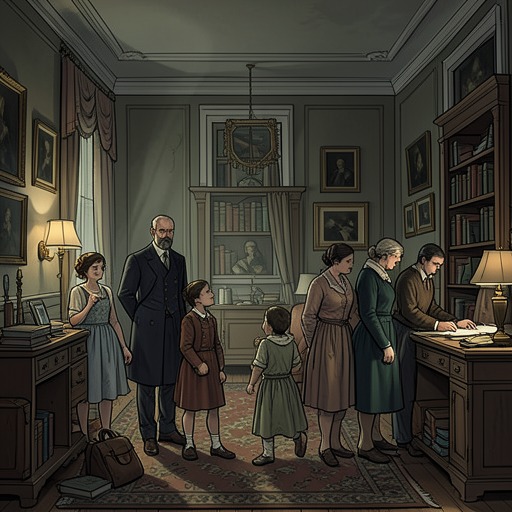
Jennie
The Yellow Wall PaperJennie, John’s sister, is the household’s careful and capable keeper during the narrator’s stay in the upstairs nursery. Her attentiveness is real, but it operates within a regimen that leaves the narrator little control over her time or space. As the narrator secretly writes and becomes increasingly absorbed in the yellow wallpaper, Jennie shifts in her imagination from trusted caregiver to suspected observer and rival in the effort to reach the woman she believes is trapped behind its pattern.
Identity and Household Role
Jennie is introduced as “Such a dear girl” and “so careful” of the narrator. She is also a “perfect and enthusiastic housekeeper,” and the narrator understands that Jennie hopes for no better profession. Her care is expressed through domestic competence: after the Fourth of July visit leaves the narrator tired, Jennie sees to everything, while the narrator does nothing. The arrangement makes Jennie an important practical support in the household, but it also confirms how completely the narrator’s daily responsibilities and activity have been taken over by others.
The narrator’s feelings about this care are complicated by her own sense of incapacity. She wants to be a help and comfort to John, and feels like a burden instead; meanwhile, Jennie’s ability to manage the household makes the narrator’s enforced inactivity visible. Jennie is not described as openly cruel or neglectful. Rather, her role is one of competent service within a home where the narrator’s wishes are routinely subordinated to a prescribed plan of rest.
Care, Work, and Secrecy
The narrator hides her writing from Jennie. When Jennie arrives, she must stop; she can resume only when Jennie is out, and the windows let her see Jennie approaching from a distance. This furtive practice reveals that writing has become an activity the narrator cannot comfortably claim in the household. She has already thought that writing might relieve the pressure of her ideas, yet she finds it tiring and lacks advice or companionship about her work. Jennie’s presence therefore marks both a practical interruption and the larger isolation surrounding the narrator’s self-expression.
The narrator suspects that Jennie believes writing made her ill. This suspicion is not confirmed as Jennie’s own view, but it gives the narrator another reason to conceal her pages. The household’s care and the narrator’s need for secrecy coexist uneasily: the same domestic attentiveness that keeps the room and routines in order makes private work harder to pursue. Jennie is positioned less as an antagonist than as part of an environment in which the narrator’s voice is not openly encouraged.
The Wallpaper and Suspicion
As the narrator’s attention fixes on the wallpaper, she begins to watch Jennie as well as John. She catches Jennie looking at the pattern and once finds her hand on it. When challenged, Jennie turns as if caught stealing, asks why the narrator frightened her, and explains that the wallpaper stains whatever it touches: she has found yellow marks on the narrator’s and John’s clothes and wants them to be more careful. The exchange supports an ordinary explanation for Jennie’s interest in the wall, while the narrator interprets it as evidence that Jennie, too, is studying the pattern.
That difference in interpretation is central to Jennie’s place in the story. The narrator calls Jennie’s explanation innocent in tone but privately resolves that nobody else will discover the pattern as she does. The narrator’s certainty does not establish that Jennie shares her belief about a woman behind the wallpaper. Instead, Jennie’s ordinary attention to stains and household surfaces is absorbed into the narrator’s increasingly secretive system of suspicion. Her hand on the paper, which may be housekeeping, becomes in the narrator’s account a sign of concealed knowledge.
The Last Night and Aftermath
On the final night, with John staying in town, Jennie asks to sleep with the narrator. The narrator refuses on the stated grounds that she will rest better alone, describing the request privately as sly. In fact, she wants privacy so she can respond to the woman she imagines crawling and shaking the pattern. She gets up and joins in pulling at the paper; by morning, the two figures’ efforts have peeled off yards of it. The narrator presents this as a shared action with the woman behind the wallpaper, not as work performed alongside Jennie.
When Jennie sees the stripped wall, she is amazed. The narrator tells her merrily that she tore the paper down out of spite at the vicious thing. Jennie laughs and says she would not mind doing it herself, but warns the narrator not to tire herself. The narrator reads this remark as a betrayal, as though it exposes Jennie’s own concealed opposition to the wallpaper. But Jennie’s words remain compatible with ordinary sympathy or amusement; the sense of a secret alliance belongs to the narrator’s interpretation.
Jennie’s care continues even as the narrator’s condition and behavior depart further from ordinary household life. She cautions against exhaustion, and earlier had taken over the work during the tiring holiday visit. Yet the narrator finally insists that nobody touch the paper but her, even while preparing to remain alone behind a locked door. Jennie thus stands at the boundary between care and confinement: she helps maintain the domestic order around the narrator, but cannot enter the private reality that the narrator has built around the wall. Her final appearance in the supplied episodes is as an astonished witness to the torn paper, whose concern for the narrator’s physical limits is reinterpreted as complicity in the narrator’s imagined struggle.