the ancestral halls
The Yellow Wall PaperThe ancestral halls are the remote summer estate where John brings the narrator for a regimen of rest, and the setting that turns domestic care into a material experience of confinement. The house first appears to her as a possibly haunted, long-empty mansion; its distance from the village, legal history, and commanding nursery give that unease a physical form. As the narrator’s room and movements become increasingly bound to John’s arrangements, the estate’s scale and apparent freedom contrast with her restricted choices and private acts of resistance.
Identity and Setting
The narrator introduces the ancestral halls as a hereditary estate secured for the summer by people she calls ordinary. She imagines it as a colonial mansion, perhaps even a haunted house, but checks that romantic possibility with wry restraint: such a setting would be asking too much of fate. What she will declare, more confidently, is that something about the place is queer. Its unusually low rent and long vacancy seem to invite explanation, though those facts do not establish anything supernatural.
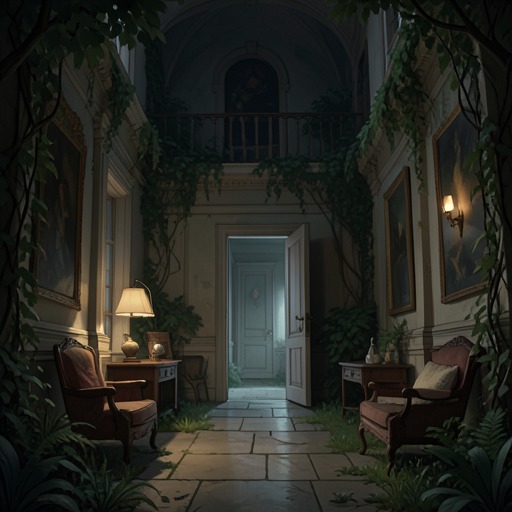
The estate stands well back from the road, about three miles from the village. Its hedges, walls, and lockable gates make it feel to the narrator like an English country property from a book, and separate little houses once served the gardeners and other people on the grounds. The large, shady garden has box-bordered paths and long grape-covered arbors with seats beneath them. Greenhouses remain, but they are broken. The landscape thus offers both cultivated beauty and visible neglect: ordered paths and sheltered places persist alongside structures no longer maintained.
The narrator attributes the house’s emptiness to legal trouble involving heirs and coheirs, although she presents this account as uncertain. That history undercuts her ghost-story speculation without removing her sense of strangeness. She tells John that the house feels queer on a moonlit evening; he answers that she feels a draught and shuts the window. The disagreement establishes two ways of reading the estate: she attends to atmosphere and intuition, while John reduces the sensation to a practical cause.
The House and the Nursery
The narrator’s preferred room is downstairs, opening onto the piazza, with roses at the window and old-fashioned chintz hangings. John refuses that choice because the room has only one window, cannot accommodate two beds, and has no nearby room for him if he sleeps elsewhere. The alternative is not selected by the narrator: John says the couple came to the house for her recovery and that she needs rest and as much air as possible, so they take the nursery at the top of the house.
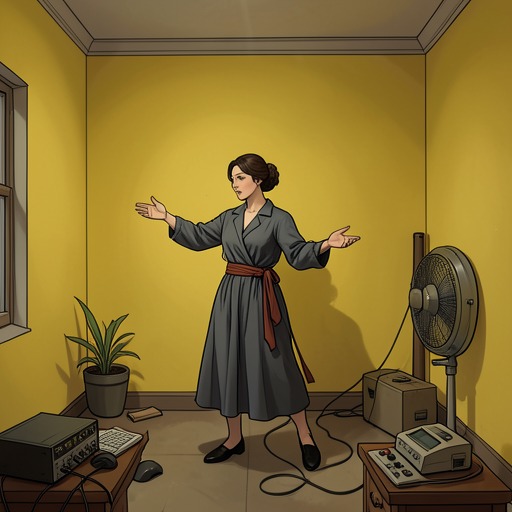
The nursery occupies nearly the entire upper floor. Its windows face in every direction, and it is filled with air and sunlight; the narrator infers that the large space served first as a nursery and later as a playroom and gymnasium. The barred windows and rings fixed in the walls are concrete remnants of those uses. They also make the room’s history present in its fittings: a place designed for children’s activity and supervision becomes the adult narrator’s assigned bedroom and the setting for her enforced rest.
The room’s finishes bear further signs of previous use and damage. Its paint and paper look, in the narrator’s judgment, as if a boys’ school had occupied it. Wallpaper has been stripped away in broad patches around the head of the bed, as far as she can reach, and in a large low section on the opposite side. She finds the remaining paper grotesque in pattern. The nursery is therefore not a neutral, freshly prepared refuge; its worn surfaces and altered walls make the room feel difficult to inhabit even before the narrator’s attention fixes on the wallpaper.
Care, Choice, and Confinement
The estate’s distance and enclosed grounds imply ample room to move, but the narrator’s access to domestic space is decided for her. John is described as careful and loving, yet he hardly lets her stir without special direction. He sets an hourly schedule, takes responsibility for her care, and prescribes rest. The narrator feels ungrateful for resenting arrangements presented as protection, even though she plainly preferred a different room and was not permitted to choose it.
The nursery’s design sharpens that contradiction. John’s explanation emphasizes fresh air, and the room’s many windows make it open to light and breeze; the barred windows, however, recall the control built into its earlier use. Her assigned place is at the top of the house, within a room selected according to John’s account of what her treatment requires. The estate’s apparent spaciousness therefore coexists with an intimate restriction: the narrator occupies a large room but has little authority over where she sleeps or how her day is organized.
Her unease about the house also meets the same practical dismissal as her preference about the room. When she describes a strange feeling, John calls it a draught and closes the window. He has already urged her not to think about her condition, and she reports trying to control her feelings in front of him, an effort that leaves her tired. The house’s meaning consequently emerges not only from its architecture but from the couple’s unequal interpretations of it: John treats discomfort as something to manage, while the narrator’s perceptions and wishes remain difficult to voice without being corrected.
The Estate as a Place of Resistance
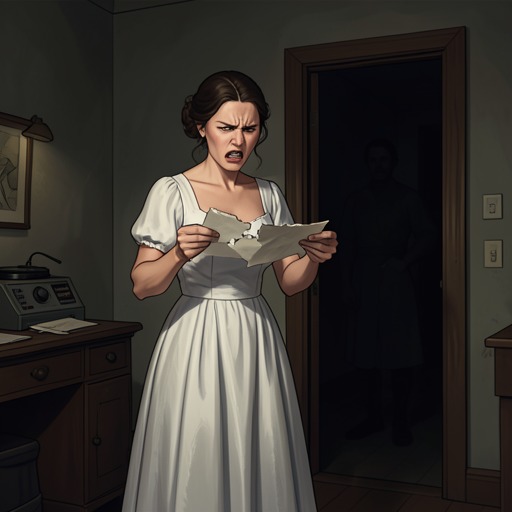
Later, the narrator’s relation to the house shifts from uneasy observation toward furtive action. She says that she locks the door whenever she creeps in daylight, because she cannot do so at night without John suspecting something. This use of a lock makes the house’s rooms part of a concealed routine: the narrator seeks privacy inside the estate, but only by controlling access to a door and timing her actions around John’s presence.
As the story approaches its climax, she locks the door again and throws the key down into the front path. She does not want to go out or to let anyone in before John arrives; she wants to astonish him. The front path, once part of an expansive property that seemed to promise distance and freedom, becomes the place where she disposes of the key and makes her chosen seclusion harder to interrupt. The act does not erase the house’s earlier restrictions. Instead, it reverses control over a threshold: the narrator, previously placed in a room selected by John, now determines who may enter and when.
The ancestral halls thus gather the story’s spatial contrasts into one setting. Their old estate grounds suggest breadth, beauty, and seclusion; the nursery concentrates the narrator’s life in a room whose use and furnishings recall supervision; doors, windows, and the thrown key shape what movement is possible. The house is not simply a backdrop for her distress. Its distances and thresholds give visible form to the gap between John’s claim to provide care and the narrator’s limited power to choose her surroundings, while her secret use of the locked room turns the same architecture into a means of resistance.