the imagery of creeping and escape
The Yellow Wall PaperThe imagery of creeping and escape turns the narrator’s increasingly urgent response to the yellow wallpaper into a physical pattern of movement. A woman first appears to creep behind the paper’s design; later, the narrator sees her outside, imitates her crawl, and tears away the wallpaper in an effort to release her. The image culminates in an ambiguous escape: the narrator claims freedom from John and Jennie, but continues to creep around the room, crossing over John after he faints.
Confinement Made Material
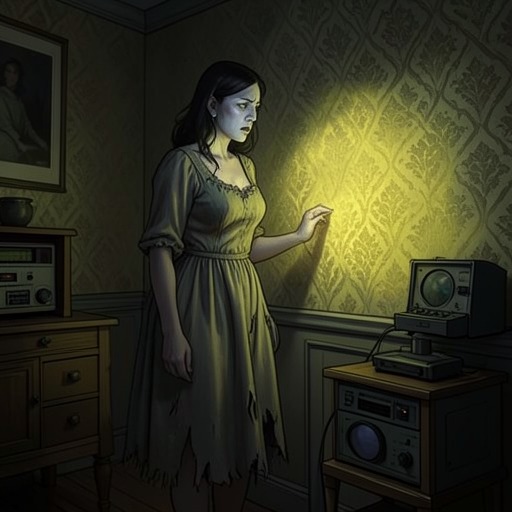
The movement motif is rooted in the room’s arrangement, not only in the narrator’s visions. She wants a downstairs room opening onto the piazza, with roses at the window, but John rejects the request. He says the room has only one window and cannot accommodate two beds, and that there is no nearby room for him if he takes another. Instead, the couple occupies the upstairs nursery because John says the narrator needs perfect rest and air. It is a large, airy space, with windows in several directions, but its apparent openness is qualified by bars on the windows and rings in the walls, remnants of its use as a nursery and playroom. The room’s surfaces preserve signs of earlier force. Wallpaper has been torn away in patches around the bed and low on the opposite side; the floor is scratched, gouged, and splintered, the plaster dug out in places, and the heavy bed appears battered. Against that worn setting, the later mark near the mopboard becomes more than an incidental stain: it runs around the room behind every piece of furniture except the bed, as if something has repeatedly traveled the same circuit. The narrator wonders who made the mark and how, then describes its roundabout course as dizzying. The room thus gives creeping a physical geography before it becomes the narrator’s own repeated action.
From Figure Behind the Pattern to a Body in Motion
As the narrator watches the wallpaper, the indistinct shapes behind its outer pattern grow clearer. She identifies one shape as a woman stooping and creeping, and the front pattern seems to move because the woman behind it shakes it. At times the narrator imagines many women; at others, only one. In her account, the figure crawls rapidly, shaking the pattern, and grips the bars in the shadowed parts of the design. The image fuses the wallpaper’s pattern with the room’s actual barred windows: the woman appears both caught within a decorative surface and struggling against confinement. The narrator then imagines that the woman gets out during the day. She says she has seen her from every window, creeping along a road beneath trees and hiding under blackberry vines when a carriage approaches. This outside figure carries the room’s movement into the surrounding landscape, but not into uncomplicated freedom: she still crawls and has to hide. The narrator says that being caught creeping in daylight would be humiliating. Her account makes the movement at once a sign of escape and a mark of exposure, something the imagined woman attempts to conceal from other people. The division between the woman and the narrator begins to collapse in the narrator’s own descriptions. She says that she locks the door when she creeps by daylight, because at night John would suspect something. The locked door keeps other people out, but it also makes her creeping a secret practice carried on inside the nursery. She does not want anyone but herself to get the woman out at night, and wonders whether she could see her from all the windows at once. The narrator’s effort to watch and rescue the figure therefore draws her further into the figure’s movements and circumstances.
The Room Becomes a Route and a Struggle
On the night before John is due back, Jennie offers to sleep with the narrator. The narrator persuades her to leave her alone for the night. Once the moonlight falls and the woman appears to crawl and shake the pattern, the narrator gets up to help her. She and the figure pull against the wallpaper together: when one pulls, the other shakes, and when the narrator shakes, the woman pulls. By morning they have peeled away yards of paper, including a strip about as high as the narrator’s head and extending halfway around the room. The imagined rescue has become a shared physical labor whose visible result changes the room. The final attempt to control the space makes its obstacles explicit. The narrator locks the door and throws the key onto the front path, preventing entry while also denying herself an ordinary way out. She has hidden a rope, which she imagines using to tie the woman if she escapes and tries to get away. Yet she cannot reach far without something to stand on, and the heavy bed will not move. She pushes and lifts it until she is lame, then bites a piece off one corner in anger, hurting her teeth. Unable to shift the bed, she tears down all the wallpaper she can reach from the floor. The room’s objects, rather than serving as neutral scenery, set the limits of her action and register its cost.
Escape Claimed, Confinement Continued
After pulling down much of the paper, the narrator describes being securely fastened by her rope and insists that she will not be got out onto the road. She finds it pleasant to creep around the great room as she pleases, and refuses to go outside even if Jennie asks. Outside, she says, one must creep on the ground, where everything is green rather than yellow. The contrast makes the nursery, despite its locked door and barred windows, the space in which she now claims freedom of movement. Her escape is not a return to ordinary life beyond the room: she prefers the yellow interior and its circuit to the green exterior. When John finally enters, the narrator keeps creeping and looks back over her shoulder. She declares, "I've got out at last," says she has done so in spite of John and Jane, and adds that she has pulled off most of the paper so he cannot put her back. The assertion presents the tearing as release from both the wallpaper’s enclosure and the control exercised over her. Yet the scene ends with John fainting across her path. The narrator has to creep over him each time she passes along the wall, so the claimed victory remains physically circular: she is in motion, but still moving within the room.
The Motif’s Significance
Creeping links the wallpaper’s imagined captive to the narrator’s lived restriction without making their relationship a simple, detached metaphor. The narrator first reports the woman as an object of observation, then sees her outside, joins her in pulling down the paper, and finally speaks as though she herself has got out. Each shift makes the boundary between witness, rescuer, and captive less stable. The repeated movement gives that change a bodily form: she watches crawling, hides her own daylight crawling from John, and ultimately organizes her freedom around crawling through the room. The motif also sets claimed autonomy against the material conditions that limit it. John chooses the room and its prescribed use; its barred windows, locked door, immovable bed, and furniture determine how the narrator can move. She responds by controlling the door, hiding the key, pulling at the paper, and making a route around the room. Those acts are purposeful, but they do not lead her outside or restore the alternative space she had wanted downstairs. In the closing image, escape is both real in the narrator’s declaration and unresolved in its physical form: she has torn through the surface that seemed to imprison the woman, yet her route still loops around the walls and over John’s fallen body.