the narrator
The Yellow Wall PaperThe narrator, the first-person diarist of “The Yellow Wallpaper,” records a widening conflict between her own experience of illness and the authority exercised by her physician husband, John. Her account moves from disagreement about treatment and a thwarted wish to write toward an imagined escape enacted through creeping and the destruction of the wallpaper. Because the story is told through her private record, readers encounter both the constraints placed on her and the changing perceptions through which she understands them.
Identity and Medical Background
The narrator is described by John and her physician brother as suffering from temporary nervous depression and a slight hysterical tendency. She doubts that this diagnosis captures what she is experiencing: she suspects that John’s disbelief may be one reason she does not recover faster, and observes that he believes there is nothing seriously wrong with her. His professional standing and their marriage reinforce his judgment in the eyes of relatives and friends, while her own account remains private and difficult to assert.
Treatment is organized around rest, air, exercise, journeys, tonics, and phosphates or phosphites; she is expressly forbidden to work until she is well. The regimen does not simply prescribe care but also removes decisions and activity from her. Although she recognizes John as careful and loving, she feels unable to make her suffering persuasive to him: he sees no reason for it, and that absence of an acknowledged cause satisfies him. She consequently worries that she is failing in her duty and becoming a burden rather than the help and comfort she had hoped to be.
Work, Voice, and Confinement
The narrator believes that congenial work, excitement, and change would help her, directly opposing the physicians’ prescription. She has written despite their prohibition, but keeping the activity secret exhausts her because she must be sly or face heavy opposition. She also thinks writing might relieve the pressure of her ideas and let her rest, yet becomes tired when she tries and has no advice or companionship about her work. The diary therefore serves at once as an outlet and as evidence of how little space she has to express herself openly.
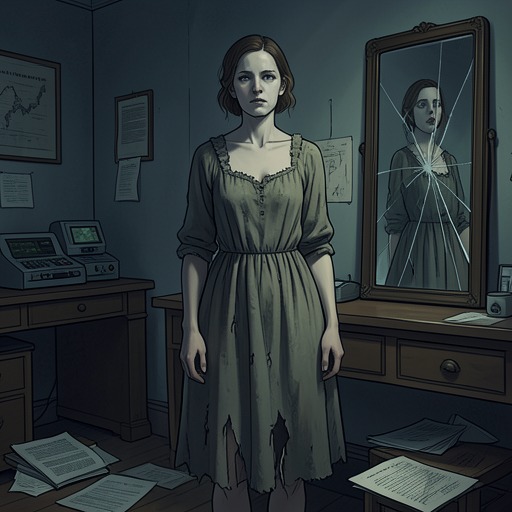
The same restriction is built into the arrangement of the house. She wants a downstairs room opening onto the piazza, with roses at the window and old-fashioned chintz hangings; John refuses, citing the single window, the space required for two beds, and the lack of a nearby room for himself. Instead, they occupy the upstairs nursery, a large, airy room covering nearly the whole floor, with windows looking in every direction. Its former uses as a nursery, playroom, and gymnasium are legible in its barred windows and wall rings. The room offers air and sunshine, as John promises, but its bars and the narrator’s lack of choice make its spaciousness an ambiguous form of care.
Perception and the Request to Leave
The narrator’s view of the estate includes shaded arbors, old-fashioned flowers, trees, a bay, a private wharf, and paths where she sometimes imagines people walking. John cautions her against indulging her fancy or making stories, treating her imaginative power as a danger to be controlled. She tries to follow that advice, even as the lack of stimulus and companionship around her work weighs on her. Her account thus repeatedly sets what she sees and feels against the interpretation John authorizes.
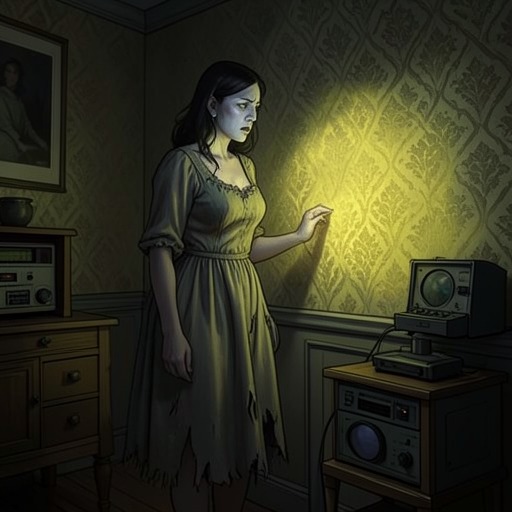
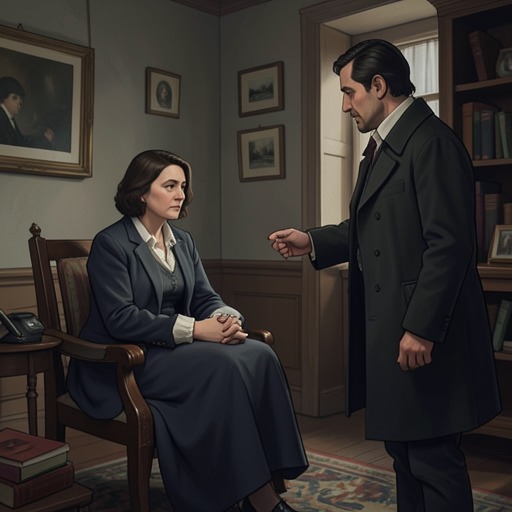
That divergence sharpens around the yellow wallpaper. The narrator begins to see a woman stooping and creeping behind its pattern, a shape that grows clearer to her over time. The sight disturbs her and leads her to wish that John would take her away. Speaking to him is difficult because he is wise, in her view, and loves her; nevertheless, she tells him that she is not improving and asks to leave. John answers that the lease has three weeks to run, repairs at home are unfinished, and he cannot leave town. He says he would go if she were in danger, but insists that she is gaining flesh and color and that her appetite is better. She disputes those measures, saying that she weighs no more—and perhaps less—and that her appetite improves in the evening when he is present but is worse in the morning when he is away. His affectionate reassurance and decision to defer the discussion do not resolve the disagreement over whose account of her condition counts.
Creeping and the Ending
As the woman behind the wallpaper becomes central to the narrator’s perceptions, she describes seeing her on a road under trees and hiding beneath blackberry vines when a carriage approaches. The narrator says she locks the door when she creeps by daylight, but cannot do so at night because John would suspect something. She also does not want anyone but herself to get the woman out at night. These details make secrecy and restricted access part of the same pattern: she attempts to control her movement and protect the figure she perceives, while anticipating John’s scrutiny.
Near the end, the narrator locks the door and throws the key down into the front path. She does not want to go out or let anyone in before John arrives, and says she wants to astonish him. When he reaches the locked room, he cries out in alarm and asks what she is doing. She keeps creeping, looks back over her shoulder, and says that she has got out in spite of John and Jennie and has pulled off most of the paper so that she cannot be put back. John faints across her path by the wall; she continues creeping and has to pass over him each time. The final scene turns the wish to leave into a physical, startling reversal: John, who had directed her treatment and movement, lies in the path while she continues on hers.
Narrative Role and Significance
The narrator’s diary gives the reader access to judgments and sensations that are not recognized in the household’s medical account. Its private form is crucial: writing is prohibited, yet it is the means by which she records her disagreement, describes the treatment’s effects, and traces the wallpaper’s growing hold over her attention. The account does not make her perceptions a neutral clinical report; instead, its intimate perspective places readers inside the increasingly unstable experience through which she interprets her confinement.
Her relationships with John and Jennie are shaped by this gap between care and control. John’s attention is presented as loving and practical, but it accompanies a regimen that denies her work and discounts her testimony; Jennie appears in the final declaration as someone, along with John, from whom the narrator claims to have escaped. The ending does not offer a straightforward recovery. The narrator’s claim of escape and the continuing act of creeping coexist with John’s collapse, leaving the reader to confront both her defiant seizure of agency and the breakdown that frames it. Through that unresolved ending, the narrator’s struggle over illness becomes a struggle over who may speak, interpret, and move freely.