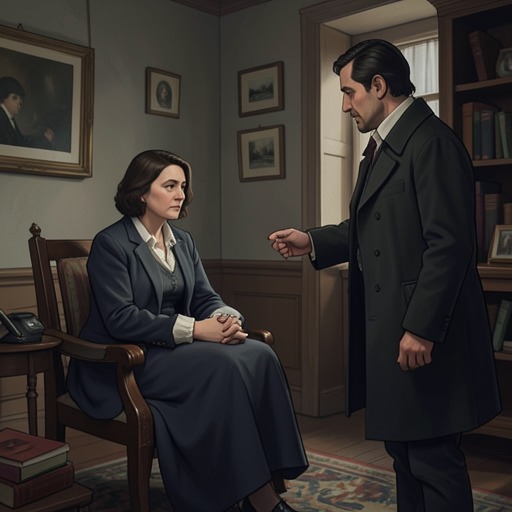
the narrator and John's marriage
The Yellow Wall PaperThe narrator and John's marriage is at once intimate and unequal: John loves his wife and organizes her care, but his authority as a physician leads him to discount her account of her own distress. The relationship’s central conflict lies not in a lack of declared affection but in the distance between what John considers evidence and what the narrator privately experiences. His care can comfort her even as it limits her choices, making the marriage a crucial setting for the story’s examination of illness, authority, and self-expression.
Identity and Background
John is both the narrator’s husband and a physician of high standing. She says he laughs at her, adding that she expects as much in marriage, and describes him as practical, impatient with superstition, and skeptical of what cannot be seen or measured. The narrator wonders in her private writing whether his profession helps explain why she is not recovering faster. Her brother, also a respected physician, shares John’s view that her condition amounts to temporary nervous depression and a slight hysterical tendency. In this medical consensus, her suffering is named and bounded by others before her own interpretation can carry much weight.
The narrator’s journal presents a more uncertain and conflicted account. She reports being told that she is not truly sick, yet also records how much she suffers and how discouraging it is to be unable to do what she considers her duty. John knows, she says, that there is no reason for her to suffer, and that assurance satisfies him. The contrast is not simply between a caring husband and an uncaring one: John’s confidence in his diagnosis coexists with an inability to recognize the distress that the narrator insists is real.
Care, Treatment, and Daily Authority
John’s concern takes practical form in an extensive regimen. The narrator is given phosphates or phosphites, tonics, journeys, fresh air, and exercise, and is forbidden to work until she is well. John prescribes a schedule for each hour and takes decisions and responsibilities from her. She calls him careful and loving, but also says that he hardly lets her stir without special direction. His attentiveness thus has a double effect: it signals devotion while reducing her control over her own activity.
That arrangement is reinforced by the narrator’s dependence on his judgment. She feels basely ungrateful when she cannot value the care as she believes she should, and she worries that she has become a burden rather than the help and comfort she meant to be. John’s version of care can therefore become a source of guilt as well as protection. The narrator is not only required to rest; she is also left to question whether her resistance to that rest makes her unreasonable or ungrateful.
The conflict appears especially clearly around writing. The narrator believes congenial work, excitement, and change would help her, and says that writing can relieve the pressure of ideas. John’s restrictions make her write in secret; the effort of concealment exhausts her and risks heavy opposition. She wants advice and companionship about her work, but the stimulus of visitors is also refused for the present. Her private journal becomes the record of an activity the treatment excludes and of a perspective that ordinary conversation with John does not make room for.
Requests, Reassurance, and Conflict
The narrator tries to make a case for leaving the house and visiting relatives, but John says she is not well enough to travel or to manage the visit. She begins to cry before finishing her argument. He gathers her into his arms, carries her upstairs, and reads to her until the reading tires her head. He calls her his darling, comfort, and everything he has, and asks her to take care of herself for his sake. The scene places tenderness and constraint together: he responds to distress with physical affection, yet the response does not grant the request she was trying to express.
John also makes recovery a matter of self-command. He tells the narrator that no one but herself can help her out of her condition, and urges will, self-control, and resistance to what he calls silly fancies. This instruction places responsibility for improvement on her while leaving the treatment and its rules largely in his hands. Her private disagreement is sharpened by that mismatch: she is expected to manage her thoughts and comply with care, while the work and stimulation she believes might help remain forbidden.
When the narrator says plainly that she is not gaining and wishes to be taken away, John answers with practical obstacles. The lease has three weeks to run, repairs at home are unfinished, and he cannot leave town; he adds that he would leave if she were in danger. He also claims that she is gaining flesh and color and that her appetite is better. The narrator contests this assessment: she says she has not gained weight and that her appetite is worse in the morning, when he is away. Her bodily account and his professional reading of her condition remain in direct tension, but his assurance closes the discussion more effectively than her evidence opens it.
John further appeals to their marriage and family, asking her not to let the idea that she is unwell enter her mind for even an instant, for his sake, their child’s sake, and her own. He calls that idea false and dangerous, then asks whether she cannot trust him as a physician. The appeal makes trust in the husband inseparable from acceptance of the doctor’s judgment. The narrator stops arguing, though she remains awake afterward, privately turning over what she sees in the wallpaper. Silence in these exchanges does not resolve the disagreement; it moves the disagreement into the journal and her solitary attention.
Change and Narrative Significance
John’s loving language persists even where his actions restrict the narrator’s independence. His embraces, assurances, and expressions of devotion are real features of their relationship, but they do not answer her requests to work, visit relatives, or leave the house. The marriage is consequently defined by a painful distinction between care as John administers it and help as the narrator says she needs it. Neither tenderness nor professional certainty bridges that gap.
The journal gives the reader access to the side of the relationship that John’s confidence cannot register. The narrator can acknowledge his love and still identify his disbelief as part of her suffering; she can feel guilty about resisting his care and continue to disagree with its terms. This divided account complicates any simple opposition between affection and harm. Within the marriage, the decisive imbalance is that John’s conclusions govern treatment, while the narrator’s first-person testimony survives chiefly in secret. Their relationship therefore frames the larger conflict between medical authority and lived experience, and between prescribed silence and the narrator’s continuing effort to express herself.