the narrator tears down the yellow wallpaper
The Yellow Wall PaperThe narrator tears down the yellow wallpaper in the upstairs nursery, transforming an imagined collaboration with the woman behind it into a physical struggle with the room. The action begins as an effort to release the figure she believes is trapped behind the pattern; it ends with most of the paper removed, John fainted across her route, and the narrator declaring that she has escaped and cannot be put back.
Setting and Conditions
The tearing takes place in a room chosen by John as part of his plan for the narrator’s rest. She had wanted a downstairs room opening onto the piazza, with roses at the window and chintz hangings, but John rejected the request, citing the room’s single window, its lack of space for two beds, and the absence of a nearby room for himself. He said they had come to the house for her and that she needed rest and air, so they took the nursery at the top of the house.
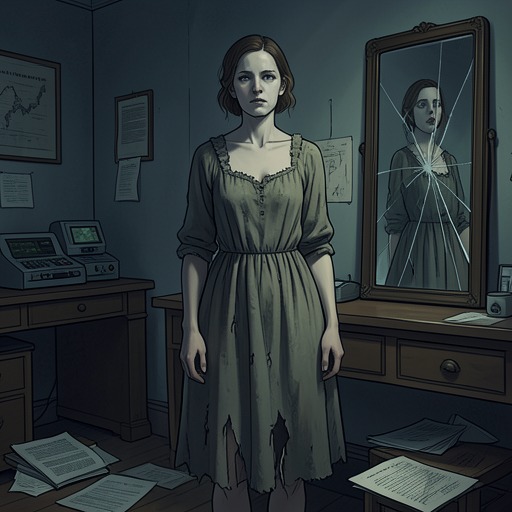
The nursery is spacious and airy, occupying almost the whole floor, with windows facing in every direction. Its former uses as a nursery, playroom, and gymnasium remain visible: the windows are barred for children, and rings and other fixtures remain in the walls. Its wear is equally tangible. The floor is scratched, gouged, and splintered, the plaster is dug out in places, and the heavy bed looks as if it had been through a war. The paper has been torn in patches, including around the bed and low on the far side of the room. These marks form the material setting for the narrator’s later work: the room is not an untouched refuge but a space already shaped by confinement, rough use, and damage.
One further trace circles the walls: a long, even smear near the mopboard, passing behind the furniture except for the bed. The narrator wonders who made it and how, then connects this repeated mark to the woman she imagines crawling around the room. The pattern, she concludes, moves because the woman behind it shakes it. That belief gives the paper a double status: it is the object she can pull from the wall and, in her account, the barrier holding another woman in.
The Night’s Work
On the last day before the household is due to leave, John stays in town overnight. Jennie wants to sleep with the narrator, but the narrator persuades her that she will rest better alone. The privacy is deliberate. When moonlight comes and the woman begins to crawl and shake the pattern, the narrator gets up to help her.
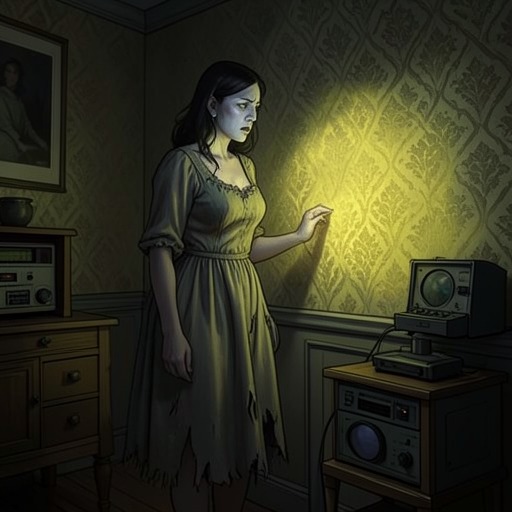
She describes their work as shared effort: the woman shakes while the narrator pulls, then the narrator shakes while the woman pulls. Before morning, they have peeled off yards of wallpaper—a strip about as high as the narrator’s head and extending halfway around the room. The sequence makes the imagined figure an active partner in a real, strenuous task. What the narrator experiences as a joint escape is also an expanding act of destruction against the room’s most absorbing surface.
At sunrise, the pattern seems to laugh at her, and she declares that she will finish the job that day. The household is preparing to leave the following day, and the furniture is being moved downstairs so that the room can be returned to its former arrangement. The deadline intensifies the act: after a night of substantial tearing, the narrator insists on completing the work before departure, even as the others begin clearing the room around her.
Secrecy, Possession, and Resistance
When Jennie sees the stripped wall, the narrator merrily tells her she has torn the paper out of pure spite for its viciousness. Jennie says she would not mind doing the same herself, but warns the narrator not to tire herself. The narrator reads this response as betraying Jennie’s own involvement with the paper’s influence. The exchange sets the narrator’s private interpretation against the practical explanation she offers aloud: she presents the tearing as spite, while guarding her conviction that the woman behind the pattern must be released.
The narrator insists that no one else may touch the paper, alive or otherwise. She tells Jennie that the room is quiet, empty, and clean, and claims she will lie down and sleep, asking not to be woken for dinner. When Jennie and the servants have gone and the furniture has been removed, the room is left with the great bedstead, nailed down, and its canvas mattress. The narrator has secured her privacy, but the emptied room also leaves her face to face with the remaining paper and the bed that cannot be shifted.
Before John returns, she locks the door and throws the key down into the front path. She does not want to leave or have anyone enter until he arrives; she wants to astonish him. The key’s destination makes the separation concrete: access to the room is no longer controlled from within by an ordinary unlocked door, and the narrator has made herself the sole person able to continue the work, at least until someone retrieves it.
Resistance and Its Limits
The narrator has a rope hidden in the room, which Jennie has not found. She imagines using it to tie the woman if she gets out and tries to escape, a plan that reverses the apparent purpose of her labor: she helps the figure out of the paper, yet also imagines restraining her. The rope is an actual object in the room, but its intended use belongs to the narrator’s shifting account of the woman and her escape.
Her physical effort meets obstacles. She cannot reach far without something to stand on, and the bed will not move. She pushes and tries to lift it until she is lame; in anger she bites a small piece from one corner, hurting her teeth. Unable to move the bed or reach all the wall, she peels away as much paper as she can while standing on the floor. It sticks horribly, and she experiences the pattern’s grotesque heads, eyes, and growths as jeering at her resistance. The work is therefore neither effortless liberation nor a complete clearing of the room: the fixed bed, her limited reach, her pain, and the paper’s tenacity all measure its physical limits.
The barred windows also mark a boundary. The narrator considers jumping from one as an admirable form of exercise but recognizes that the bars are too strong even to try. She says she would not do it and that such an act would be improper and might be misconstrued. The scene places the paper-removal alongside another thwarted way out: she cannot pass through the barred window, so she concentrates her action on the wall, tearing at the enclosure from within.
John’s Arrival and the Ending
John reaches the locked door and quietly asks to be let in. The narrator does not open it; she tells him that the key is under a plantain leaf by the front door. She repeats the information gently and slowly until he goes to retrieve it. Once inside, he stops short at the doorway and cries out in alarm at what he sees. The entry turns the private work into a witnessed confrontation, but the narrator continues creeping rather than stopping to respond in the expected way.
Looking over her shoulder, she tells John, "I've got out at last," and adds that she has acted despite him and Jane and pulled off most of the paper, so he cannot put her back. Her declaration gives the stripping its climactic meaning: she treats the removed paper as proof that she has escaped an enclosing power. The ending keeps the claim bound to the scene’s unstable terms. The narrator is still creeping around the room, and John faints across her path; she must creep over him each time she passes. Her announced escape brings no straightforward return to ordinary movement or control, but the action has reversed their positions in the room: John lies helpless on the floor while the narrator continues, and the wallpaper that had seemed to contain her has been largely torn away.