the narrator's final breakdown
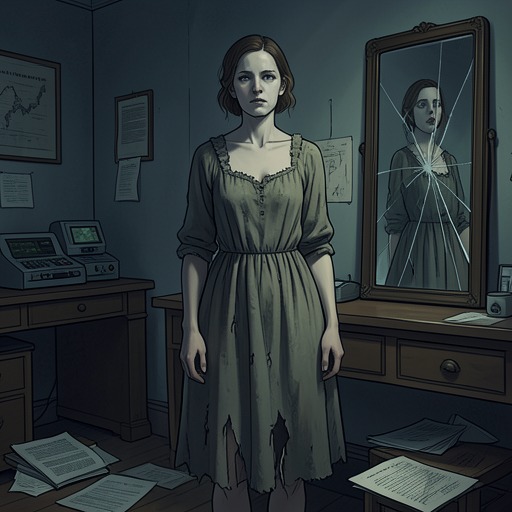
The Yellow Wall PaperThe narrator’s final breakdown is the story’s decisive reversal: after secretly stripping the yellow wallpaper from the nursery walls, she identifies herself with the woman she has imagined imprisoned behind its pattern and creeps past an unconscious John. What she calls escape is both an assertion of freedom and the culmination of a crisis in which her own perceptions have become inseparable from the figure in the paper.
Causes and Background
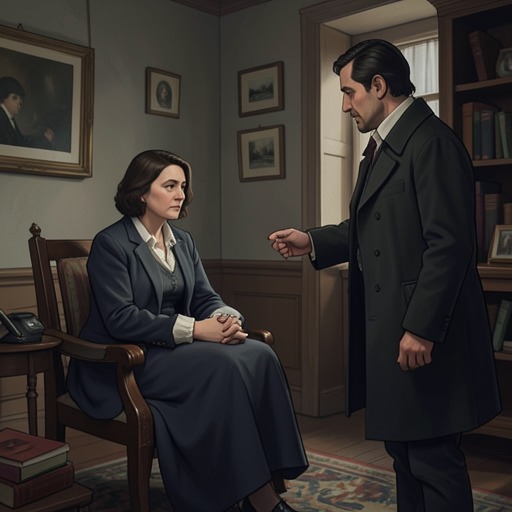
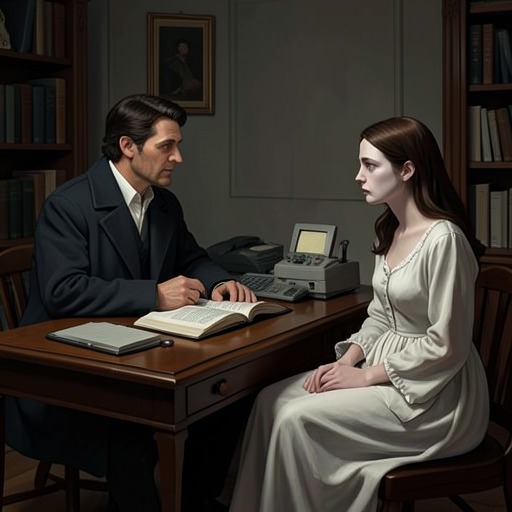
The breakdown develops against a conflict between the narrator’s felt experience and the medical account imposed on it. John, her physician as well as her husband, does not believe she is sick; he describes her condition to friends and relatives as temporary nervous depression with a slight hysterical tendency. His practical disbelief in what cannot be seen or measured leaves little room for her own account of suffering. She even wonders privately whether his profession is one reason she is not recovering faster.
The disagreement is not merely about a label. The narrator says John does not know how much she suffers: because he sees no reason for her distress, he considers that sufficient reassurance. She feels burdened by her inability to perform her duties and fears that she has become a burden to the husband she had hoped to help and comfort. Her private writing, which she believes might ease the pressure of her ideas, is tiring and lacks the advice and companionship she wants. The discrepancy between her reported symptoms and John’s judgment grows especially sharp when she asks to leave the house: he says she is gaining flesh and color, while she replies that she has not gained weight and that her appetite is worse in the morning when he is away.
That contrast gives the final episode its accumulated force. John treats her distress as compatible with recovery and postpones departure because the house lease still has three weeks to run and repairs at home are unfinished. He insists that he would leave if she were in danger, but tells her she is better whether she can see it or not. The ending does not present her declaration of escape as proof that her illness has lifted. Instead, the clash between his confidence and her increasingly private reality has reached a point where the room, the paper, and the woman she sees in it organize her actions.
The Last Night and the Stripping of the Paper
The immediate opportunity comes on the final day before the household is due to leave. John is to remain in town overnight and will not return until evening. Jennie wants to sleep in the narrator’s room, but the narrator tells her that she will rest better alone. Her apparent wish for solitude conceals a different purpose: when moonlight appears and the woman behind the wallpaper seems to crawl and shake the pattern, she gets up to help her.
The scene turns imagined companionship into physical labor. The narrator says that she and the woman pull and shake against the paper together; by morning they have peeled away yards of it. They have removed a strip as high as the narrator’s head and extending halfway around the room. When the sunlight makes the pattern seem to laugh at her, she resolves to finish the work that day. The paper is no longer simply an object she dislikes: tearing it becomes the action through which she believes she can assist the captive woman and prevent her confinement from continuing.
Jennie later says she would not mind taking down the wallpaper herself but cautions the narrator against tiring herself. The narrator interprets this as evidence that Jennie has betrayed what she knows. She insists that nobody, while alive, may touch the paper but her. That guarded claim marks a further shift: the task is no longer something she might share with a helper, but a private effort whose control she reserves for herself.
Seclusion and the Claimed Escape
The narrator secures the room as the household empties it. She tells Jennie that the room feels quiet, empty, and clean, and says she will lie down and sleep as long as she can; Jennie is not to wake her even for dinner. Once Jennie and the servants are gone, and the other things have been removed, the great bedstead remains, nailed down with the canvas mattress found on it. The narrator notes that the bedstead is badly gnawed, another mark of the room’s physical wear, before returning to her work.
She locks the door and throws the key down into the front path. She does not want to leave or to let anyone enter before John arrives: she wants to astonish him. The locked door makes her isolation deliberate, while the discarded key turns that isolation into a practical obstacle. By the time John reaches the room, the narrator has arranged the encounter on her own terms, although those terms are shaped by an increasingly distorted understanding of what the wallpaper and the room contain.
Her account of escape shifts between the woman behind the pattern and herself. She wonders whether the creeping women she imagines outside also came out of the wallpaper. She says that she is securely fastened with a well-hidden rope and resists the idea of going into the road; she expects she may have to get back behind the pattern at night. The language does not establish a literal escape from the house. Instead, it reveals how thoroughly her identity and imagined movement have fused with the figure she believes the paper contains.
The distinction between the imagined woman’s confinement and the narrator’s own movement becomes still more unstable when she refuses to go outside, even if Jennie asks. Outside, she says, one must creep on the ground, where everything is green rather than yellow. Inside, she can creep smoothly across the floor, with her shoulder fitting into a long mark around the wall so that she cannot lose her way. The room that once held her under John’s treatment now provides the route she follows; freedom is recast as movement within a closed circuit.
John at the Door
When John comes to the locked door, he speaks quietly and asks her to open it. She tells him that the key is under a plantain leaf by the front door. She repeats the instruction gently and slowly until he goes to retrieve it and comes inside. The detail of the key makes the barrier she created concrete, but her calm manner does not restore a shared understanding between them: he enters only after following directions that lead him away from the room.
John stops short at the sight before him and cries out, asking what is the matter and what she is doing. The narrator keeps creeping and looks over her shoulder. Her final declaration is that she has got out at last despite John and Jennie, and has pulled off most of the paper so that he cannot put her back. The speech treats the torn wallpaper as proof of liberation from confinement, yet its terms reveal that she understands John and Jennie as agents who might return her to the pattern. The declaration offers no reliable separation between her own plight and the imagined woman’s.
John faints across her path by the wall. The narrator continues creeping and must go over him each time she circles the room. His collapse reverses the immediate physical arrangement: the physician who has interpreted her condition and directed her care is now incapacitated, while she moves around him without stopping. But the reversal does not amount to recovery or reconciliation. The last image is not a restored conversation, an opened way out, or a settled diagnosis; it is the narrator’s repeated passage over John’s body.
Narrative Significance
The conclusion gathers the story’s conflict over whose account of illness will count into a single enclosed scene. Earlier, John’s professional certainty overrules the narrator’s descriptions of suffering, while her private writing is difficult to sustain and denied the companionship she seeks. At the end, her account temporarily dominates the room: she has shut out the household, removed most of the paper, and speaks to John from within a world in which the woman behind the pattern is also herself. Yet her apparent agency is inseparable from her breakdown, and the episode leaves the cost of that reversal plainly visible.
The wallpaper’s transformation from hated pattern into the supposed barrier holding a woman captive gives the narrator’s escape claim its force and its ambiguity. She once imagines and helps the woman; now she declares that she herself has got out, even while continuing to creep around the nursery. The difference between liberation and entrapment therefore remains unsettled. The ending makes the narrator’s repetitive movement the material form of that contradiction: John is down across her route, but she does not leave the room or stop circling it.